44
CONSTRUCTION WORLD
MARCH
2014
vans says China has
become a global leader
in railway development,
from high speed passenger
trains to heavy freight trains.
“China is now the world’s
most intensive user of rail-
ways and its rail system
carries more passengers and
freight per route-kilometre than any other
system in the world.”
When Evans first visited China in 1989,
he concluded that in general technical
terms the Chinese railways were about 15
years behind South Africa’s railways. “At
the time China still used many steam loco-
motives, only a few mainlines were electri-
fied, little in the way of long-welded railway
track was in place and railway maintenance
was labour intensive,” he says.
Evans says China is well ahead of South
Africa on many technical developments.
“China has undergone massive economic
development and a sophisticated railway
system was recognised by the govern-
ment as critical. Huge investment was
ploughed into the system and develop-
ment continues at extraordinary pace.”
Massive rail development
Between 1989 and 2013 China’s public
railway system grew from around 60 000 to
100 000 route-km and on average between
200 and 400 route-km of new lines continue
to be added each month. China’s railway
network is now the world’s second largest.
About 40 000 trains are operated daily of
which about 4 000 are long-distance and
regional passenger trains.
Evans says in 1989 China’s fastest
passenger trains were limited to a
maximum speed of just 120 km/h. “From
1994 the key mixed-traffic mainline
network was progressively up-graded to
permit maximum speeds of up to 160 and
200 km/h in some cases.
“Just five or six years ago China opened
its first true high-speed modern dedicated
passenger railway and since then a network
of such lines totalling about 9 000 route-km
has been put into operation with maximum
permitted speeds ranging from 250 km/h
to 350 km/h. About 800 streamlined high-
speed train sets are now in service. Many
more lines are under construction to meet
China’s target of having a 20 000 route-km
high-speed dedicated passenger network
in place by 2020.”
China’s high-speed dedicated pass-
enger railway network with its sleek
modern bullet trains and large architectur-
ally dramatic stations in the major cities
has greatly impressed the world, attrac-
ting many politicians, railway officials
and others eager to assess whether some-
thing similar could not provide solutions
to particular transport challenges in their
own countries.
Evans says although there are many
factors that support high-speed passenger
railways in China – high population, many
large cities, rapidly growing affluence and
a large pent-up travel demand – there
are many in China who question the
EQUIPMENT
LESSONS
FROM CHINA
“Railway development in China over the past
25 years provides ample examples of what can
be achieved when it comes to modern railways.
Some aspects of China’s railway solutions could
be applicable to South Africa and are worth
considering in particular for a new Durban-
Gauteng high-standard, standard-gauge railway,”
says GIBB railway consultant, Bruce Evans.
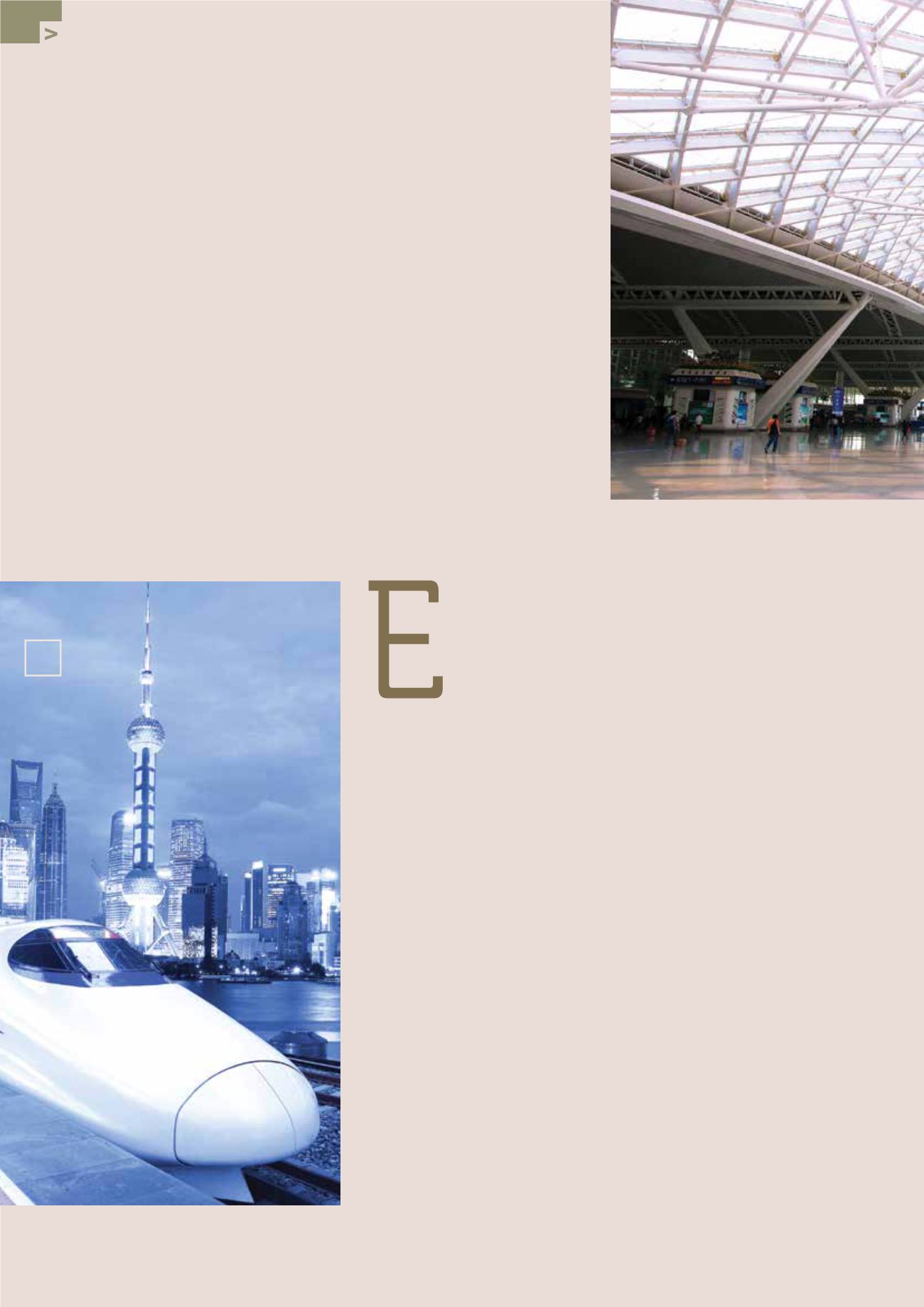
Guangzhou South Railway Station for high speed trains
is a large railway station.
High-speed trains at the Shanghai Lujiazui
City background.


