42
CONSTRUCTION WORLD
MARCH
2014
A Joint Venture
formed by Japa-
nese firms IHI Infra-
structure Systems
and Sumitomo Mitsui Con-
struction, is in charge of the
construction of the Nhat
Tan Bridge, which is also
known as the Vietnam-Japan
Friendship Bridge.
The need for cranes
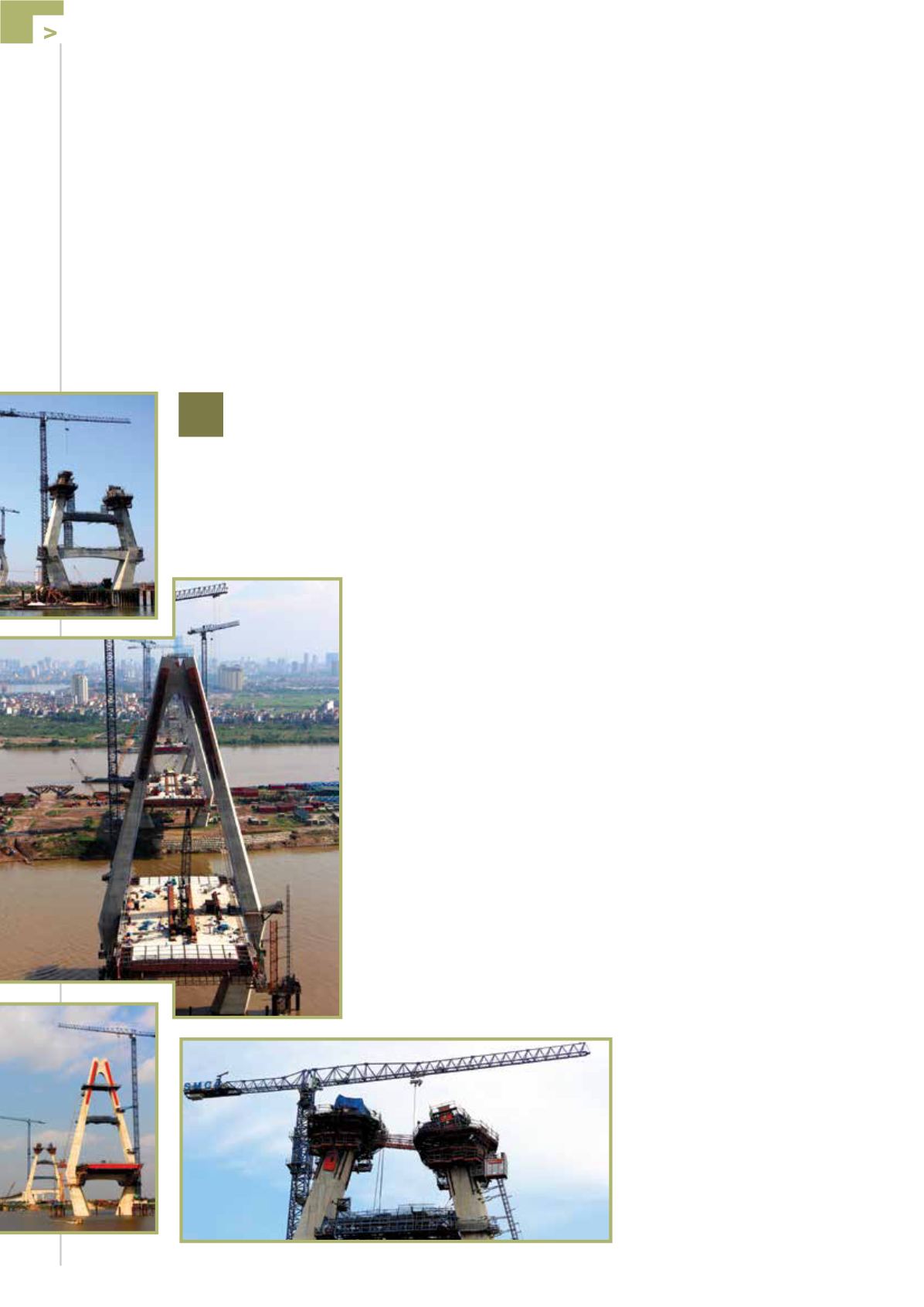
The main part of the bridge, 1 500 metres in
length, will feature five A-shaped concrete
pylons, to which the clamping cables will
be tied. The construction of these pylons,
located every 300 metres along the bridge,
has been done by five 21LC550 18 t tower
cranes, supplied to Sumitomo Mitsui
Construction by Asia-Ted, a dealer of Linden
Comansa in Singapore.
The initial assembly of the five cranes,
as well as some jacking-up operations, was
carried out by a team of Linden Comansa’s
technicians, who exceptionally moved to
Hanoi from Spain to attend this sophisti-
cated operation. All pylons are practically
of similar dimensions, so the cranes were
erected with the same settings: jib length of
50 metres and 11 tower sections, to reach a
freestanding height of 63,8 metres. In addi-
tion, each one of the cranes was erected on
foundations over four steel piles driven to
the ground, giving the crane a further height
of between 5 and 11 metres, depending on
the location of the pylon.
The erection of three of the five cranes
was especially complicated, as the pylons
were completely surrounded by the water
of the Red River. The lifting of the sections
had to be done by crawler cranes located in
barges in the river, which made the maneu-
vers more difficult the days in which waters
flow down at high speed. In addition, the
need to transport material and sections
on barge demanded a large planning and
slowed down the erections tasks.
PROJECTS AND CONTRACTS
Building the
Hanoi, the capital of Vietnam, will, by the end of 2014 have a
new road connection between the city centre and the Noi Bai
International Airport. The pathway of this new eight-lane-road,
four for each direction, crosses the Red River. To save its 1 200
metres of width, Vietnam’s Ministry of Transportation launched
a project of a spectacular cable-stayed bridge and approach
viaduct of 3 080 metres in total length.
‘FRIENDSHIP BRIDGE’
As the pylons were being built, each one
of the cranes had a first tie at a height of
31,1 metres (after the sixth tower section),
and using a hydraulic cage, each 21LC550
was climbed to a height under hook of 85,8
metres (15 tower sections).
Months later, they had to be tied for a
second time at a height of 60,6 metres (after
the 11th section) and another climbing
allowed the cranes to reach a final height
of 107,8 metres (19 tower sections), which
together with the height of the foundations,
allowed the cranes to reach high enough to
finish building the pylons, between 109 and
111 meters high.
As all of the cranes had the same D33
mast section, which is 2,5-metre wide, only
two hydraulic cages were necessary to
perform all the jacking-ups, which meant a
significant economic saving.
The five tower cranes have worked at the
jobsite since 2009, raising all the necessary
materials for the construction of the pylons,
such as formwork, prefabricated rebar cages,
concrete, etc. The 21LC550 have also helped
to unroll and place the cables of the bridge,
as well as to raise the cable anchor boxes to
the top of the pylons.
These 29 red pieces of anchor boxes per
pylon, which have been directly embedded
into the concrete, weight a maximum of 18
tons per piece, forcing the cranes to employ
100% of its maximum load capacity.
The main steel girders of the bridge deck
of maximum 7 tons in weight are lifted at 50
metres radius by the 21LC550 from the barge
or ground to the bridge deck area.
The chosen hoisting mechanism for
each of the five cranes at the jobsite was
the optional 65 kW, which allows speeds of
up to 220 metres per minute, very suitable
for this type of project. In addition, the easy
manoeuvrability of the crane and its great
precision to locate the load in place, have
facilitated a fast and agile construction.
During the project execution, the tower
cranes were equipped with Obstruction
Lights for air navigation and lightning
protections to provide safe circumstances
for the work force.
The construction of the five of the
pylons and the connection of steel bridge
decks between the three pylons has finished
recently. The work of jacking-down and
dismantling of the cranes has already started.
These tasks, especially when dismantling the
ties, are critical because the cranes are very
close to the expensive cables that hold the
bridge, and any small impact could damage
them badly, forcing the management to
either repair or replace the complete cable.
Project manager Hitoshi Yamaji, from
Sumitomo Mitsui Construction, showed his
satisfaction with the performance of the
>


