Energy and EnviroFiciency
A
bout the author
and cereal crops in Western Europe over the last decade, mainly
as a consequence of a massive decrease of atmospheric S inputs.’
Gluten is a sulphur compound, and lack of sulphur in the wheat-
fields resulted in a low-gluten wheat that gave a loaf perceived to be
markedly inferior to one made with normal-gluten wheat. A natural
flux of 10 – 20 kgS/ha from the atmosphere requires an ambient
concentration of 0,7 - 1,4 ppm SO
2
. If this is the effectively natural
background of SO
2
, is it reasonable that 1 ppb SO
2
could be in any
way harmful? It seems most unlikely.
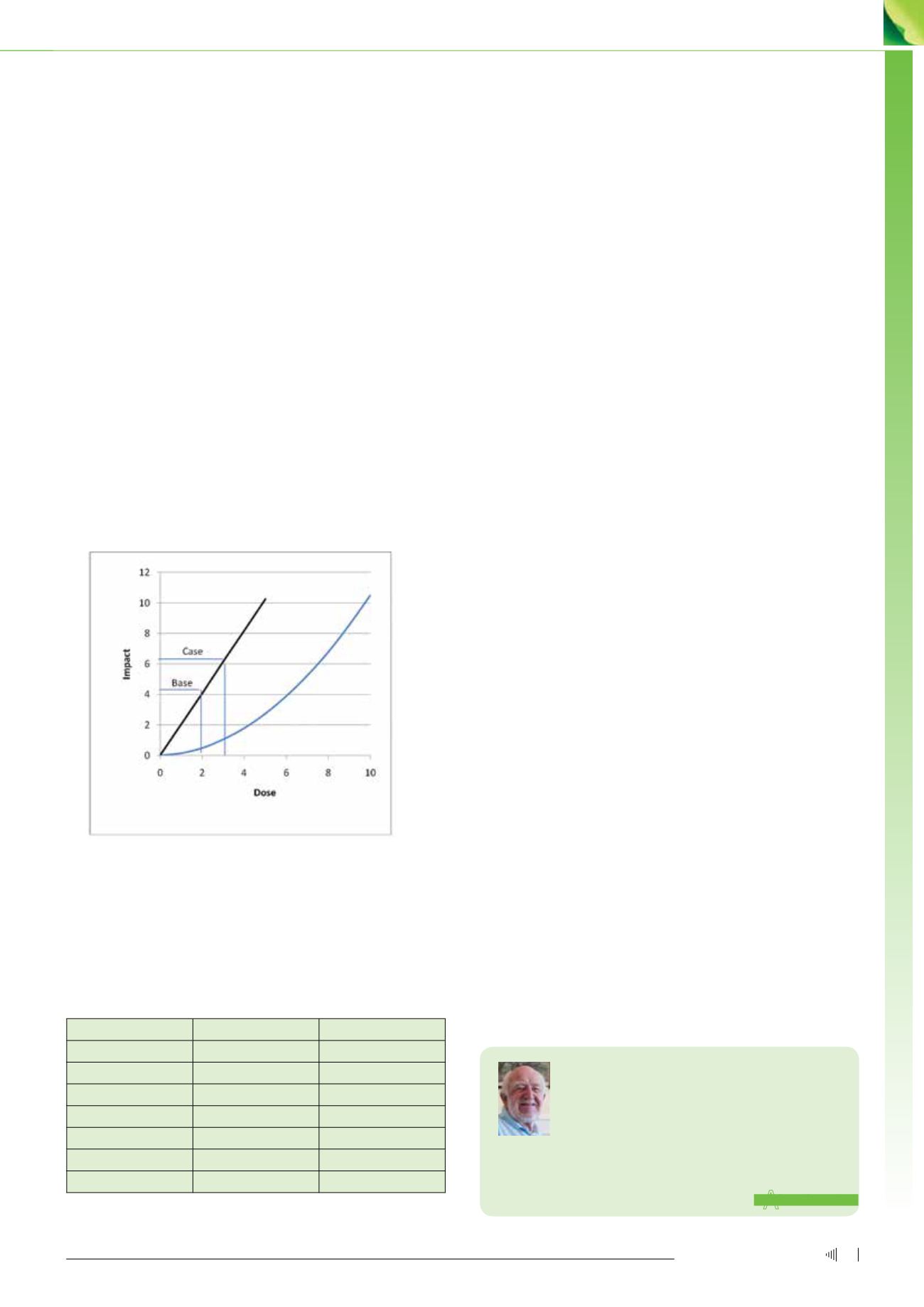
The difficulty of employing the zero-threshold liners impact
response model can also be illustrated by considering the dose-
response similar to that shown in Figure 2.
In this case, a 50% increase in the dose only increases the impact
by 50%, whereas in the case considered in Figure 2, it doubled the
impact. For low concentrations it certainly seems more reasonable
that the impact would increase faster than the dose, rather than in
direct proportion to the dose.
Figure 3: Dose-impact for zero-threshold response.
Corrections to Riekert and Koch
The stacks at Kusile will be 220 m high, and it seems most reasonable
to assume a flue gas desulphurisation efficiency of 90%, so following
Riekert and Koch, at the maximum ground level concentration (GLC)
and at Phola, the nearest conurbation would be increased by:
GLC, μg.m
-3
.
Phola, μg.m
-3
SO
2
6,2
6,2
NO
2
1,8
3,1
PM10
0,1
a
2,2
a
As
0,76E-07
b
1,68E-06
b
Cr(VI)
1,50E-06
3,30E-05
Pb
2,93E-07
6.,4E-06
Ni
4,35E-07
9,56E-06
Table 1: Additions to background levels at two conurbations near Kusile
•
a
– reduced by a factor of 10 due to use of bag filters in place of
electrostatic precipitators (ESPs)
•
b
– all ions scaled from PM10
References
[1]
[2]
Accessed April 2013.
[3] Dutkiewicz, RK and De Villiers, M.G. (1993). Social cost of elec-
tricity production. Engineering research, Report for the National
Energy Council, Pretoria
[4] Van Horen C. 1996. Counting the social costs: Electricity and ex-
ternalities in South Africa. Cape Town: University of Cape Town
Press and Elan Press
[5] Spalding-Fecher R and Matibe DK. 2003.Electricity and externali-
ties in South Africa, Energy Policy.
[6] Thopil GA and Pouris A. 2010. An overview of the electricity ex-
ternality analysis in South Africa within the international context.
South African Journal of Science.
[7]
-
Eskoms-Kusile-plant-awarded-20101129.
[8] Ravenscroft P, Brammer H,Richards, K. 2011. Arsenic pollution - a
global synthesis. Science Publishers.
[9] National Academy of Sciences. 2005.
-
emies.org/onpinews/newsitem.aspx?RecordID=11340.
[10]Aurengo A, Averbeck D, Bonnin A, Le Guen B, Masse R, Mornier
R, Tubiana M, Valleron AJ and de Vathaire F. 2006. Dose-effect
relationships and estimation of the carcinogenic effects of low
doses of ionising radiation: Joint report of the Académie des
Sciences & Académie nationale de Médecine. International J of
Low Radiation 2.3 (2006).
[11]Health Physics Society (2010) Radiation risk in perspective: Posi-
tion paper.
.
[12]Rennenberg H. 1984. The fate of excess sulfur in higher plants.
Ann.Rev.Plant Physiol.
[13]Zhao FJ, Hawkesford MJ &McGrath SP. 1999. Sulphur Assimila-
tion and Effects on Yield and Quality of Wheat, J. Cereal Science.
[14]Agency for Toxic Substances and Disease Registry. 2011. Arsenic
Toxicity.
.
[15]http://www.lecbiz.com/serv02.htm.
[16]Nielsen FH. 1974. Essentiality and function of nickel. Trace Element
Metabolism in Animals – 2. Ed. Hoekstra, W.G. et al, Butterworth,
London.
Philip Lloyd is on his third career, as a Research Professor
at CPUT, having previously been part of the R&D team of
the Chamber of Mines Research Organisation and then part
of the world of international construction. He trained as a
chemical engineer at UCT and nuclear physicist at MIT. He
has won a number of awards, including a SANEA Award in 2010. Enquiries:
Email
.
43
December ‘13
Electricity+Control


