Energy and EnviroFiciency
T
here has been growing concern about the external costs of
power generation, particularly the generation of power from
coal. A major effort by a team from the European Union pro-
duced the ExternE study, which concluded that the external costs
were a strong function of such variables as the population density
in the area around the power station, the local climatology and the
level of pollution control employed. There was therefore a wide range
of external costs.
Other studies have ignored the ExternE, and attempted a number
of shortcut methods which have had a doubtful theoretical basis.
Typically, they have relied on an assumption of linear no-threshold,
which in effect states that no matter how low the dose, harm will
result. The assumption almost certainly overestimates the impact and
therefore the external costs. The linear no-threshold theory is there-
fore examined, and it is concluded that it is most unlikely to be valid.
In economics, an external cost (or benefit) arises from an activity
that has some impact upon someone who had not chosen to incur
the cost (or receive the benefit). So, for example, diesel fumes may
settle on buildings, which therefore require more frequent cleaning.
The extra cost of cleaning falls on the owners of the buildings, not
on the owners of the diesel vehicles. That extra cost is therefore an
external cost. In the same vein, the city may decide to provide lights
in your street, and you would benefit from improved security at night
even though your contribution to the cost of the lighting installation
was minimal.
There is an economic philosophy which holds that for goods or
activities that have external costs, market prices do not reflect the
full social cost of the goods or activities. The market is therefore be-
lieved to be inefficient, because goods or activities which have high
external costs could be sold at a lower cost than competitive goods
or activities that have low external costs. Should one, for example,
prefer cheap electricity generated from coal combustion over rela-
tively expensive electricity generated from renewable sources, when
it is clear that the coal-generated electricity has some external costs
associated with it, whereas the primary external cost of renewable
energy is the cost of public relations to overcome objections to the
relatively large footprint they have.
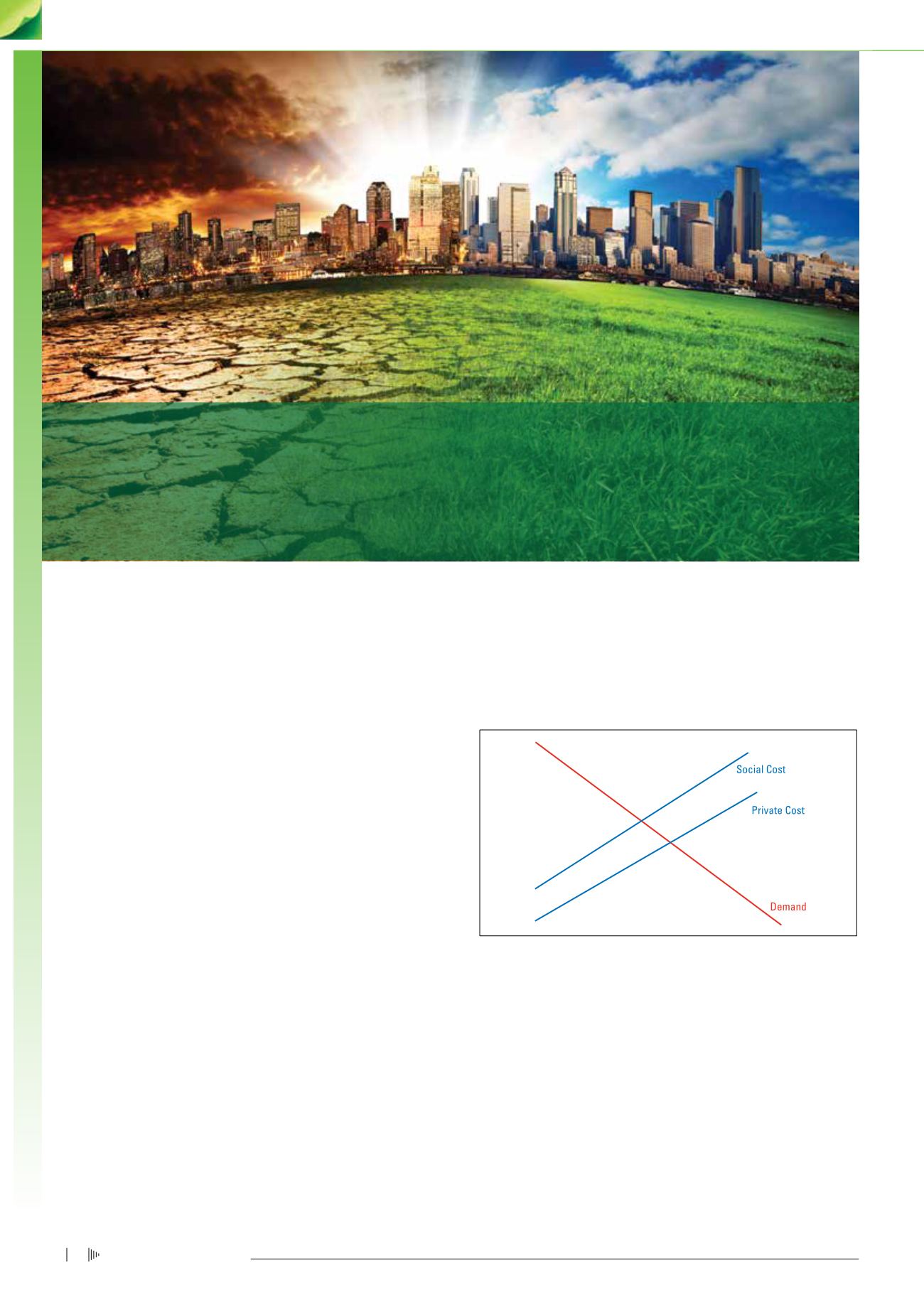
These concepts can be illustrated graphically. In Figure 1, the im-
pact of an external cost is shown. If the impact of an activity on society
is ignored, then the costs will be purely the private costs. Demand will
vary with price. Where the private cost intersects the demand line,
the equilibrium demand Qp will determine the equilibrium price Pp.
Figure 1: Price-demand and external costs [1].
However, an external cost will increase the private cost to the social
cost. The price should then rise to Ps and the demand will reduce to
Qs. The problem, however, is how to determine these external costs.
Taking the simple example of the diesel fumes above, one needs to
know how often the buildings would have been cleaned if there had
been no diesel fumes, because it is only the additional cleaning that
incurs the external cost. Establishing a baseline from which the ex-
ternal costs may be estimated is therefore necessary. This task may
be made difficult by the natural background, which itself is variable.
Facing this difficulty, in 1991 the European Union set up a pro-
gramme, ExternE, to estimate the external costs of energy genera-
tion. It took more than 50 teams from 20 countries to develop these
estimates. As the final report in 2006 notes:
External costs of power generation
By PJ Lloyd, Energy Institute, Cape Peninsula University of Technology
The social benefits of power so far exceed the social ‘external’ costs that one can conclude that power generation is well-merited, even from coal.
Electricity+Control
December ‘13
40


