Technology of the Future
ROUND UP
A
lstom
introduced its advanced circulat-
ing fluidised bed boiler at Asia's premier
industry expo, Power-Gen Asia inThailand.
Utilising the efficiency of ultra-supercriti-
cal (USC) steam conditions and the flexibility
of circulating fluidised beds (CFB), the Ad-
vanced CFB boiler offers 660 MW or more in
output, based on the type of fuel.The boiler
provides customers in coal-rich markets
with the opportunity to reduce operating
costs and increase output. By combining the
two principles, Alstom offers customers a
single, highly attractive boiler option, which
diminishes fuel consumption and the CO
2
footprint by 6% versus plants of comparable
size using traditional technology.The boiler
is able to achieve this while ensuring fuel
flexibility and reliability.
With ultra-supercritical boilers the overall
net efficiency of the power plant is increased
by around three points compared to tradi-
tional technology based on subcritical steam
pressure and lower steam temperatures.
Alstom has already established leadership
in ultra-supercritical boilers and up to
30% of the world’s boilers use Alstom
technology.
In addition, circulating fluidised
bed technology allows for a wide
range of lower-grade fuels, such as
lignite and anthracite, to be com-
busted efficiently and with low emis-
sions – reducing the need for additional
environmental protection measures. Further
versatility comes from the ability to fire on
mixes of fuel types, and even ‘fuels of oppor-
tunity’, including biomass and oil shale. Over
32 GW of CFB boilers installed in the world
today use the Alstom technology with a
maximum commercial size around 350 MW.
“The new advanced circulating fluidised
bed boiler brings together Alstom's leading
expertise in both USC and CFB technology,”
said senior vice president of Steam, Andreas
Lusch. “By offering both fuel flexibility and
high efficiency it enables operators of
coal-fired plants to take full advantage of
cheaper fuels, safe in the knowledge that
performance and emissions levels will be
comparable to plants burning higher grade
fuels.” This product is best deployed in
markets where lower quality fuel is avail-
able. As a result, areas of Vietnam near the
anthracite mining industry is a prime market,
as are the lignite producing regions inTurkey,
India and eastern Europe. Other developing
markets include Indonesia, where more high
moisture lignite is being produced and South
Africa which has large amounts of waste
bituminous coal available.
Enquiries: Sue-Ellen Swazi.Tel. 011 784 2598
or email
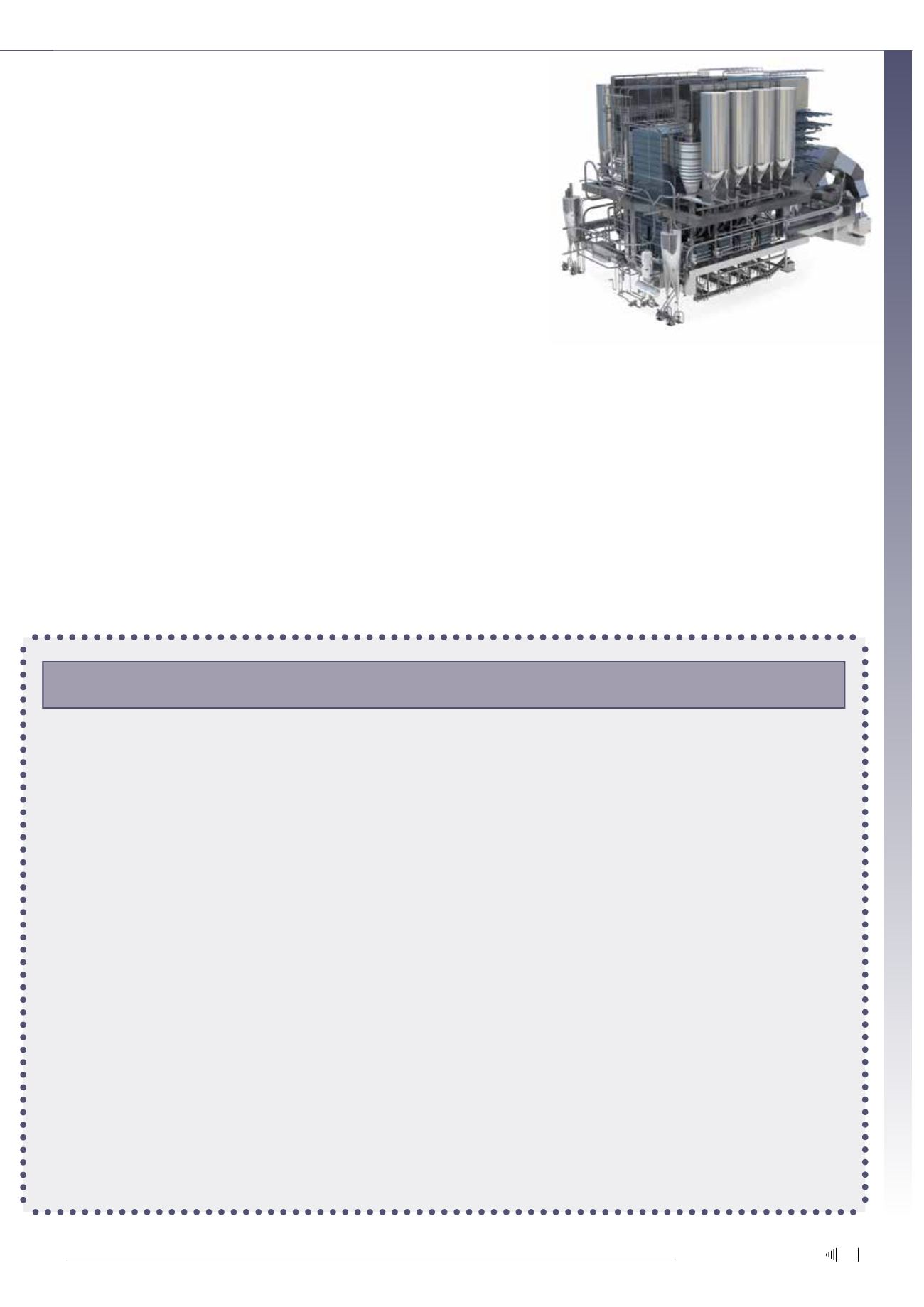
Advanced circulating fluidised bed boiler
2015
USB shocks the power grids
A new form of utility power is taking the world by storm.The humble
USB plug, so common for connecting and charging gadgets, is emerg-
ing as the new standard for electric power in the home and office, and
on the move. Invented over 20 years ago, the USB plug was originally
designed to simplify connecting devices to computers, but hidden
in its design was a stroke of genius that would change the world - it
also carried power to the device you were connecting. That made it
easy to do away with power adapters and proprietary plugs; if you
could connect your gadget, you could charge it too. Smartphones and
tablets were the first to jump on this idea, but soon any device that
could operate on low voltage, from GPS to LED lights, was happily
plugged in to USB. USB is smart power; it operates in any country; it
is digitally controlled; and the cables can carry data to and from the
device at the same time.
Now USB has upped the ante, with variable voltage and two-way
current; so you can feed into your micro-grid from a battery pack
when you need it, and charge the battery later, when your solar panel
is active, all from the same plug.
USB wall sockets come with built in intelligence, and you find them
everywhere these days, even on airplanes and boats.You never need a
travel adapter for your gadgets ever again! Adding to your micro-grid
at home is simple - just plug n play.The one thing you cannot charge
from USB is your electric car.
2017
Global warming is no more
It is official, the global warming scare is over. The latest report from
the independent panel on climate change is warning of decreasing
global temperatures, and the impact that will have on crops and food
security. If you believe the power of computer models to predict the
future, then you had better stock up on winter woollies. According to
the meddling modellers, it is about to get a whole lot colder in the
great northern hemisphere, where so much of humanity has its home.
With no significant warming in 20 years, you would have thought the
bureaucrats would have abandoned the global warming band wagon
much sooner. But a trillion dollar international edifice takes some
time to unbundle.Those who placed the responsibility for climate at
the door of human carbon emissions have faded into obscurity.The
hard-core officials have argued that ‘climate anomalies’ are still a
major threat to world peace, and need to be managed, no matter if it
is warming or cooling that is at issue. Optimistic realists, on the other
hand, point out that the cycle turned in 2013, when sea ice made an
unexpected come back in theArctic summer, destroying all predictions
of an ice-free northern sea route in the future. So preparing for an ice
age in the next century may be equally alarmist. Climate change, like
so many phenomena at the geological and cosmic scale, cannot be
controlled by humans, no matter how arrogant we are. Perhaps now
we can get back to dealing with real environmental problems, like
pollution, biodiversity and preserving natural habitats.
MindBullets scenarios are fictitious and designed purely to explore possible futures, challenge and stimulate strategic thinking.
Enquiries: Email
.
39
December ‘13
Electricity+Control


