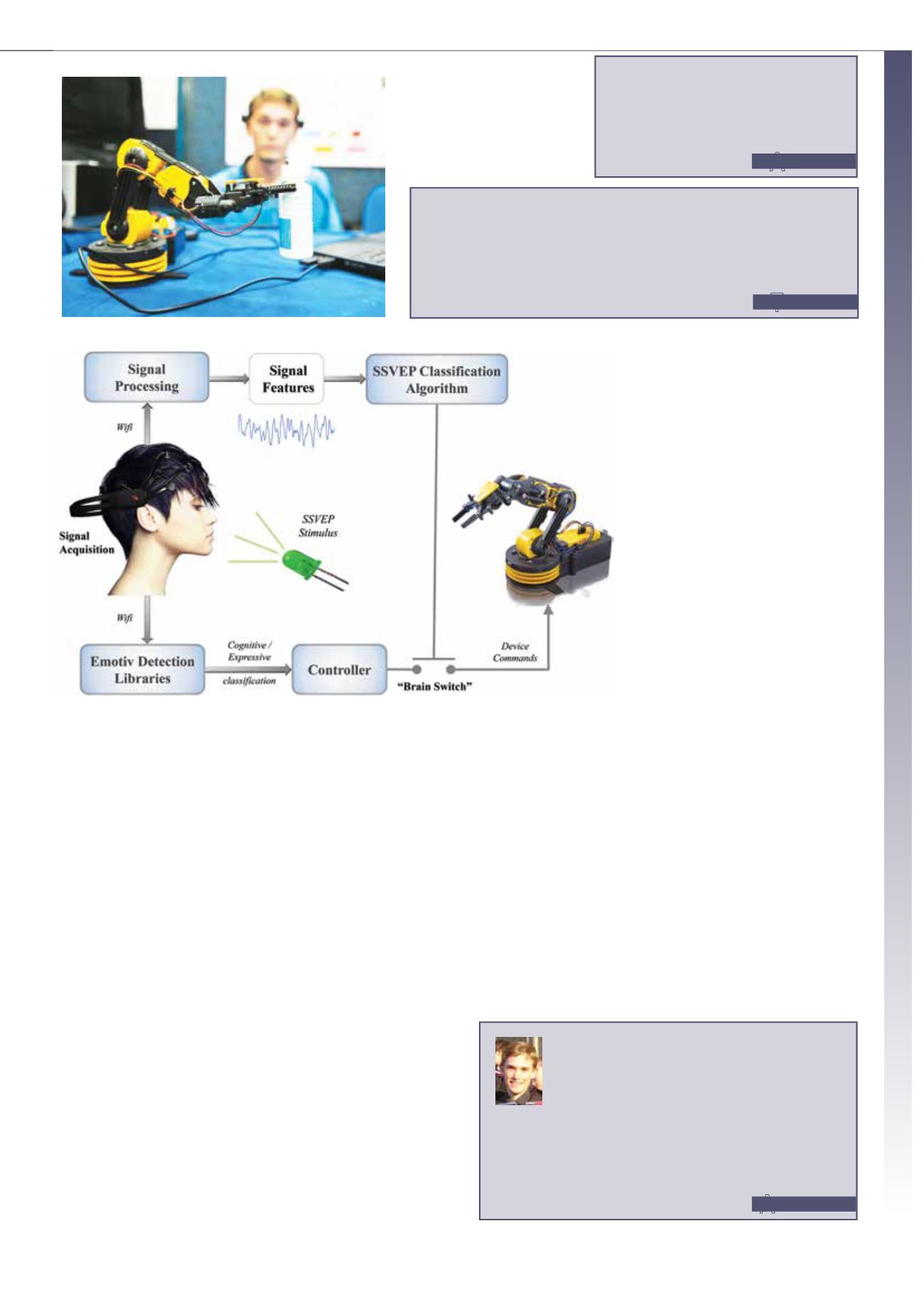
Controlling an object without using hands
The system provides a complete, cost-effective means for someone
to control an object without the use of their hands. Previous systems
have been implemented, but are generally more expensive. Last year,
researchers at the Providence Veterans Affairs Medical Centre, Brown
University, and Massachusetts General Hospital created a versatile
mind-controlled robotic arm that enables a woman to drink from a
bottle without assistance.
The difference, however, is that the robotic arm is controlled via
a chip that is implanted in the brain. Invasive surgery is therefore
required, and the overall cost of the system is relatively much higher
than the cost-effective system described in this article.
Consumer-grade BCI devices
What is required for a viable system is a low-cost, non-invasive solu-
tion to the problem on hand. Consumer-grade BCI devices currently
exist on the market like the Emotive EPOC EEG headset. The EPOC can
be purchased off the shelf for less than R9 000. Peyton and Hoehler
made use of the EPOC as a cost-effective, non-invasive alternative for
monitoring the activity of the brain. The only down-side of using a
consumer-grade device is that it allows for less precise control of the
arm. Peyton and Hoehler’s system is able to move in three degrees
of freedom (up and down, left and right, and open and close pincers),
but the movement is fairly slow and
imprecise. Nonetheless, the research is
one significant step in the right direction.
Dream BCI
While the field of BCI research and devel-
opment has focused primarily on neuro-
prosthetic applications, the possibilities
for applications in other arenas such as
information technology are practically
limitless. The ultimate goal converges on
what may be termed ‘Dream BCI’ – the
achievement of total reconnaissance of
human thoughts without any problem
or concern. Such a system could be fully
integrated into a system such as the in-
ternet, in order to control more than just
a wheelchair or prosthesis, but entire
systems and processes. Of course, this
‘dream’ is currently idealistic. Present
signal acquisition methods are presently still imperfect and our un-
derstanding of the human brain limited.
Conclusion
Despite these challenges, robotic prostheses and BCIs will undoubt-
edly gain much momentum in the near future. Ray Kurzweil, the
acclaimed inventor and futurist, believes that humans and technol-
ogy will eventually merge. We have always been a human-machine
civilisation; since the origin of our species, we created tools to extend
our reach, and will continue to do so. Increasingly advanced research
in the field of BCIs is becoming so advanced that it is set to create a
whole new symbiotic relationship between man and machine.
Technology of the Future
T
ake note
A
bout the author
Graham Peyton received his BEngSc and BSc degrees in
Biomedical and Electrical Engineering from the University of
the Witwatersrand in 2010 and 2012. He is currently working
on his MSc degree as part of the Biomedical Engineering
Research Group at the University of the Witwatersrand.
Graham's main areas of interest are biomedical signal processing and
brain-computer interfaces. Presently, he is working on developing signal
processing techniques to analyse magneto-encephalography (MEG) data.
Enquiries: Email
A
bbreviations
BCI - Brain Computer Interface
EEG - Electroencephalography
EMG - Electromyography
MEG – Magneto-encephalography
SSVEP - Steady-State Visually Evoked Potential
• A brain computer interface (BCI) is a communication interface between a human and a
computer.
• A BCI that translates cognitive commands and facial gestures into movements of a
robotic arm has been designed.
• The possibilities for BCI applications in other areas - such as information technology - are
limitless.


