Health, safety, environment and quality
with copper and copper alloys, can be used in food processing areas
to help reduce the risk of cross-contamination of moulds and even
dangerous food-borne pathogens. Suggested applications include dry
food contact surfaces (such as mixers, transfer chutes, conveyors and
work tables) and touch surfaces (for instance door fittings and taps).
Heating, ventilation and air-conditioning
Heating, ventilation and air-conditioning (HVAC) systems are believed
to be factors in over 60% of all ‘sick building’ situations and can also
benefit fromantimicrobial copper components, such as filters, cooling
fins, drip pans and tubes, which eliminate bacterial and fungal growths
that typically thrive on damp internal surfaces. This can potentially
improve the resultant air quality. Apart from commercial and public
buildings, controlled air spaces such as operating theatres and food
preparation areas may especially benefit.
Lighting
Perhaps no area of the medical facility has greater need for precise
lighting levels than the surgical suite. Controllable light levels in these
areas are critical. They require high light levels to prepare the room
and equipment for medical procedures, while lower light levels are
needed when video screens, computers, and microscopes are used
to clearly view the images. Doctors need lower perimeter lighting to
reduce eye fatigue and remain focused during long procedures. Also,
during procedures where the patient is awake, lower ambient light
levels help the patient relax.
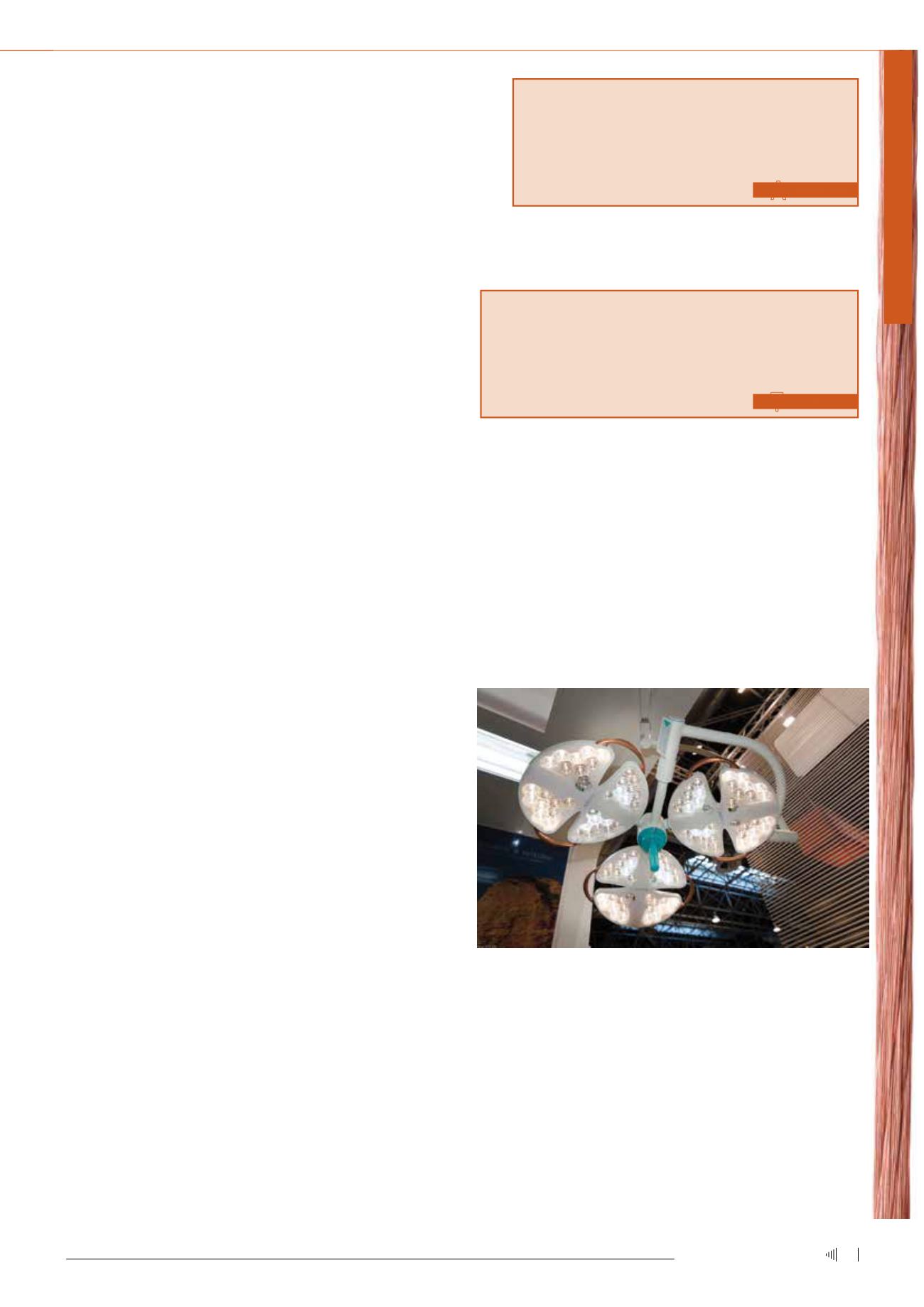
Recently, the world’s first antimicrobial copper surgical lights,
aimed at reducing the spread of infection in operating theatres, were
debuted. These lights combined the necessary lighting control fea-
tures along with the broad-spectrum antimicrobial efficacy of copper,
thus offering an additional line of defence against infection, which
could be critical to post-surgical patient outcomes.
Copper and copper alloys
Copper is well known for excellent thermal and electrical properties,
as well as high ductility. However, copper also forms alloys with a
wide range of elements to produce the following cast and wrought
alloy families:
Copper with:
• Tin makes bronze
• Tin and phosphorus makes phosphor bronze
• Aluminium makes aluminium bronze
• Zinc makes brass
• Nickel makes copper-nickel.
One of the key requirements of an approved antimicrobial copper
alloy is that there must be a minimum copper content of 60%. As a
general rule, efficacy increases with copper content.
T
ake note
A
bbreviations
Alloying provides improvements to strength, hardness, ductility,
machining and joining properties, and castability and corrosion
resistance, but results in lower electrical and thermal conductivities.
Designers and manufacturers who wish to use copper alloys for
the production of antimicrobial components will find that they are
easy to fabricate by machining, hot or cold working or casting. There
should be no problemwith existing tooling and fabrication equipment
used for other materials.
With over 450 approved alloys to choose from, offering a wide
range of properties and attributes, it is easy to select an appropriate
alloy for the application and fabrication route required. In fact, there
will usually be several that meet particular design requirements.
Alloy selection criteria
Product design must encompass many factors including aesthetics,
economics, ergonomics and engineering. Together, these inform the
choice of material and manufacturing route to achieve the most suit-
able design solution. Copper alloys continue to be widely specified
because they are the most suitable material for those applications
where they excel. However, the use of copper alloys for key touch
surfaces is a relatively new field of design and requires consideration.
Alloy selection will often be a balance between aesthetics and
antimicrobial efficacy. In long term clinical trials, where copper and
alloys have been used in a busy hospital environment, no signifi-
cant difference in performance has been detected between alloys.
This is probably because other factors such as recontamination and
AMC – Antimicrobial Copper
EPA - Environmental Protection Agency (United States of America)
HVAC - Heating, Ventilation and Air-conditioning
HCAI - Healthcare-associated Infection
MRSA - Methicillin-resistant Staphylococcus Aureus
ICU - Intensive Care Unit
• Copper is a powerful antimicrobial substance.
• Copper offers a broad spectrum efficacy against pathogens that may
threaten public health.
• Copper is easily worked and fully recyclable.
37
July ‘13
Electricity+Control


