20
Mechanical Technology — May 2013
⎪
Materials handling and logistics
⎪
T
he changing role of
project houses in
the African mining
industry has come
to the fore in a distinct manner over
the past two decades; from a scenario
where mining clients appointed several
independent specialist consultants and
suppliers for different project compo-
nents to the current model in which
project houses are appointed to manage
major portions of a project, or the entire
project from design to commissioning.
So says Trevor Anderson, of engi-
neering and project management servic-
es company, K’Enyuka, who adds that
the initial thrust of this trend embraced
the EPCM (Engineering, Procurement
and Construction Management) con-
tract arrangement in which the EPCM
contractor assumes responsibility for
the correct and timely completion of
a project.
“About 20 years ago, a mining
company would source and manage
multiple independent suppliers, but
the more contemporary drift to EPCM
offers these companies a spectrum of
attractive benefits,” he says. “The cli-
ent has one point of contact, while a
single project manager controls project
implementation. In most cases, project
houses are able to tap into a broad
range of in-house competencies and this
translates into improved costing and
time management, as well as efficient
meshing of the various engineering
disciplines. Well-established interdis-
ciplinary communication, arising from
long term in-house relationships, also
contributes to the smooth progress of
a project.
“Another major benefit is the sum
of the expertise in a project house’s
professional competencies pool. These
professionals are all specialists in
their particular discipline, across all
commodities and their combined ex-
perience from past projects frequently
leads to innovative approaches on the
Trevor Anderson, of engineering and project management services company K’Enyuka says
the role of project houses in the African mining industry has evolved from providing EPCM
services towards a turnkey (TK) approach. He highlights the growing need in the medium to
small mining sector for the supply of modular plants on a turnkey project basis.
The evolving role of the project house
and modular turnkey solutions
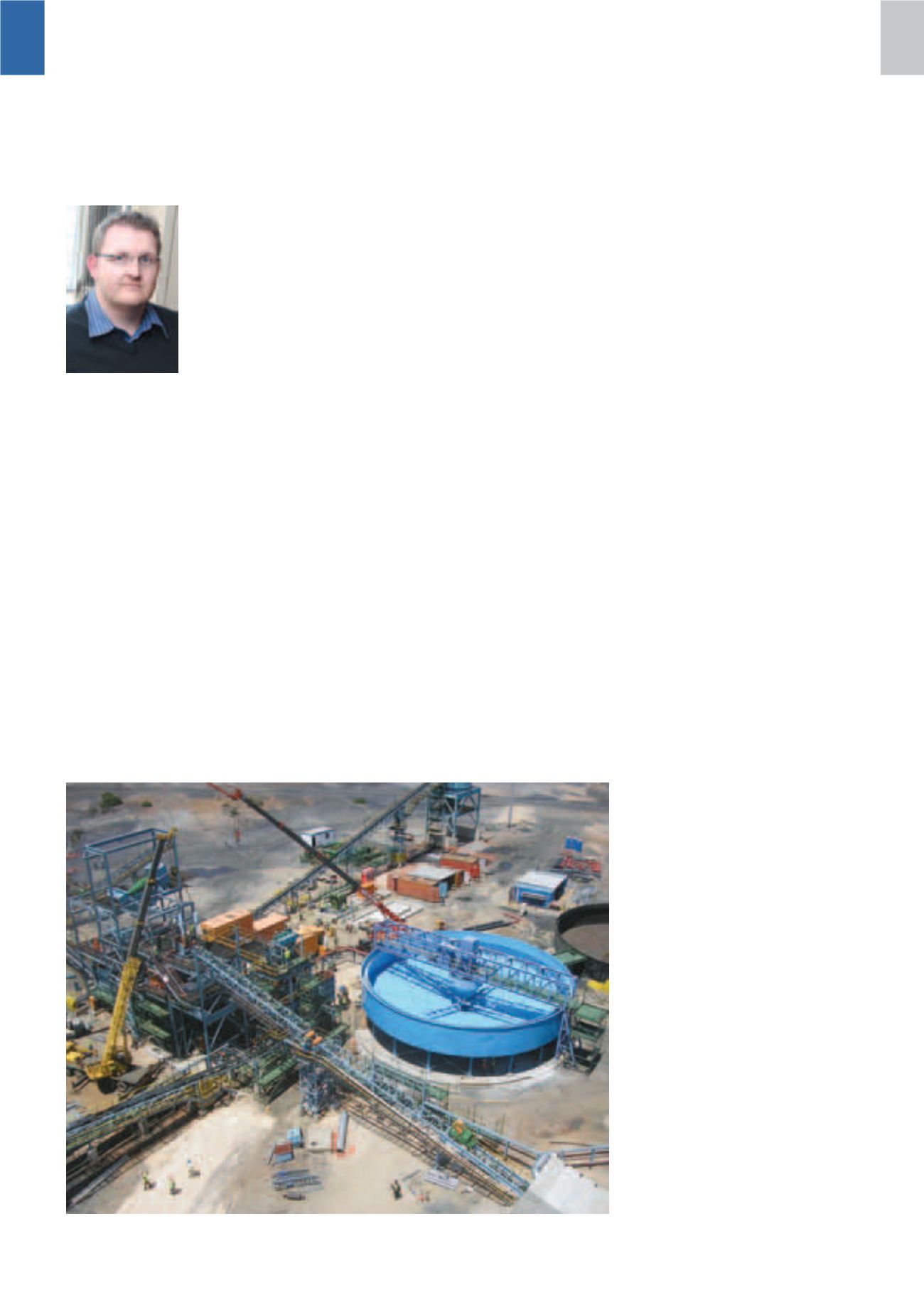
K’Enyuka provides full EPCM services within all minerals sectors.
next project. After all, many of these
engineers began their careers in an in-
house project environment at some of
the leading mining companies. Today,
many of them have been absorbed into
project houses where they work as part
of a multi-disciplinary team.”
Anderson says the EPCM model rose
to prominence in the industry from the
early 1990s, until the global economic
crisis of 2007 impacted the African
mining market.
EPCM model has evolved
“I believe the African market is now
demonstrating a clear move away from
EPCM to turnkey (TK) projects,” he
says. “This development has arisen out
of the tighter controls being applied to
clients’ budgets. With greater-than-ever
emphasis on mitigating financial risk,
the project model has had to evolve
to accommodate a growing number of
requests from clients, particularly in
Africa, for design-and-build, as well as
TK projects.
“These models differ from EPCM in
that EPCM takes a reimbursable con-
tract approach – effectively costed from
month to month until project comple-
tion – and being subject to change. The
other two models place more risk on
the project house, with fixed costs for
project execution agreed upon, provided
that the scope remains the same over a
known duration.
“With EPCM, project houses are
fundamentally selling services, but
TK projects require them to be able to
cover all the costs of the project until
handover. Beyond South Africa’s min-
ing industry, risk-averse clients in other
regions of the continent, where the
mining environment is very volatile, are
increasingly choosing a TK approach to
make sure they receive a good return on
investment. The more marginal projects
in particular are focusing on maximum
net present value.
“This escalating demand for TK


