Mechanical Technology — May 2013
21
⎪
Materials handling and logistics
⎪
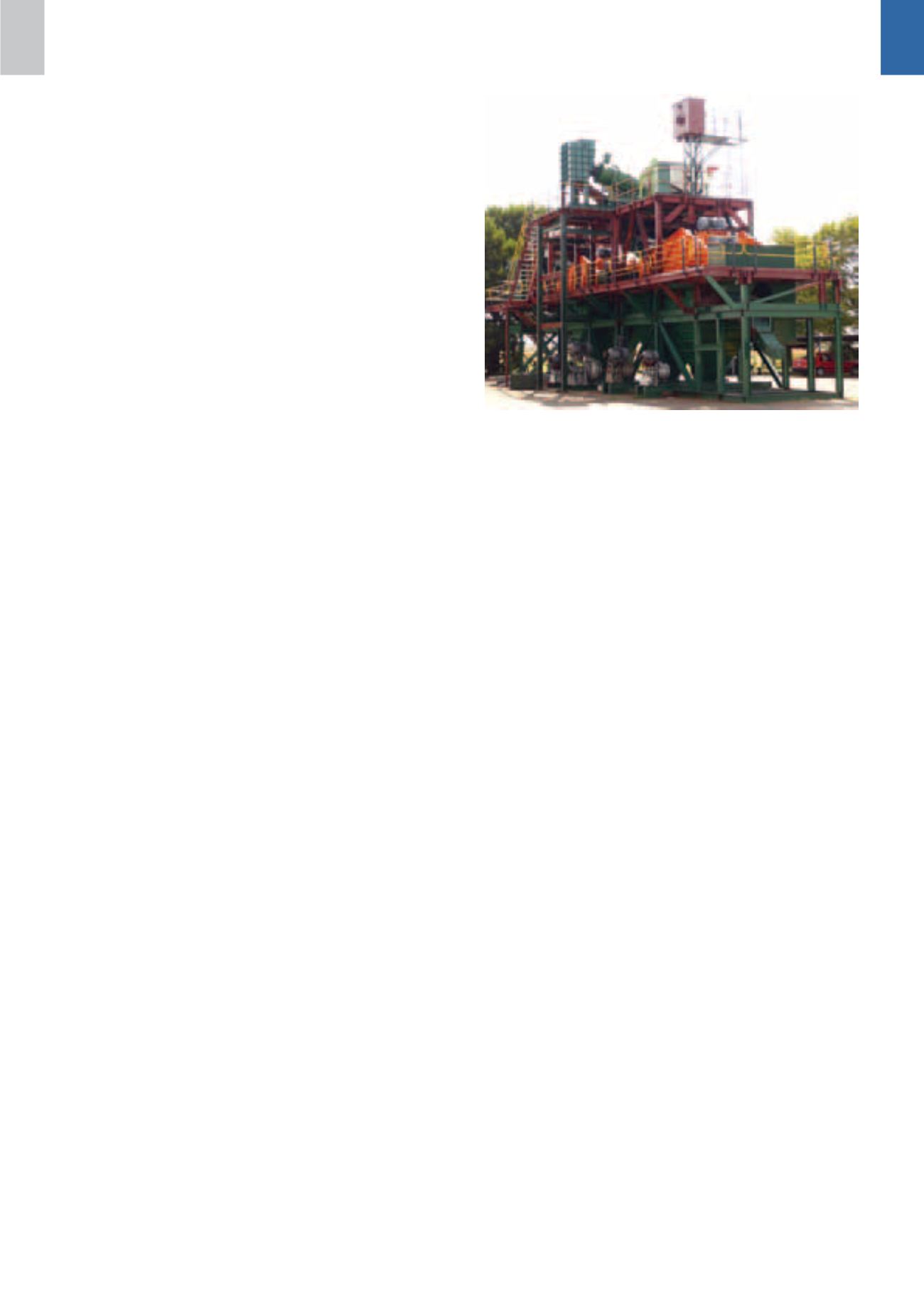
K’Enyuka’s custom-built modular plants can cater for specific ap-
plication requirements.
projects has required project houses to
become more discerning about the proj-
ects they take on. A lot more engineer-
ing work is required up front in order to
quote at the correct costing and there
is also a relatively new expectation for
project houses to bring outside investors
to the table, so that projects can get
off the ground as quickly as possible.”
Significantly, K’Enyuka has devel-
oped an innovative project financing
model which could assist potential cli-
ents in attracting investment as well as
with initial project financing, especially
outside South African borders.
Global platform
Anderson adds that if the past 12
months are anything to go by, the
number of new mining projects in South
Africa is set to dwindle, with most new
ventures being established in other
parts of Africa via a TK approach.
“Today’s project houses operate on
a global platform and to compete suc-
cessfully in this international business
environment we need to be excellent in
all our disciplines,” he continues. “It’s
all about establishing an unblemished
track record. We need to be able to
come up with, and deliver cost ef-
fective and innovative solutions and
fully understand all the accompanying
implications.
“K’Enyuka is ideally positioned to
compete against Tier 1 global project
houses for both local and international
projects, while still being able to service
mining companies with professionally
designed and executed smaller proj-
ects. Technical expertise is a primary
strength, drawing from a pool of rela-
tively young engineers with fresh and
innovative concepts, underpinned by
the input of more longstanding profes-
sionals who have track records on major
projects around the world.”
While the company has traditionally
focused on South African projects, it is
keen to expand its African footprint and
has already identified heavy minerals
and copper project opportunities on
the continent.
Last year K’Enyuka announced a
formal skills consolidation with all
the linked enterprises associated with
Read, Swatman & Voigt (RSV) (Pty)
Ltd, to create the “RSV Group”. All
enterprises linked to RSV, including
K’Enyuka, are now able to draw from
one another’s capabilities, building on
a common high value
brand. Established in
1991, RSV is one of
the foremost consulting
engineering and project
management compa-
nies servicing the global
mining and industrial
sectors. Its growth strat-
egy includes the cre-
ation of linked enterprises
through which the com-
pany offers customers
the benefit of combined
proven experience across
the full spectrum of min-
ing, metallurgical, min-
eral processing, industrial
plant and infrastructure
design, installation and commissioning.
Kenyuka’s modular plants
Modular plants offer numerous benefits
to both large and small scale opera-
tions, and are particularly sought after
by junior miners and clients in Africa
eager to generate cash flow quickly and
effectively, maximising on the quicker
access to product, which provides
greater flexibility on limited life reserves,
thus saving costs. They are ideal for ap-
plications where the lifespan of the mine
is relatively short. Plant can easily be
moved to a new site when the reserves
are depleted.
Anderson describes some of the
advantages of erecting modular plants.
“The structural design of the plant facili-
tates easy disassembly and reassembly
on different sites. Fewer construction
man hours are required and one does
not need a highly skilled labour force
on site since the plant is assembled off-
site in a controlled environment where
quality control is rigorously monitored.”
The off-site assembly, he explains,
means alignment is easily checked and
fewer fitting errors and reworking result
thanks to the pre-fitting of components
prior to delivery. Off-site erection also
minimises laydown space, an important
consideration for small or congested
field sites. Schedules are shortened,
allowing concurrent project processes
to run unhindered. The wider benefit is
a reduction to the client of the overall
impact on his operation, especially
when it is fully operative.
The cost for engineering and con-
struction is minimised and the plant
can be transported to site in modular
sections using regular road transporta-
tion or easily shipped, internationally,
via regular containers.
Modular plants, Anderson claims,
can be up and running within weeks if
civil preparation and upfront planning
have been conducted.
K’Enyuka’s modular plant treats
a range of product, from -50 mm to
+0,5 mm sized coal in the dense
media cyclone and dense media drum
respectively. These plants are offered
on an EPCM or turnkey basis. K’Enyuka
can design and construct all modular
plant tie-ins including raw coal handling
systems, fines beneficiation modules,
dewatering systems and discard- and
product-handling systems.
The modular plant is particularly
suited to smaller operations and can
accommodate from 50 tph to 200 tph
per module, so two or more modules
can be placed side by side if greater
throughput is required.
All plant is tailor-made to customer’s
specific requirements for different
minerals sectors, and includes mobile
crushing and screening modules, large
and small coal washing and spirals
modules.
“Where customers are unsure of
the best solution, we offer expertise
in up-front consultation, feasibility
studies and test work prior to project
initiation on full beneficiation solutions
from run-of-mine to finished product.
In effect, we enter into a partnership
to ensure a win-win solution with the
customer obtaining value for money and
a plant tailored precisely to deliver the
requisite finished product,” Andeson
concludes.
q


