4
Mechanical Technology — May 2013
I
scor shut down its Pretoria West
steel mill in 1997 and moved pro-
duction to Saldanha, leaving the
over-the-fence Afrox oxygen and
nitrogen supply from its 2 x 750 tpd
air separation facility relatively redun-
dant. Since then, Afrox has continued
to operate one of its two ASUs on the
site in maximum turndown mode. “But
this is energy-inefficient, and taking into
account the age of the plant, we saw
this as an ideal opportunity to replace
an existing plant, originally commis-
sioned in 1987, with more modern
and efficient technology,” says Kimber.
The new R200-million air separa-
tion unit (ASU) at Afrox’s Pretoria West
site is part of a capital investment
programme by the Linde Group, the
company’s parent, of R1,5-billion over
the next three years. The new ASU will
produce high purity oxygen, nitrogen
and argon to service the industrial and
medical markets in South and sub-
Saharan Africa.
The engineering division of the Linde
Group was responsible for the design,
supply and building of the new ASU, im-
porting the best in modern technologies
into South Africa. “The ASU is remotely
controlled from a global operations
facility in the UK, ensuring optimal
output and quality. The development
also included integrating an existing
nitrogen liquefier unit into the new ASU
and linking production from the ASU to
existing cluster storage tanks. The cool-
ing water system, the electrical supply
and instrumentation have also been
upgraded,” Kimber announces.
Three cold boxes, an air compressor,
coolers, pump skids and PPU skids
were shipped from Germany to
Durban and then transported
to Pretoria. The extraordinary
length of the main cold box
made it a challenge to trans-
port as an abnormal load and
to lift it into position on site.
“The number of role players
involved also rendered this proj-
ect highly complex,” comments
Kimber. “However, execution
was streamlined and activities
fell into place as scheduled.
The R200-million project was
completed on time and under
budget, which is unusually
impressive for large capital proj-
ects in South Africa,” he adds.
Cryogenic air separation
technology
Carl von Linde developed the
first continuous process for the
liquefaction of air back in May
1895, and this relatively simple
process, at its fundamental
level, remains the foundation
stone of all cryogenic air separa-
tion technology. At atmospheric
pressure (1,01 bar at sea level)
Afrox officially launched its new high efficiency air separation unit (ASU) in
Pretoria West on 20 April, 2013.
Peter Middleton
attends and talks to Afrox’s
Donal Mackinnon about modern air separation technology and Brett Kimber,
the new managing director, about the company’s reinvestment vision.
Brett Kimber, Afrox’s managing director,
presents the company’s reinvestment
vision.
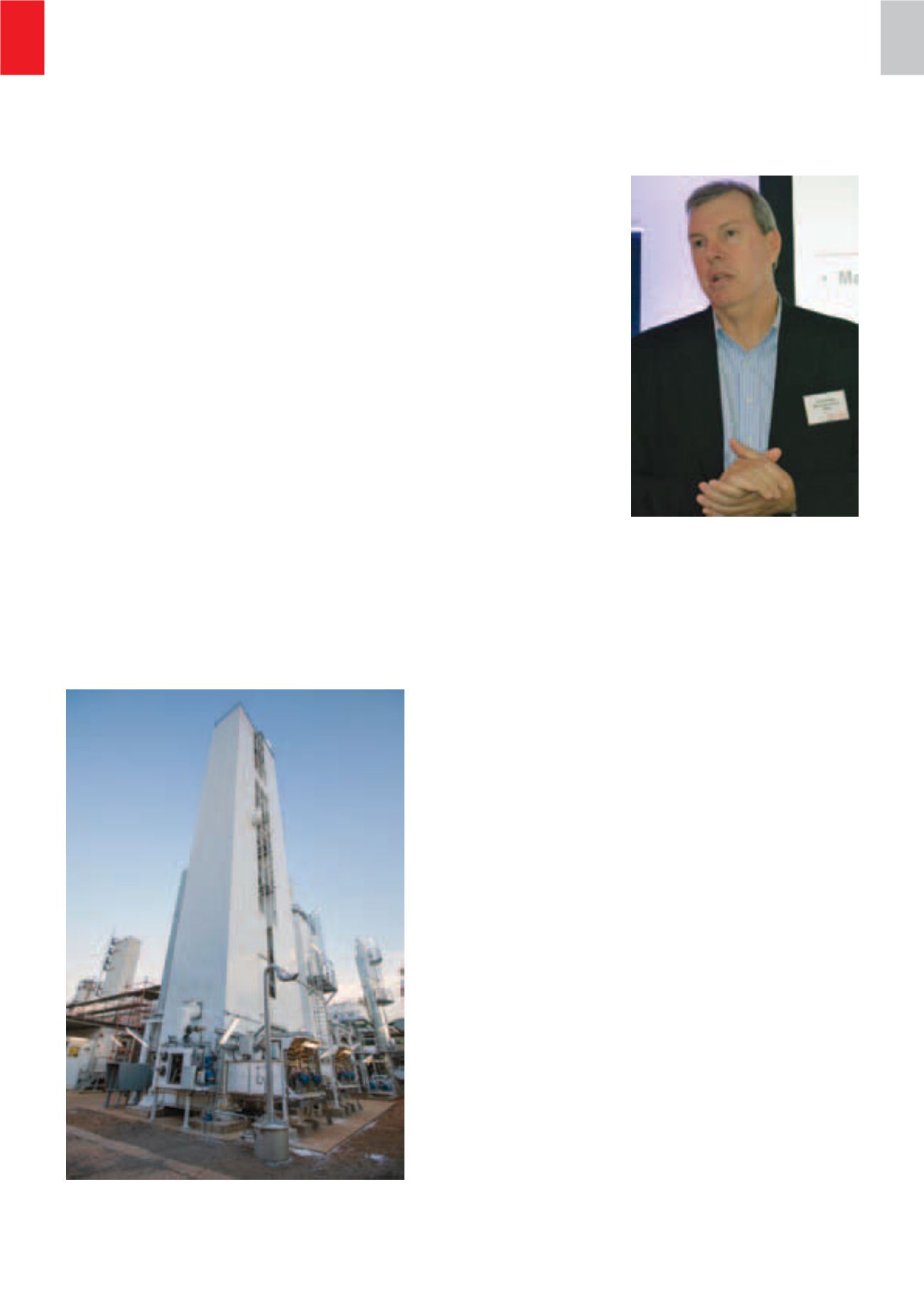
The new R200-million air separation unit (ASU) at Afrox’s
Pretoria West site, part of a R1,5-billion capital investment
programme by the Linde Group.
Afrox’s R1,5-billion rejuvenation
air must be chilled to -192°C (81,5 K)
before condensation begins. This boil-
ing/condensation temperature rises as
pressure increases, so air at a pressure
of 6,0 bar can be condensed at -172°C
(101 K).
Since dry air is a mixture of gases
– mostly nitrogen (78%), oxygen
(20,95%) and argon (0,93%) – the
boiling/condensation points of each gas
in the mixture are not the same. It is
therefore possible, by tightly controlling
the temperatures and pressures in-
volved, to liquefy or evaporate individual
gases from the mix to separate them.
At the starting point of Afrox’s new
ASU in Pretoria West is a modern
3,0 MW Atlas Copco air compressor
that sucks in atmospheric air and com-
presses it to 5,5 bar. “In Durban, atmo-
spheric pressure is at around 1,01 bar,
but because we are on the Highveld
(0,85 bar) more energy is required of
the blower,” Mackinnon points out.
The compressed air is passed
through a direct contact air cooling
tower, where moisture is condensed
out and the air is cooled to between 10
and 12°C. “At cryogenic temperatures,
water in the air will freeze and cause
blockages, so it is very important to get
all of the moisture out. We use some of
the dry gaseous nitrogen off the main
process to chill water. This chilled water
is then trickled in direct contact through
⎪
On the cover
⎪


