10
Mechanical Technology — May 2013
⎪
Special report
⎪
W
heat is the basic food
staple for 3,5-billion
people, while more than
two billion depend pri-
marily on rice and 900-million on corn.
Furthermore, 500-billion cups of coffee
are consumed and eight million tons of
chocolate are produced every year – and
here lies the core of Bühler’s business.
The Swiss-based company, with a net-
work of over 10 000 people spanning
more than 70 countries specialises
in processing equipment for all of the
above industries and invests around
80-million Swiss francs per year on ba-
sic research and applied development.
Present in South Africa since January
1972, Bühler has acquired an intimate
knowledge of its clients’ specific re-
quirements. The strong local presence
allows fast response to enquiries and
short delivery times. Customers ben-
efit from local manufacturing facilities
producing at appropriate local prices
and a large spare parts stock. Trained
specialists are available to clients for
after sales service throughout the life
cycles of their production plants. If up-
grades or green-field projects are being
considered, Bühler offers customers
assistance with feasibility calculations
and financial solutions.
But customer needs vary greatly
across sub-Saharan Africa. Bühler’s
response to this challenge is to provide
commercially optimised solutions in
order to guarantee maximum customer
benefit. Hence Isigayo, a two t/h mobile
compact mill aimed at tackling the
South African government’s mandate to
develop the small-scale milling sector
and improve food security in the south-
ern African region, and the supplier’s
solution to the need in South Africa
to move the processing of raw maize
product into rural areas.
“Although agricultural production of
maize in South Africa was flourishing,
processing was not answering the need
for industrial development in rural and
disadvantaged areas, particularly owing
to the noticeable lack of small-scale
milling provisions,” says Bühler Group
CEO Calvin Grieder. “This technology
will create jobs, develop skills and pro-
vide affordable and improved nutrition
through vitamin enrichment, as well
as empower and generate income for
entrepreneurs and existing small-scale
millers,” he adds.
According to Grieder, Isigayo repre-
sents a little revolution in milling. The
word is of Zulu/Nguni origin (-gaya) and
refers to the traditional process of grind-
ing maize or beans using a base and
grinding stone or a pestle and mortar.
The Department of Trade and Industry (dti), in collaboration with the Foundation for African Business and
Consumer Service (FABCOS), and Bühler South Africa, the food processing plant and equipment specialist,
launched an innovative new agroprocessing mill called Isigayo in Johannesburg on Friday, 12 April, 2013.
MechTech
reports.
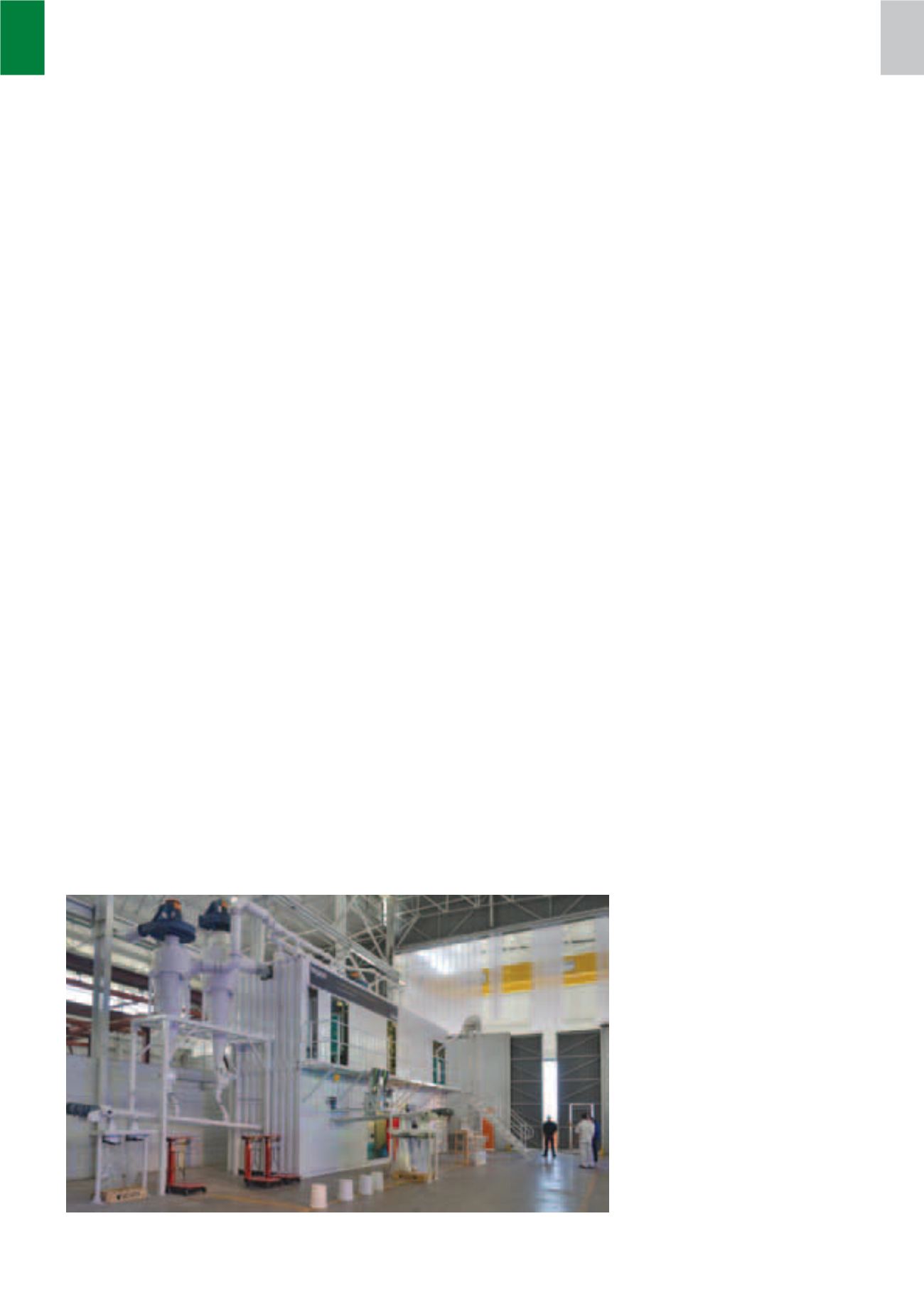
Isigayo, the new 2,0 t/h mobile compact mill aimed at the small-scale milling sector.
Isigayo: the maize mill for South Africa’s SMEs
“Our aim is to replace traditional grind-
ing processes with an efficient modern
equivalent that is affordable for the rural
market,” he suggests.
Isigayo is a small, easy to transport
mill for the small scale milling industry
that will develop skills and help rural
economic development. “Bühler’s strat-
egy has not changed. We are known
as a technology partner and supplier
of state-of-the-art equipment, of highly
efficient equipment and solutions for the
food milling and processing industries.
But Isigayo shows we are also ready
and capable of offering affordable and
portable solutions that are ideal for rural
South Africa. This is not a change in
policy, but an addition to our portfolio
to better meet the needs of this market.
And we are very proud of our excellent
solution,” he announces.
At the starting point of implementing
this vision, was the signing an agree-
ment for the purchase of 24 Isigayo
plants between Bühler and FABCOS,
the Foundation for African Business
and Consumer Service, a membership-
based organisation promoting the de-
velopment of black business in South
Africa. Speaking following the signing
ceremony, FABCOS’ deputy president,
Phillip Usiba, announced the establish-
ment of a new company, Homegrown,
which will ensure that Isigayo millers
get a constant supply of grain and have
a guaranteed buyer of their produce.
“FABCOS’ strategy involves training
new producers via its farm incuba-
tors – programmes that help launch
new agricultural businesses through a
combination of production and busi-
ness education – that offer subsidised
input costs; centralised land tenure and
equipment leases to participants. We
host and train new farmers as they
produce food, share equipment, develop
their markets, and learn from mentor
farmers, agricultural professionals and
each other. Then, once their businesses
are viable, the new producers move off
the incubator farm and find their own
land to farm,” Usiba explains. The addi-


