Mechanical Technology — May 2013
7
Investments for Africa’s future
“Afrox is an 85-year-old proudly South
African gases and welding company
with thousands of customers and
turnover of R5,6-billion per year,”
continues Kimber. “But recession and
policy uncertainty can freeze investment
in a company like ours. We generally
can’t make investments unless there
are opportunities: piggybacking with an
over-the-fence supply, for example, or
an expanding industrial market sector.
For several years prior to this invest-
ment, opportunities have been rare.
There was never enough development
to justify new plants and we have had
to rely on ageing infrastructure.
“But we are here to stay and so we
had no option but to reinvest. Globally,
we understand that the most expensive
gas is no gas. Reliability of supply is
critical and to achieve that, we need
upgraded facilities at multiple plants
so that we are able to offer a 24/7/365
service. In my previous appointment
with Linde in South Korea, we had to
guarantee supply to Samsung Electron-
ics, for example, at all times and at a
level that we are not yet used to here,”
Kimber says.
“Afrox has underinvested in key
facilities for several years. But we are
part of the global Linde Group and
our German CEO wants us to be part
of Africa’s future. Linde’s strategy is
informed by clear global megatrends:
clean energy, healthcare and emerg-
ing markets. There is absolutely no
nervousness about investing in Africa,”
Kimber reveals.
In addition to the Pretoria West facil-
ity’s new ASU, Linde has also commit-
ted to two greenfield developments: a
R500-million, 111 000 m
2
super site
in KwaZulu-Natal and another new
R250-million ASU in the Eastern Cape.
“The KZN development will be the most
modern and biggest single project we
have ever undertaken,” says Kimber. It
will include: an industrial and medical
gases filling plant; a dissolved acetylene
production plant; an upgraded LPG
filling facility; a customer engineering
support services centre, an Afrox Gas &
Gear retail outlet and an allowance for
a future investment in a new ASU. “We
already have excellent relationships
with the KwaZulu-Natal Department
of Health on the medical gases side
and the LPG facility will go a long way
to supporting the local tourism and
hospitality industries,” he explains.
The Port Elizabeth development in the
Eastern Cape will include a 150 tpd ASU
that will come on stream during the first
quarter of 2015 to support the region’s
automotive and related component man-
ufacturing industries as well as the food
and beverage, hospitality and medical
sectors. “We believe this development
will secure supply in the Eastern Cape
and foster future growth. The Coega IDZ
and the modern deep water harbour will
benefit – and it will make long distance
trucking a thing of the past.”
Turning his attention to the local
manufacturing side of Afrox’s business,
Kimber says that Afrox is unique in
the Linde Group because of its weld-
ing consumables and gas equipment
manufacturing capability. “This is a key
opportunity for us to influence Linde’s
global portfolio,” he advises. “As long
as we have innovative, cutting edge
technology and we can manufacture
products that the world needs, then
South Africa can become a manufac-
turing base for the Group. We have the
R&D capability and, to make sure that
we remain globally competitive, we are
benchmarking ourselves against all of
the best practices adopted by Linde
Group companies around the world,
and we will be adopting these to ensure
that our local activities achieve the best
international standards.”
From its Gas Equipment factory,
Afrox is about to launch a revolutionary
new regulator that Kimber suggests is a
“step change” within the Linde Group.
“With these technologies, we are
emerging as an OEM manufacturer in
our own right, providing leadership and
vision on the manufacturing side. And
our product will be distributed not only
through our Afrox channels, but also
through the entire Linde Group – and we
will be manufacturing to the standards
required for this,” he assures.
When asked about African develop-
ments north of our borders, Kimber says
that Afrox is already involved in upgrad-
ing a small plant in Nigeria. “Afrox has
been active in sub-Saharan Africa for
50 years, and many of those facilities
also need upgrading. We are developing
our branch activities to better support
local industry and construction, and
wherever big project opportunities pres-
ent themselves, we will connect through
our global parent.
“While the committed investment is
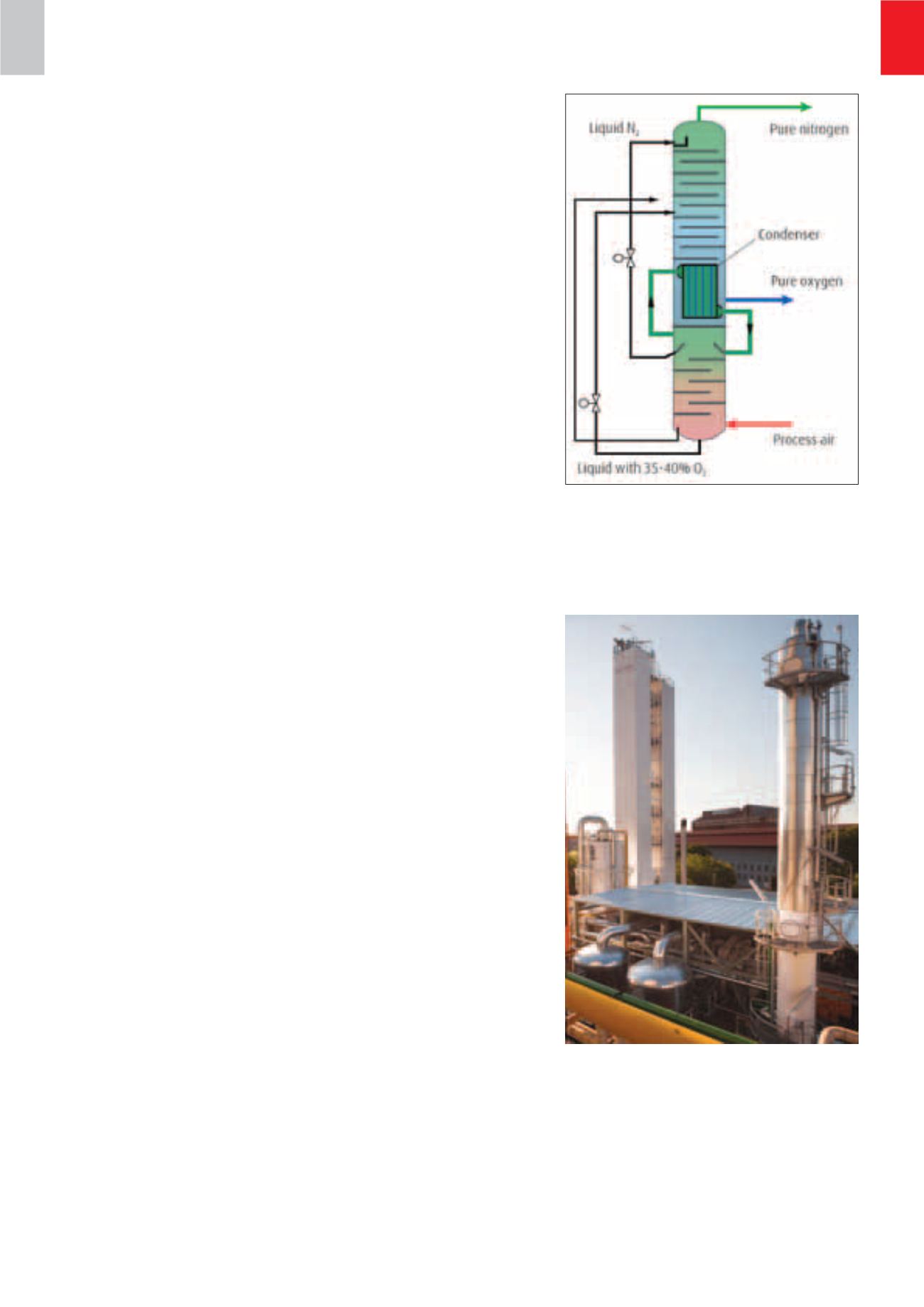
Air separation in ASUs occurs through a process
called rectification. Condensed liquid trickling down
becomes increasingly pure in oxygen and rising gas
becomes increasingly pure in nitrogen. A double-col-
umn rectifier is divided into a high pressure (5,0 bar)
lower section and a lower pressure (0,3 bar) upper
portion by a liquid oxygen heat exchanger.
The new ASU will produce high purity oxygen, nitrogen
and argon to service the industrial and medical mar-
kets in South and sub-Saharan Africa.
mostly in South Africa, we do not intend
to stop there. The R1,5-billion is just
the money that has been committed
so far. We will continue to prioritise
investment destinations across Africa to
better position Afrox for future growth,”
Kimber concludes.
q
⎪
On the cover
⎪


