Mechanical Technology — May 2013
5
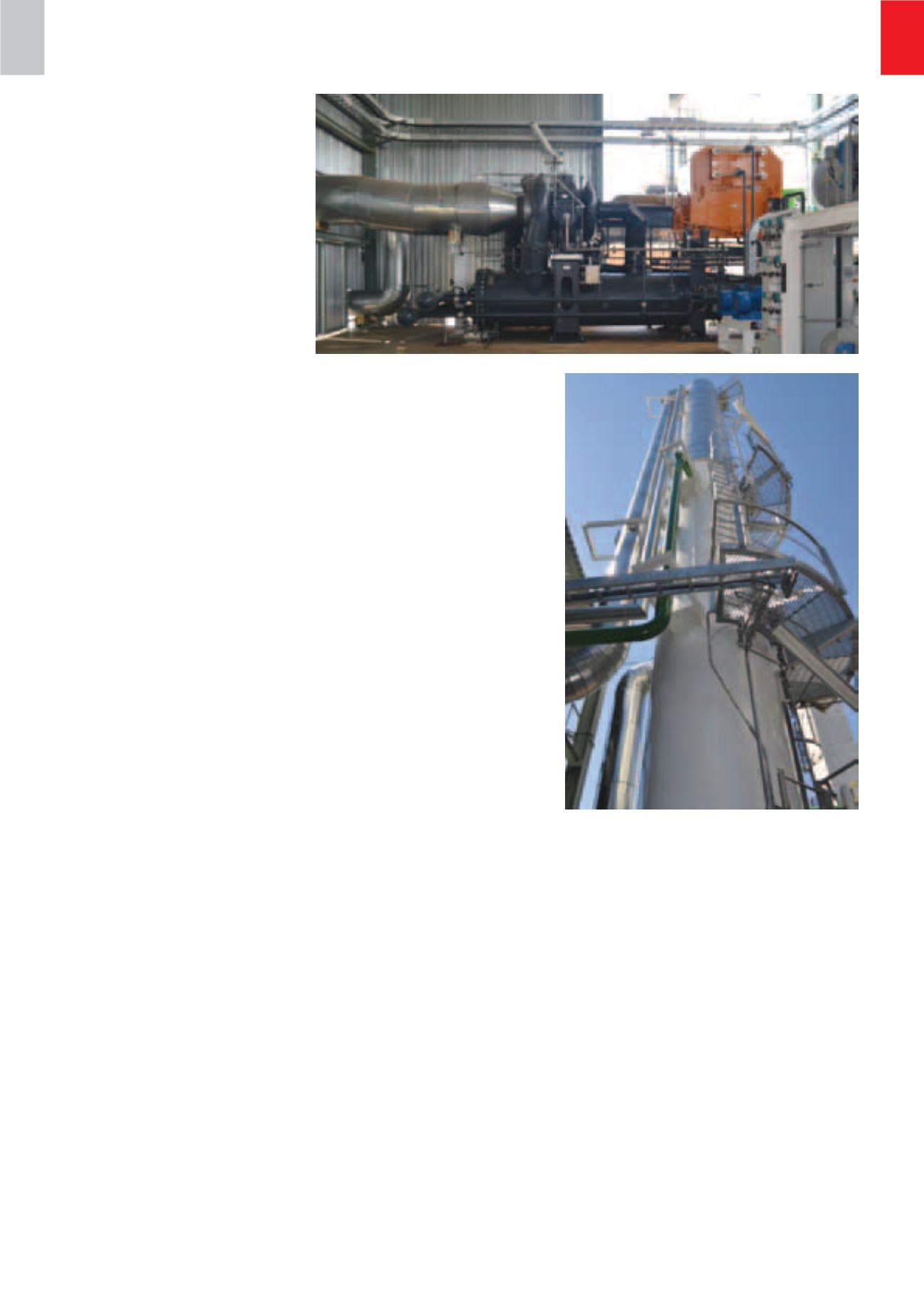
Above:
At the starting point of Afrox’s
new ASU in Pretoria West is a modern
3,0 MW Atlas Copco air compressor.
Right:
The compressed air is passed
through a direct contact air cooling tower,
where moisture is condensed out and the
compressed air is cooled to between 10
and 12°C.
the air, which is a very efficient way of
cooling the air and condensing out the
moisture at the same time,” Mackinnon
informs
MechTech
.
The cool air is further purified by
passing it through a molecular sieve
consisting of three layers. The first
removes any remaining water. Then a
catalytic layer converts hydrocarbons
into CO
2
and water, while the final
molecular sieve traps these. “This is an
exothermic process, so the purified air
comes out of the sieve at about 14°C,”
he adds.
The air is then cooled to cryogenic
temperatures in the main heat exchang-
er against outgoing cryogenic nitrogen
and oxygen. But to achieve optimum
control, the air stream is split into two.
One path passes through the main ex-
changer and directly into the separation
column, while a second stream passes
through an expansion turbine with an
adjustable brake before entering the
column. “The flow through this stream
is carefully controlled to achieve an air
temperature of -175°C at the inlet to
the column,” says Mackinnon.
Air separation in ASUs occurs
through a process called rectification,
commonly known as countercurrent
distillation. Because of the different
condensation temperatures of the dif-
ferent gases (oxygen liquefies at higher
temperatures than nitrogen) along with
the different partial vapour pressures
of each gas in a mixture (nitrogen has
the higher vapour pressure), oxygen
will condense to liquid first, and any
nitrogen in liquid form will evaporate
first. “So when condensation starts, the
liquid develops a higher oxygen concen-
tration. By continuously repeating the
condensing/evaporation cycle, the liquid
becomes increasingly pure in oxygen
and the gas becomes increasingly pure
in nitrogen,” Mackinnon explains.
The main distillation column is split
into two, a low pressure upper section
at 0,3 bar and a high pressure lower
section at 5,0 bar. The liquefaction pro-
cess begins in the high pressure lower
column. A series of interlocking sieve
trays in the column provide condensa-
tion sites for the oxygen-rich liquid. As
a tray fills with liquid, it overflows into
the tray below. At the same time evapo-
ration, of mostly nitrogen, is occurring
and gas is rising up between the trays.
In the bottom of the high pressure lower
section of the column, a liquid consist-
ing of 35-40% oxygen accumulates.
The two sections of the column are
separated by a liquid oxygen bath,
which is used as a heat exchanger. “The
low and high pressure sections enable
the boiling temperatures of oxygen and
nitrogen to be manipulated. The liquid
oxygen in the low pressure liquid bath
has a higher boiling point than the
nitrogen rising in the high pressure col-
umn below. It therefore becomes pos-
sible to use liquid oxygen to condense
nitrogen, which is essential to provide
reflux for the high-pressure column,”
says Mackinnon. The heat exchanged
in condensing the nitrogen also boils
the liquid oxygen from the low pressure
bath to provide gas upflow in the upper
section of the column.
By repeating the counter-current
distillation process at low pressure in
the upper column, high purity oxygen
forms in the centre of that column, while
high purity nitrogen gas accumulates at
the very top of the column.
Argon, which has a condensing
temperature between that of nitrogen
and oxygen, is further processed in
a second column alongside the main
separator. An argon-rich mixture of
oxygen and argon is tapped off from the
upper column into the adjacent argon
column. “To optimise the efficiency
of this ASU, the argon column uses
structured packing instead of trays,”
Mackinnon tells
MechTech
. This was a
significant ASU development that works
similarly to the sieve trays but offers
much better contact between liquid and
vapour, because of the relatively high
surface area of the packing material. In
the argon column, liquid flowing down
becomes increasingly rich in oxygen,
while the ascending vapour product is
high purity argon. And because of the
use of packing instead of trays, there is
a lower pressure drop between the top
and bottom, resulting in lower power
consumption for the separation process.
When asked about other reasons
for the better efficiency of this ASU,
Mackinnon points towards much better
process control: “Traditional plants have
very few monitoring points, but on this
one, we are monitoring every possible
part of the process, so we are much
better able to optimise the performance
and respond to variations. And Linde’s
engineering capability is amazing!” he
exclaims. “Everything they install works
first time and well,” he adds.
⎪
On the cover
⎪


