Mechanical Technology — May 2013
11
⎪
Special report
⎪
The Isigayo mill
The maize milling process starts where dry,
off-the-cob dry maize kernels are placed in a
hopper. The kernels are then carried by a screw
conveyor into a cleaning and conditioning bin,
where foreign material such as husk, straw,
dust, sand, stones, metal, and anything too big,
too small or too light are removed, leaving only
cleaned maize kernels. Water is also added to
allow the husks to be peeled off more easily and
to add some mass to the meal.
The cleaned and conditioned maize kernels
then enter a degerminator where the skins are
peeled off and the husks removed. A set of
opposing mill rolls crack the kernels and the
lighter skins and husks are sucked off, leaving
the maize to drop into a hopper below.
The maize then passes through several fur-
ther milling and sifting processes to achieve the
grind consistency required. The combination of
roller milling and sifting results in a higher qual-
ity product than alternative small scale milling
processes, such has plate or hammer milling.
In the final stage of the process, ground
maize is conveyed back down to ground level
where it is bagged.
The combination of roller milling and
sifting results in a higher quality product
than alternative small scale milling pro-
cesses, such has plate or hammer milling.
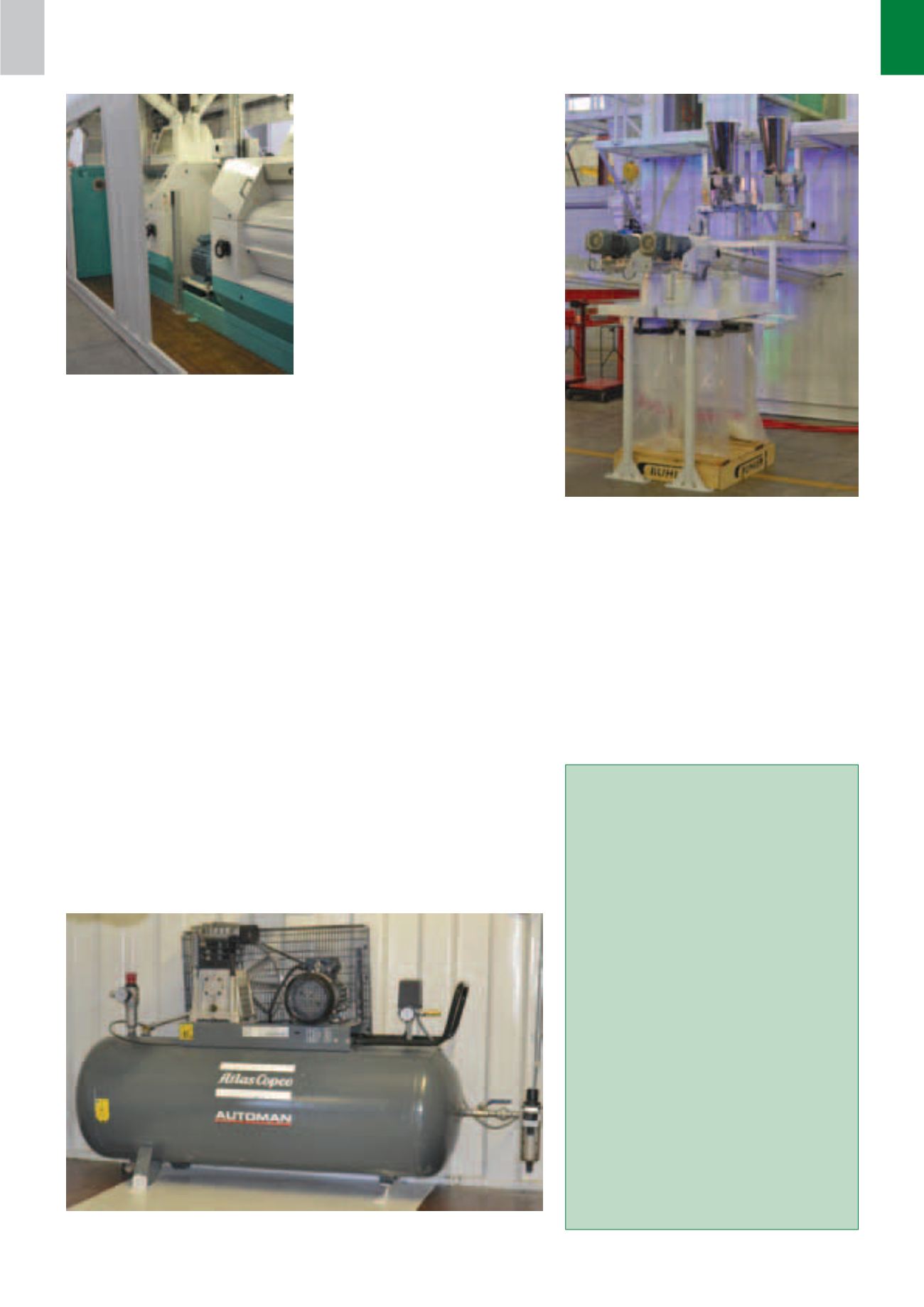
An Atlas Copco compressor supplies air for separating and conveying.
In the final stage of the process, ground maize is con-
veyed back down to ground level where it is bagged.
tion of the Isigayo mills and Homegrown
adds a missing piece of the processing
chain to the farm incubators.
Maize is the most important crop in
South Africa, as it is both the major feed
grain and staple food for the majority
of the population. According to the dti,
since the maize milling industry was
deregulated over 10 years ago, up to
37% of the consumer price of maize-
meal is accounted for by transport and
logistics costs. “Maize is grown in rural
areas and transported to urban and
peri-urban areas for milling before being
transported back to rural consumers,”
says Usiba. “We see the same shops,
the same taxis and the same shopping
malls in towns all over South Africa,
which makes it difficult for local people
to participate in the economy, and the
best way to improve local participation
is to localise the market,” he argues,
“with initiatives like Isigayo that create
local employment and cheaper food.”
Quoting from the dti’s Industrial
Policy Action Plan (IPAP), Usiba says:
“The maize milling sector is highly
concentrated, and domestic prices ap-
pear to be subject to anti-competitive
practices. There is significant potential
for the development of a class of small-
scale millers, which could sustainably
reduce the current high cost of basic
food products. This would contribute to
poverty reduction and would alleviate
pressure on real wages, because lower-
income workers spend a substantial
proportion of their income on basic
food products.”
The Isigayo intervention by small
businesses into the economy will im-
prove competitiveness in this environ-
ment. It will help the maize-meal sector
to be competitive and lead to poverty
alleviation,” he predicts.
The dti, the third party in the Isigayo
collaboration was represented at the
launch by acting deputy director-general
for industrial policy, Garth Strachan,
who said the new Isigayo maize milling
machine will introduce new technology
which will bring new entrants into the
market including small, medium and
micro enterprises (SMMEs).
“South Africa’s foreign direct invest-
ment into manufacturing is robust and
the R5,66-billion 12i Tax Incentive,
designed to support new industrial proj-
ects as well as expansions or upgrades
of existing industrial facilities, has sup-
ported large manufacturing investments
worth R22,5-billion, a large proportion
of which has been in the agroprocessing
sector,” he said.
He added that it was common
knowledge that primary agriculture and
agroprocessing, especially the milling
sector, plays an important role in ad-
dressing poverty, transformation and
rural economy.
The Isigayo is fitted with standard
Bühler equipment, is pre-assembled
in two containers and pre-engineered
as a complete milling plant. There is
very little infrastructure necessary and
the mill is easily transportable and very
easily installed, making it ideal for rural
SME’s.
q


