June 2014
MODERN MINING
39
EQUIPMENT
the machine at Tete very closely. If it proves the
success we expect, we would anticipate seeing
other coal miners taking the plunge and invest-
ing in the machines.”
The surface miner concept will be familiar to
most readers but, to recap, the machines – origi-
nally developed from mobile milling machines
– allow the mining, crushing and loading of
material in one continuous process, providing
a viable alternative to conventional drilling and
blasting in many mining environments. There
are a number of companies worldwide that
produce them but Wirtgen – which produced
its first prototype in 1980 – says it is the clear
market leader in terms of sales.
All surface miners are characterised by a cut-
ting drum fitted with cutting tools. As the miner
moves forward, the cutting drum – at least in
the case of Wirtgen’s machines – rotates against
the direction of travel and cuts material from
the rock formations in individual layers. The
cylindrical cutting drum is centrally located on
Wirtgen’s range. It is fitted with replaceable car-
bide metal tools – or ‘picks’ – and is mounted
close to the centre of gravity.
Wirtgen has several models in its line-up,
with the 2200 SM, which has a 2 200 mm cut-
ting width, an engine output of 708 kW and
an operating weight of just over 49 tonnes,
ranking as the most widely used unit. As men-
tioned, the biggest machine in the range is the
4200 SM, which is offered in versions for soft
and hard rock. The soft-rock version is the one
being delivered to Mozambique.
Designed as a high-performance machine
for mine operators and customers in large-scale
opencast mining whose goal is to achieve a
mining capacity in soft rock of up to 12 mil-
lion tonnes a year with a single machine, the
4200 SM for soft rock has a cutting width of
4 200 mm and is able to work at a maximum
cutting depth of 830 mm without blasting. It is
equipped with a 16-cylinder diesel engine from
Cummins, capable of an output of 1 194 kW –
which allows for tremendous reserve capacity.
A two-stage conveyor system – with
1 800 mm wide primary and discharge con-
veyors and a discharge conveyor length of
12 000 mm or 16 000 mm – supports the min-
er’s impressive cutting performance of up to
3 000 tonnes per hour. The discharge convey-
or’s large slewing angle of 180 degrees, flexible
height adjustment and variable belt speed are
said to ensure smooth loading of large transport
trucks even in space-restricted conditions.
Newby notes that a similar machine to the
one going to Tete has been operational at the lig-
nite mine of North American Coal Corporation
near Ackerman, Mississippi, for several years
and has proved a big success, enabling the mine
– amongst other things – to increase the pay-
load of its trucks from 120 tonnes to 135 tonnes
(because the material is crushed and more com-
pact than would be the case with ore generated
by conventional mining).
He also points out that Wirtgen has recently
developed the WPI (Wirtgen Pick Inspection)
system, which measures the wear of surface
miner cutting tools via eight very rapid mea-
suring sensors integrated into the cutting drum
compartment. This not only cuts the time
needed for pick inspection but also allows the
life of the picks to be maximised. In addition,
the service intervals can be planned more pre-
cisely. The WPI was specifically developed for
use in iron ore mining at FMG’s mines, where
wear rates are very high, and is not considered
necessary in most other applications.
Summing up, Newby says that while surface
miners are not appropriate in every mining
situation, they do have wide applicability
across many mining scenarios. The capital cost
of units is high but this is easily recovered,
given the savings that result from the elimina-
tion of drilling, blasting and primary crushing.
Because blasting is not required, exploitation
of deposits can be safely carried out right up
to property boundaries and noise and dust
generation is vastly reduced. “Surface miners
have obvious benefits. They’re never going to
supplant traditional mining methods but we
nevertheless believe they are destined to play
a much bigger role in our mining industry in
the future. Matched to the right type of deposits
to enable selective mining of seams and sepa-
rating material from the interburden, they are
unbeatable,” he concludes.
Report by Arthur Tassell, photos courtesy of Wirtgen
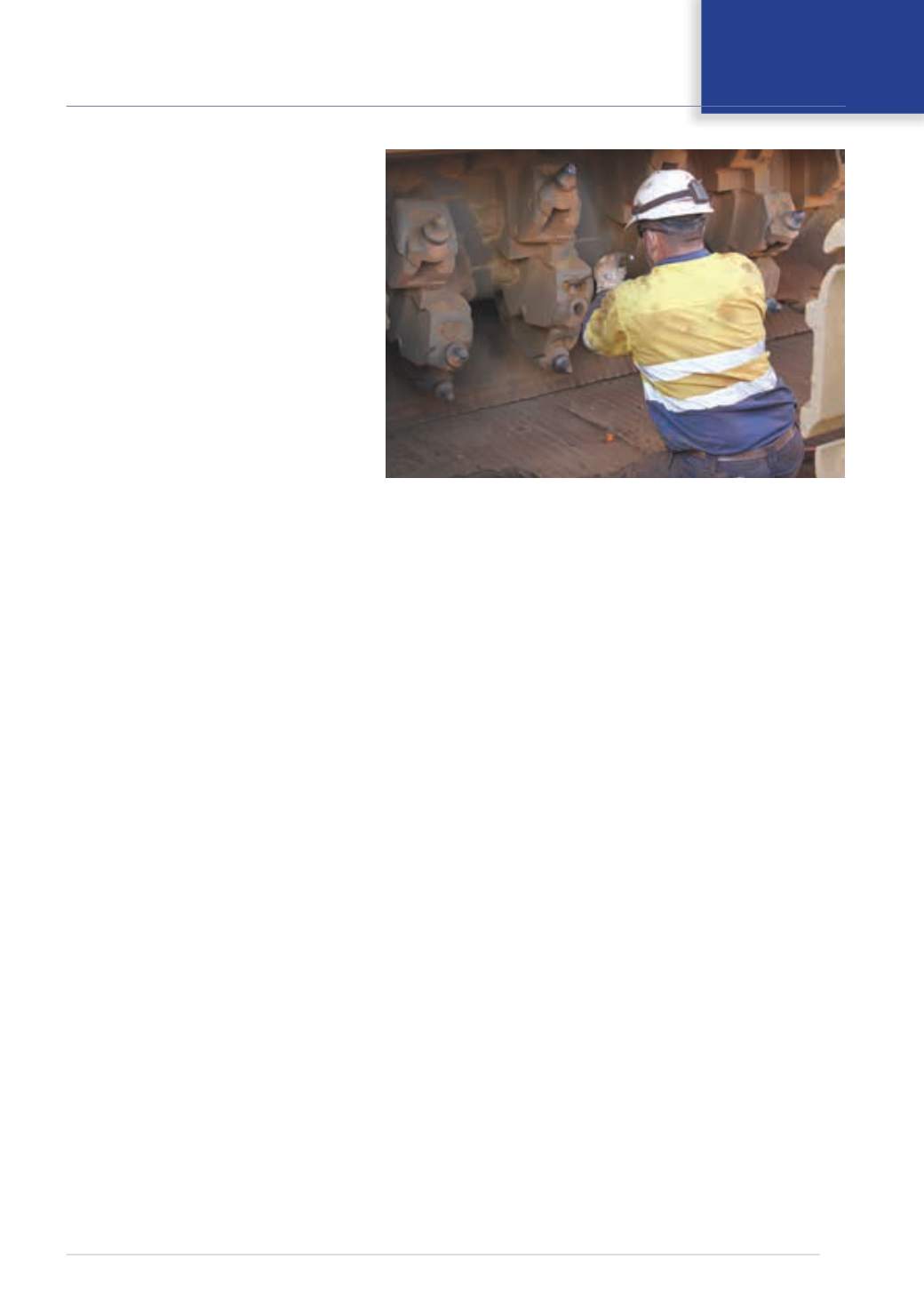
Changing picks on a
Wirtgen surface miner.
“All the coal
producers will
be watching the
performance of
the machine at
Tete very closely.
If it proves the
success we
expect, we would
anticipate seeing
other coal miners
taking the plunge
and investing in
the machines.”
Wirtgen South Africa’s
Mike Newby


