
AIM-listed Andrada Mining, a tin producer with a portfolio of critical minerals mining and exploration assets in Namibia, has announced the initial results of its ore sorting test-work undertaken at the Brandberg West project(BW).
The initial test-work forms part of a multi-phased assessment programme at BW, that includes evaluating the tailings and waste material from the historical mine, and an exploration drilling programme.
Highlights
- Grade uplift: across all nine samples with significant grade increases from the feed to the concentrate because of ore-sorting;
- Tungsten: grade increased from 24% to 1.45% (Sample A5).
- Copper: grade increased from 73% to 2.81% (Sample A7).
- Tin: grade increased from 31% to 2.09% (Sample A8).
- High metal recoveries of tungsten and tin: tungsten recoveries up to 91% and tin recoveries of up to 94%.
- 90% mass reduction: highlighting possible lower capex and accelerated route to production.
- Validation of polymetallic efficiency: the sensor-based (XRT) ore sorting technology, demonstrated the ability to effectively identify and separate multiple target elements simultaneously, confirming the potential to produce a high-value polymetallic concentrate.
Anthony Viljoen, Chief Executive Officer, commented:
“These results represent an important validation milestone in highlighting the economic potential of tungsten as a key critical metal at the Brandberg West project, particularly against a backdrop of exceptionally strong commodity prices. The grades achieved in this test-work on the historically mined waste dumps are significantly higher than the global average for tungsten deposits with corresponding high recovery rates. This outcome reinforces our confidence as we advance toward larger-scale test batches and firmly positions tungsten as a cornerstone critical metal within Andrada’s overall portfolio.”
Overview of results
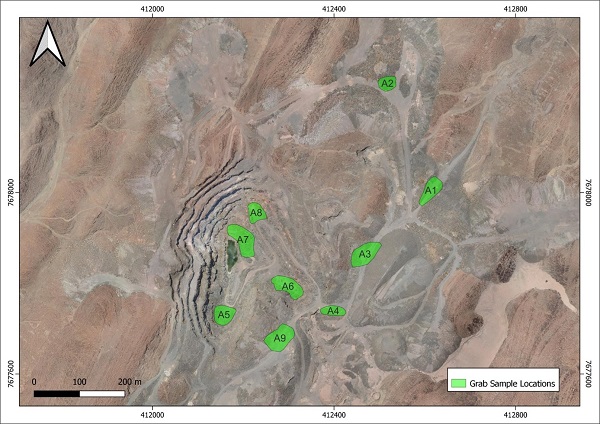
The Brandberg West Mine, located on EL5445, has historically been recognised for its significant tin, tungsten, and copper mineralisation. This initial testing programme focused on nine grab samples (A1 to A9) collected from various locations within the historical mining area. The samples were derived from previously blasted or waste material and, represent the diverse mineralisation styles at BW. The results from these grab samples validate the inclusion of the discard and waste areas in this phase of the Agreement as it may accelerate the production timeline since the material is readily available at surface in large volumes.
Technical Summary
Each of the grab samples weighed approximately 30kg and comprised loose material found at each of the sample locations as shown below in Figure 1. Concentrate and discard streams were analysed at UIS Analytical Services, a certified independent laboratory. A sodium peroxide fusion coupled with ICP-OES analysis was used to determine the element concentrations. Due to the coarse nature of the mineralisation, together with the effects of weathering and inherent variability within surface material, the samples are not representative of the average grade at each location. Although every attempt was made to collect samples to reflect variability across the areas tested, the sample mass was too low for representativity. Bulk testwork has been planned to provide a more representative assessment of the material types.
By utilising XRT sorting at the TOMRA facilities, the Company was able to identify and isolate the mineralised fractions from the waste material with a high degree of precision. The results demonstrate that the mineralisation at Brandberg West is highly amenable to sensor-based sorting technology. The process consistently reduced the total mass by 90%, which could lead to lower transportation and milling costs. Importantly, the grades achieved in this initial programme are comparable to those observed in primary mineralisation within the quartz veins, supporting the potential to extract value from historical waste streams. Furthermore, these initial results have recorded tin and tungsten recoveries above 80% in multiple instances, and where the recoveries are reduced, an upgrade multiple is still achieved. As larger samples are processed, providing greater training datasets, we believe the recoveries will continue to increase and become more consistent.
The testwork is being advanced under the staged earn-in agreement (the Agreement) with ACAM LP’s affiliate BWCAM Limited (BWCAM). Under the Agreement, BWCAM could provide up to USD51 million funding to accelerate the exploration and development of BW polymetallic prospecting licence and up to 49% ownership of the project. The current phase of the Agreement aims to evaluate all the historical discard streams (waste, plant discard and tailings) as well as hard rock material within the existing pit.
