

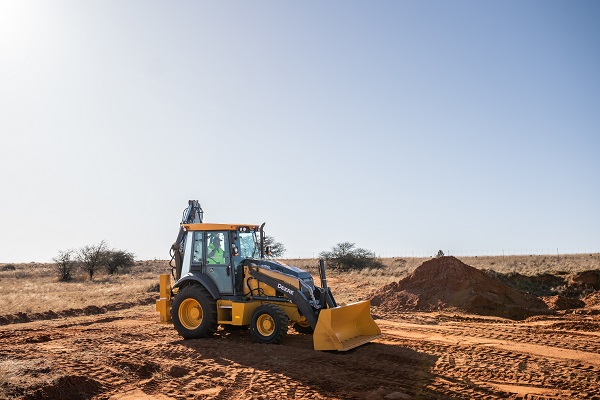
Juanita Pienaar spoke to Evans Morupane - Territory Sales Manager at John Deere Africa Middle-East, to explore how the company’s latest P-Tier backhoe loaders are reshaping operator experience, durability, uptime, and long-term cost efficiency across Southern Africa’s demanding construction and infrastructure environments.
Operator comfort takes centre stage
Across the global construction machinery landscape, operator comfort has steadily grown from a ‘nice-to-have’ to a decisive purchasing factor - particularly as machine utilisation and shift lengths increase. John Deere has responded by embedding comfort into the core design of its latest 310 P-Tier and 315 P-Tier Backhoe Loaders.
“Comfort is key to reducing exhaustion for operators,” explains Morupane. This philosophy runs through both machines, from seating to suspension to ride quality. The 315 P-Tier, for instance, “has an option for a cushion seat to ensure the long hours in the cab are not physically draining.”
Comfort, however, extends beyond seating. Maneuverability and smooth travel are also critical to reducing strain. “With optional ride control activated, front loader hydraulic cylinders act as a shock absorber, smoothing travel over rough terrain, helping full loads reach their destination, and reducing operator fatigue.”
Inside the 315 P-Tier, operators are met with an operator station “loaded with creature comforts including an efficient HVAC system and either an adjustable mechanical or air-suspension seat.” In the 310 P-Tier, the ergonomic considerations are equally well-thought-out, with a “mechanical suspension deluxe fabric swivel seat with a range of lumbar settings, fully adjustable armrests, expansive front window, and more legroom.”
Storage space - often overlooked - is also addressed. “Cabin storage and space on the 315 P-Tier allows operators to store their belongings, giving peace of mind and time to focus on the job.”
Visibility that elevates safety and productivity
Clear visibility remains one of the most direct contributors to onsite safety and operational precision. John Deere has designed its P-Tier models with this in mind.
“The windscreen for both our backhoes starts from the roof of the cab to the floor, allowing the operator’s view from all directions,” Morupane notes. The machines feature standard LED work lighting, including “2 spot- and 8 floodlights” to improve visibility in cloudy, rainy, or night-time conditions.
Even the colour palette is purposeful: “The colour of the bonnet is a charcoal grey, allowing the operator to view where the bonnet ends and the blade starts, which is yellow for clearer visibility.”
Intuitive controls for confident operation
Ease of control plays a major role in operator confidence, productivity, and precision. John Deere’s engineers designed the P-Tier range to be deft and intuitive.
On the 315 P-Tier, the “‘Palm-on-top’ loader-control grip is comfortable and easy to use.” As operators transition across phases of a job, all essential operational functions are close at hand: “Control of clutch disconnect, transmission quick-shift, auxiliary proportional roller, and momentary mechanical front-wheel drive (MFWD) is at your fingertips.”
Both the 310 P-Tier and 315 P-Tier feature the four-speed PowerShift™ transmission, which “provides on-the-go clutchless gear changes, minimising fatigue and maximising productivity.” The true four-wheel-drive system provides exceptional traction, delivering “65% of available power to the tyre with the best traction,” while MFWD can be engaged “‘on the fly’ with the touch of a button.”
This engineering philosophy aligns with John Deere’s broader belief that “ease of operation leads to increased productivity,” and ultimately that “a comfortable machine reduces operator fatigue and makes the operator more alert.”
Designed for reliability in the toughest conditions
Reliability remains one of the strongest expectations among fleet owners, particularly in Africa, where machines often operate in extreme heat, harsh terrain, and remote locations. John Deere’s P-Tier backhoes were built with enduring durability in mind.
Owners of the 315 P-Tier can “trust the John Deere PowerTech 4.5L engine to provide the muscle needed to power through any workday.” Both models use a wet-sleeve engine design, known for its uniform cooling, contamination tolerance, and long-term durability. This design, with “replaceable cylinder liners,” allows easier overhaul work and reduces overall lifecycle cost.
Hydraulic performance has also been engineered with consistency in mind. The long-proven open-center hydraulic system offers “high contamination tolerance, good swing control, smooth multifunctioning, and dependable operator feel.”
Equally robust is the drivetrain. The optional MFWD axle is “fully sealed (no external breathers),” significantly reducing the risk of dirt or water ingress - a common failure point on African jobsites.
Durability is also embedded structurally, with “heavy-duty cylinders, reinforced frames and chassis, and robust linkage points,” along with attachments designed with “reinforced cutting edges, improved hinge profiles, and clamshell dumping designs.”
Built for fast, simple maintenance
Serviceability is a cornerstone of reliability, and John Deere made it a priority from the earliest design stages.
“Daily checks made easy,” Morupane says. “Same-side ground-level service points speed daily checks and fluid fills” while “simple-to-read sight gauges and easy-access grease zerks help increase uptime and contain operating costs.”
Key filters, including the “vertical spin-on engine, transmission, and hydraulic filters,” are easy to reach, enabling quick changes without climbing, crawling, or removing panels. This ground-level layout “reduces the downtime of servicing machines” and makes routine maintenance practical even on remote sites.
A straightforward fuel and hydraulic pump system is another advantage: “Our proven high-performance systems, such as robust mechanical fuel and hydraulic gear pumps, help get your machine back to work without leaving the jobsite or dragging into downtime.”
Testing grounded in real-world conditions
John Deere validates the reliability and endurance of its backhoe loaders through a development process that is heavily guided by customer insights. “These machines are designed and built in state-of-the-art factories, but their real test begins once development is complete,”explains Morupane. He continues: “Before any model is released to market, it is sent to selected customers who operate the machines in genuine, day-to-day working conditions. This allows us to see how the equipment performs under real pressures - heat, dust, soil types, long working hours, and varied applications.”
The feedback from these customers is critical. They help identify what works, what needs refining, and what adjustments will make the machine better suited to the environments in which it will operate. This testing phase is deliberately extensive, ensuring that every backhoe loader is shaped not just by engineering standards, but by the expectations and realities of the customers who will ultimately rely on it. The result is a machine that carries both John Deere’s engineering stamp and the approval of the operators who put it through its toughest trials.
Reduced total cost of ownership by design
Lowering total cost of ownership (TCO) is an engineering priority for John Deere, starting with durability but extending to maintenance, simplicity, and versatility.
The wet-sleeve engine design, for example, contributes to lower overhaul costs and longer service life. Meanwhile, the hydraulic system’s tolerance for contamination reduces the likelihood of breakdowns in dusty settings.
Versatility also plays a major role in reducing TCO: “One machine does many jobs,” allowing customers to reduce fleet size, maintenance requirements, and overall capital investment.
Fuel efficiency is supported by smooth PowerShift™ transmissions and engines designed for consistent power delivery at lower RPMs - a critical benefit in regions where fuel is a major operational expense.
Aftersales support strengthened by digital connectivity
A strong dealer network, regional parts distribution, and advanced digital connectivity anchor John Deere’s aftersales ecosystem in Africa and the Middle East.
“Our dealer network stretches across Africa and the Middle East, offering customers multiple touchpoints for service, parts, and technical assistance. Dealers continue expanding into new towns to stay closer to their customers, ensuring faster reaction times and reliable support wherever John Deere machines operate,” Morupane says.
Digitally, all machines now come standard with JDLink™, offering subscription-free telematics: “Analyse critical machine data, track utilisation, review diagnostic alerts, and more from the John Deere Operations Center.”
Dealers have access to John Deere Connected Support, where they can “remotely monitor machine health, diagnose problems, and even update machine software without a trip to the jobsite.”
This level of proactive support helps avoid failures before they occur, maximising uptime for fleet owners.
Comfort, control, and consistency
Southern African operators have responded positively to the P-Tier range. Many spend long hours “working in tight spaces, moving between job phases, and dealing with uneven terrain,” which increases fatigue. This makes comfort, visibility, and reduced vibration essential.
Side-shift functionality on the 315 P-Tier has been a standout, enabling operators to “slide the entire backhoe boom left or right without having to move the machine itself,” significantly reducing downtime and increasing precision on constrained sites.
Ride control is another favourite. “It makes travel between points quicker, calmer, and more stable - a difference operators immediately feel.”
What operators prioritise today
Asked about trends in operator and fleet owner priorities, Morupane summarises them simply: “Safety, ease of operation, and good visibility.”
Fuel efficiency is another major focus because it “is directly linked to productivity.” While some markets prioritise advanced electronics, Southern African customers value machines that deliver comfort, visibility, reliability, and uptime as their core strengths.
Evolving with the market
John Deere remains committed to ongoing development, driven by real user feedback and the evolving needs of the African construction sector.
“We continue to track our customers and their feedback closely for prospect machines as the industry requires,” Morupane says. A growing presence across the region gives the brand “a clear view of the real conditions our machines operate in,” helping ensure new generations of backhoes continue to meet - and exceed - the expectations of the market.