



Juanita Pienaar spoke with Chantelle Scheepers, Marketing Manager at OST-Africa (Oscillating Systems Technology Africa), about the company’s VISAM vibration systems, the trends shaping the industry, and how the right vibration technology can improve performance across a wide range of industrial applications.
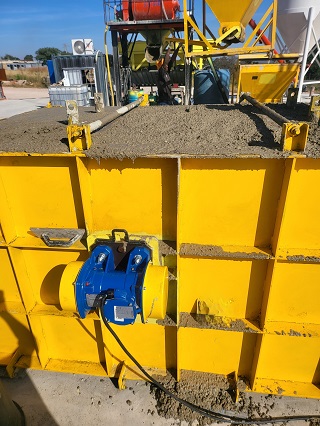 Built for demanding industrial environments
According to Scheepers, one of the key differentiators of OST-Africa’s VISAM vibration systems is the combination of product quality, reliability, and local technical support.
“What makes our VISAM systems stand out is the reliability, quality, and technical support behind the product,” she explains. “The VISAM vibrator motors are imported from Italy and are built for heavy-duty industrial applications.”
The systems are designed to operate in demanding environments where consistent vibration performance is essential to maintaining production quality and throughput. While the hardware itself forms an important part of the solution, Scheepers says the company’s approach to customer support is equally significant.
“We also focus strongly on helping customers choose the correct motor and setup for their specific application, which improves performance and avoids unnecessary costs,” she says. “Our customers appreciate that the systems are durable, easy to maintain, and backed by local support from OST-Africa.”
The technology is currently being used across several industries, particularly in sectors where vibration is essential to material movement, compaction, and processing efficiency.
“The technology is widely used across the precast concrete, mining, construction, materials handling, and processing industries,” says Scheepers. “We also supply into sectors like food processing, recycling, and general manufacturing where vibration technology plays an important role in improving production efficiency.”
Improving quality and production efficiency
Within the precast concrete industry, vibration systems are particularly important in achieving product consistency and reducing defects during production. “The vibration systems help achieve better compaction and a more consistent concrete finish,” Scheepers explains. “This reduces air pockets and improves the overall quality of the final product.”
Beyond quality improvements, the systems can also contribute directly to increased productivity. Scheepers notes that several customers have experienced significant operational gains after implementing the technology.
“In many cases, customers also see faster production cycles and less downtime,” she says. “One of our customers in the precast industry more than doubled their production output after switching to our system because of the improved reliability and efficiency.”
As manufacturers continue to invest in automated production environments, vibration systems are increasingly being integrated into larger automated processes and production lines.
“The systems can be integrated into automated production processes depending on the customer’s requirements,” says Scheepers. “They work well with automated moulding and production lines and can also be used with variable speed drives for better control.”
This integration helps manufacturers improve consistency while reducing the need for manual intervention.
“This improves consistency, reduces manual intervention and helps operations run more smoothly and efficiently,” she adds.
Addressing operational challenges
Production downtime, inconsistent vibration, and equipment failures remain some of the most common operational challenges across the industries OST-Africa serves. Scheepers says the company’s systems are specifically designed to minimise these issues through reliable performance and application-specific support.
“Some of the biggest challenges are equipment failures, inconsistent vibration, poor concrete finishes, and production downtime,” she explains. “Our systems are designed for reliability and continuous operation, which helps reduce maintenance and breakdowns.”
A key part of that process involves ensuring customers use the correct vibrator motor and configuration for their operating conditions and production requirements.
“We also work closely with customers to ensure the correct vibrator motor is selected for the application, which improves performance and extends equipment life,” says Scheepers.
The company also recognises that no two operations are identical. As a result, customisation forms an important part of its offering.
“The systems are highly customisable,” Scheepers explains. “Different motor sizes, force outputs, mounting options, and configurations are available depending on the plant setup and production requirements.”
This flexibility allows customers to adapt the systems to their specific production processes rather than relying on a one-size-fits-all solution.
“We understand that every operation is different, so we work with customers to provide solutions that suit their specific process and production goals,” she says.
Supporting efficiency and long-term performance
Energy efficiency and resource optimisation are becoming increasingly important priorities across industrial operations. Scheepers says vibration efficiency plays an important role in helping customers improve productivity while reducing unnecessary waste and maintenance costs.
“By improving vibration efficiency and reducing downtime, the systems help customers optimise production without increasing resources unnecessarily,” she says. “Better compaction also reduces waste and rework.”
The motors are also designed for durability and long service life, contributing to lower maintenance demands over time.
“The motors are designed for efficient performance and long service life, which lowers maintenance costs and improves overall operational efficiency,” Scheepers adds.
Looking ahead, Scheepers says the broader industry is continuing to shift towards smarter, more automated production environments with greater emphasis on uptime and reliability.
“We are seeing a strong move towards more automation, improved energy efficiency and systems that require less maintenance,” she says. “Customers are also looking for higher production output with better consistency and quality.”
For OST-Africa, ongoing support remains central to maintaining long-term customer relationships and operational performance.
“After-sales support is very important to us,” Scheepers says. “We assist customers with technical support, product selection, troubleshooting and ongoing advice when needed.”
The company also maintains local stock availability to help customers minimise downtime when equipment or replacement components are required.
“We also keep stock locally and work closely with customers to minimise downtime and ensure they get long-term value from the equipment,” she says.
Ultimately, Scheepers believes the company’s role extends beyond simply supplying equipment.
“I think it is important for readers to understand that we do not only supply vibration equipment - we provide complete support and practical solutions for our customers’ operations,” she concludes. “Our focus is on building long-term relationships and helping customers improve efficiency, reliability, and production performance with the right vibration technology for their application.”