


Juanita Pienaar spoke with George Jolly, National Sales Manager and Rental Fleet Manager (Domestic and International) at Werner South Africa Pumps & Equipment about the company’s locally manufactured solutions, the growing demand for efficient wastewater management, and how innovation is helping municipalities and industry reduce operating costs.
Local manufacturing gains momentum
As industries across Southern Africa place increasing emphasis on operational efficiency, reliability, and reduced downtime, locally manufactured equipment is becoming more attractive than ever. For Werner South Africa Pumps & Equipment, this trend is creating significant opportunities across multiple sectors.
The company operates as an original equipment manufacturer (OEM), designing and manufacturing a range of specialised industrial equipment for demanding applications. According to Jolly, a wide range of solutions.
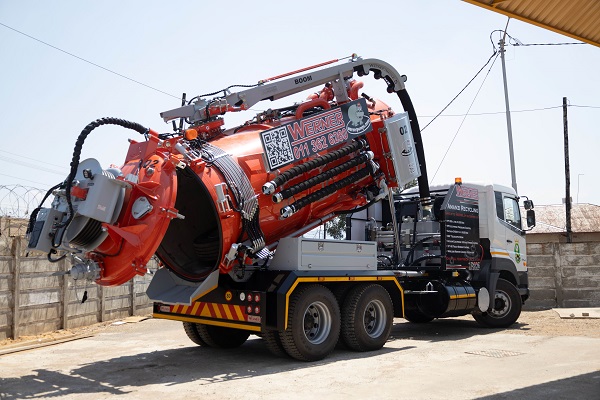
“We design, manufacture, and supply industrial vacuum trucks (Super Suckers), recycling combination vac jet trucks, industrial high-pressure cleaning machines up to 2 800 bar, and hydro jetting machines for drain management solutions,” explains Jolly.
Werner Pumps serves a diverse customer base. The sectors Werner Pumps serve continue to face increasing pressure to improve service delivery while simultaneously reducing operational expenditure and maintenance costs.
Water-saving technology takes centre stage
Among Werner Pumps’ current offerings, the company’s recycling combination vac jet truck has become one of its most significant products.
According to Jolly, municipalities and water parastatals are under increasing pressure to improve service delivery, particularly around sewer, wastewater treatment, and stormwater infrastructure. This is driving strong demand for efficient hydro jetting and drain management solutions.
“There is a big drive for municipalities and water parastatals to invest in service delivery due to the lack thereof,” says Jolly. “This means sewer and wastewater treatment plant and stormwater management is going to be top of the list for municipalities.”
The recycling functionality of the company’s combination vac jet trucks is proving especially valuable in water-constrained environments. By recycling water during operation, municipalities can significantly reduce water consumption and operating costs.
“With Werner’s recycling trucks, we are changing the game for municipalities by saving water and overall costs to operate,” Jolly adds.
The focus on water efficiency comes at a critical time for municipalities facing ageing wastewater infrastructure and water constraints.
Trends shaping the market
Jolly believes several major trends are currently influencing the local pump and vacuum equipment market. Chief among these is the growing preference for locally manufactured products that can match the quality of imported European equipment while offering improved availability and support.
“Locally manufactured pumps, with the same high quality as European products, are becoming increasingly important,” he says.
Hydro excavation using vacuum trucks is another rapidly growing area, particularly as contractors and municipalities seek safer and more efficient methods of excavation around underground infrastructure.
Additional trends include hydraulically driven systems and increased adoption of recycling technologies that improve sustainability and operational efficiency.
Experience and support remain key differentiators
While product innovation remains important, Jolly emphasises that experience, reliability, and aftersales support continue to be critical differentiators within the sector.
Werner’s products are fully designed and manufactured locally, allowing the company to maintain close control over quality standards while also responding more rapidly to customer requirements.
“100% locally designed and manufactured, high-quality manufactured components and equipment, flexible maintenance options, 38 years of experience, and a highly experienced team within the vacuum and high-pressure industry” are among the company’s key strengths, says Jolly.
“After sales and support maintenance is very important,” he explains. “Downtime on clients’ machines costs money and reputation.”
To address this, the company offers flexible maintenance solutions tailored to different customer requirements, ranging from small contractors to large mining operations.
“With our flexible maintenance options, we can cater for the small contractor to large mining companies with onsite maintenance programmes,” says Jolly.
Investing in local capability
Werner has also continued investing in its own manufacturing capabilities in order to strengthen local production and reduce reliance on imported components.
A recent addition to the company’s production facility is a new five-axis CNC machine.
“With our new five-axis CNC machine, we can locally manufacture certain components and pumps in-house that would ultimately have been imported,” says Jolly.
The investment improves control over pricing, lead times, and quality.
“We can control our overall price and quality of components,” he adds.
As supply chain disruptions and currency volatility continue to affect imported equipment costs, local manufacturing investments such as these are becoming increasingly valuable for both OEMs and customers alike.
Expanding footprint in Namibia
The company’s growing presence in Namibia serves as a recent example of successful regional expansion.
Following the successful deployment of Werner’s first combination truck in the Namibian market, municipalities in Walvis Bay and Swakopmund have continued investing in the company’s equipment.
The success of the initial deployment has helped establish a growing installed base in the country.
“The success of our first combi truck into the Namibian market has now led to over six Werner units in total being operated in Swakopmund and Walvis Bay,” he concludes.
As municipalities and industry place greater pressure on cost savings, service delivery, and operational efficiency, Jolly believes locally manufactured technologies will continue gaining traction across Southern Africa. With investments in in-house manufacturing capability, water-saving technologies, and aftermarket support, Werner is positioning itself not only as an equipment supplier but as a long-term infrastructure partner for the region’s critical industries.