


To remain competitive in today’s challenging economic environment, equipment owners are looking beyond the basics. They are looking at how their fleets of mini-excavators, skid steers, backhoe loaders, among other tool carriers, can squeeze more margins and volumes, and a strong attachment focus is gaining momentum. Attachments are key to equipment versatility and utilisation.
A key factor in succeeding with any fleet of equipment, especially compact, is getting the most out of your machines. Whether you have a mixture of mini-excavators, skid steer loaders, telehandlers or TLBs, implementing various tools and attachments can expand your assets from one-dimensional pieces of equipment into multipurpose and adaptable machines.
For many years, attachments have always been designed to enhance equipment fleets. While that likely won’t change, advancing technology means that today’s compact machine operators are benefitting from innovations that are taking accuracy, efficiency and attachment management to a whole new level. The advent of smart attachments is one of the key developments in that regard. Caterpillar and Bobcat are some of the leading names in that space.
Smart attachments
What is a smart attachment? Tharen Peterson, product application specialist at Caterpillar, explains that there are three criteria that make a Cat attachment smart. First, attachment recognition – when the attachment is hooked up to the D3 series skid steer loader or compact track loader, the machine recognises the attachment.
“Second, the machine unlocks additional screens in the advanced display. And third, a second control mode is unlocked. The D3 series skid steer or compact track loader then allows for machine control mode or attachment control mode,” he says.
Daniele Paciotti, product line manager Attachments at Bobcat EMEA, says there isn’t a single industry agreed definition of the “smart attachment” concept, but it can be described in several ways. Firstly, through the recognition of the machine/attachment combination to ensure the safest features and best performance.
“Secondly, the automation of the machine/attachment set-up to save time and to guarantee the best accuracy and efficiency. And, thirdly, remote control of the machine/attachment to provide increased safety and comfort when operating the machine,” he says.
Paciotti says grading/levelling is one of the most important applications to benefit from the use of smart attachments, while road milling is another application where this kind of smart system is needed.
Peterson says Caterpillar first investigates how the technology can be beneficial to its customers and then applies it to those applications where there is a benefit to the customer. He, however, agrees that one of the leading applications for smart attachments in the compact construction equipment space has been grading.
Why grading? The critical importance of maintaining proper grade specs, coupled with the complexity of the machine controls, necessitates for continued innovation in tools that are used for this application. How best an operator can work a grader or grading attachment remains at the core of today’s product offerings. The smart grader attachment is thus centred on easing operation as grading has traditionally been regarded as one of the most difficult applications to execute, often calling for specialised final level skills.
Bobcat’s offering
Almost all Advanced Bobcat Attachments are designed with the ACD (Attachment Control Device) system so that they can be automatically recognised by Bobcat loaders and other carriers. This kind of ‘recognition’ system, explains Paciotti, communicates through a Can-Bus to automatically set up the joystick controls and the output flow to get the best attachment performance.
“Another type of smart attachment is the integrated 2D laser or 3D GNSS/UTS system for use with our grader attachments, which allows the operator to carry out the minimum to get a job done with the maximum precision and in the quickest time, using automation,” he says, adding that these systems enable operators to create perfect surfaces, while reducing fuel and labour costs.
Another example of a smart attachment, he adds, is Bobcat’s Radio Remote Control; the system, which was launched last year, is said to be unique because it is a 100% plug & play product which is applicable to all Bobcat compact loaders with selectable joystick controls from 2007 models onwards. This hand-held system provides operators with the same control of machines but from a distance of their choosing (up to 500 m away).
“On top of that, it is completely interchangeable; for example, in less than a minute the operator can restore the machine to its original state or move the system from machine A to machine B,” adds Paciotti.
Caterpillar expands range
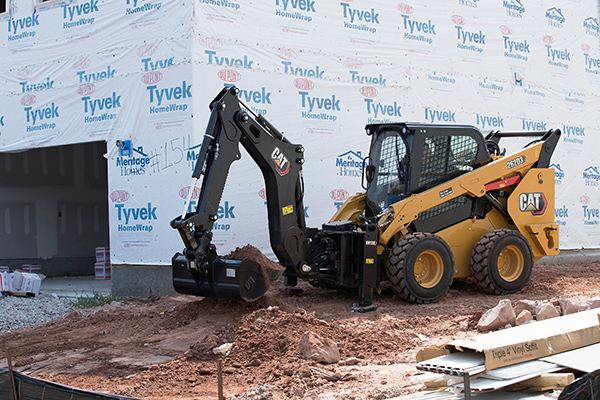
Caterpillar has recently launched three smart attachments to the market: the smart 6-way dozer blade, the BH130 smart backhoe attachment and a smart grader blade attachment. The smart backhoe and the smart dozer, says Peterson, take two attachments that have been in the skid steer loader and compact track loader segment for a long time and update them for modern usage.
“With the BH130, the engineers built off the previous Cat offering of backhoe attachment that was already advanced. With this attachment, the operator remains inside the structure of the D3 Series skid steer loader or compact track loader. However, now there is no longer a swing in control arm,” he says.
The controls are performed with the joysticks in the machine. The operator selects ‘attachment control mode’ and the machine locks down and the joysticks now control the backhoe attachment just like a mini excavator or backhoe loader. The pattern is also selectable, so based on operator preference, either backhoe pattern or excavator pattern may be selected.
The Cat BH130 smart backhoe attachment is designed for Cat D3 Series skid steer loaders, compact track loaders and multi terrain loaders. The new attachment significantly increases the versatility of these small machines, allowing them to take on a range of tasks, including utility trenching, digging footing and forming and maintaining drainage ditches.
In addition, the backhoe is compatible with Cat 3-t excavator attachments, and its auxiliary-hydraulic system allows pairing with hydro-mechanical work tools, including hammers, thumbs, augers and vibratory compactors. The backhoe also hydraulically shifts side-to-side to allow digging adjacent to buildings and footers, and integrated stabilisers provide a solid digging platform.
For the smart dozer, again, the engineers took an existing attachment and made it more user-friendly, says Peterson. Like the BH130, there is attachment control mode. The left joystick still operates the drive functions.
“Now, however, the right joystick becomes more like a full-size dozer control. No more multi-button presses to get the blade to move. Everything is done with the right joystick. In addition, there are operator assist features for the main fall (forward and backwards) as well as the blade slope. The display also provides indication to the operator for main fall, machine side slope as well as blade slope,” he says, adding that the smart dozer is compatible with the 279D3 HF XPS, 289D3 HF XPS, 299D3 HF XPS and 299D3 XE machines.
The new Cat GB120 and GB124 smart grader blade attachments are available for Cat D3- Series skid steer loaders and compact track loaders. As with the smart dozer blade attachment, the D3 host machine recognises the grader blade and unlocks special display screens that provide options for attachment control, allowing the joysticks to be repurposed to perform attachment functions.
Selecting the attachment-control mode allows the right joystick to operate blade functions – tilt (moving the joystick side-to-side), angle (rotating the thumb wheel forward or rearward), and lift (moving the joystick fore and aft). In the advanced display, the home screen shows the cross-slope of the blade, as well as the blade angle.
The ASSIST feature allows selecting either the Cross Slope Right pattern or Cross Slope Left pattern and maintains the cross-slope setting, independent of the machine’s operating angle. If the Cross Slope Right pattern is selected, the forward/backward movement of the right joystick controls the right side of the blade by raising and lowering the attachment’s right lift cylinder.
“The machine/attachment will control the left side of the blade to maintain the desired cross-slope, allowing the operator to focus on the right side of the blade. Cross Slope Left pattern reverses this setting,” explains Peterson.
Also, as the blade is angled and geometry changes, the attachment calculates and maintains the cross-slope setting. It even maintains the desired cross-slope angle when you rotate the blade to windrow the material. The special display screens of the smart grader blade provides the operator with feedback about the orientation of the attachment, displaying blade slope, as well as blade angle.
Key benefits
The basic benefits of smart attachments, says Peterson, are improved operator interface and functionality, as well as feedback to the operator in grading applications. All of this ultimately can lead to improved efficiency as well as improvement in material usage. Thus, time and material improvements can lead to lower input costs for the customer.
“At Caterpillar we will continue to listen to the needs of our customers and strive to offer solutions that provide an increased benefit to their businesses,” says Peterson.
Paciotti says high performance, better efficiency (productivity, lower fuel consumption) and increased comfort and safety are some of the key benefits of Bobcat’s smart attachment technology.
As technology continues apace, Paciotti highlights some of the innovations we will likely see in the near future. “Some of the future technologies that are coming in in the next few years – all of which depend on the extra capabilities these technologies will bring – include remote control by mobile (for example, Bobcat’s MAX Control concept system); recognition systems for the full range of Bobcat attachments and carriers; telematics on attachments; autonomous machine systems; obstacle avoidance systems; and electrical attachment systems, among others,” concludes Paciotti.