


As mines, quarries and aggregate producers face rising costs, tighter margins, skills shortages and increasing pressure to improve safety and reduce their environmental impact, mobility is emerging as one of the most effective levers to improve operational resilience.
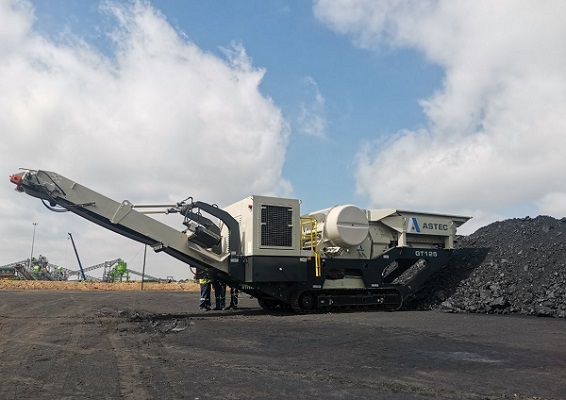
According to leading global manufacturer Astec Industries, equipment like the Astec GT205 mobile screen, GT125 mobile jaw crusher, the newly introduced FT2650 mobile jaw crusher, FT200 OC track cone crusher and GT165 scalper are increasingly sought after by astute operations recognising the benefits that they offer in terms of flexibility, lower operation costs and improved safety compared to traditional, fixed installations.
Astec Industries product sales manager Philip Saunders expands on the advantages: “By allowing material to be processed directly at the extraction point, mobile units eliminate the need for extensive haulage, significantly reducing fuel consumption, labour and maintenance expenses. Mobile equipment typically has a lower upfront cost compared to building a fixed, stationary crushing plant. Productivity is increased and overall operational efficiency boosted by eliminating the downtime associated with waiting for haul trucks. Mobile equipment boasts resale value and can be easily relocated to new projects, holding higher residual value.”
Saunders states that when it comes to operational flexibility and efficiency, mobile equipment delivers. “Because mobile plants, crushers and screens can be moved to the material, they are ideal for operators managing multiple, smaller or remote sites. They offer rapid deployment. Mobile plants typically offer significantly faster setup times than stationary alternatives - a matter of minutes and hours upon arrival of the units on site, rather than weeks and months, enabling quicker, immediate revenue generation.
Safety and environmental benefits
“By reducing haul truck traffic on-site, mobile equipment directly lowers the risk of accidents. It also benefits the environment. Since the transport requirements are lower, carbon emissions, noise and dust are reduced. It is also simpler to add, remove, or upgrade mobile units to change the process or increase capacity compared to modifying a stationary plant.”
Astec mobile incline screen plants have an array of features for maximum screening efficiency and production. “They are engineered to provide higher production capacities and more efficient sizing than comparable screens,” Saunders explains. “Our mobile plants combine heavy-duty screens with industry-leading conveyor heights. A large range of media provides flexibility for a variety of applications.”
The GT205 is a 5’ x 20’, track-mounted plant featuring a conventional screen on the top deck and high-frequency screen on the bottom deck. The unique combination of high frequency and conventional screens in one self-contained unit puts more energy into the screening process, creating a powerful machine capable of increasing capacity by up to 50 percent on the bottom deck.
The GT205’s large screen box enables the production of high volumes of material when producing straightforward products such as G5. But, with the three-deck four-product conveyor setup, there is an element of finesse available when coupled with the height and angle adjustable screen box, Saunders explains. “This functionality allows the quarry to maximise high quality low yield products such as 7 and 10mm surfacing stone.”
The three-deck mobile unit is fitted with a 5 x 20 screen and a Caterpillar C4.4 129 HP Tier III diesel engine. The screen’s gradation control allows for reclaiming fines in both wet and dry applications. Plant capacity is rated at up to 600 tph, depending on application and material conditions. With some units achieving in excess of 800TPH with modifications and upgrades for special applications.
Mobile jaw is equally effective for aggregate and recycling applications
Astec’s mobile jaw plants are engineered for maximum jaw crushing mobility and production efficiency. Featuring heavy-duty Vanguard and Pioneer-series jaw technology, these plants are designed to deliver up to 25 percent more capacity than comparable competitive models, depending on application and configuration.
Astec’s GT125 mobile jaw crusher is equally effective in aggregate and recycling applications. This crusher is making its mark around the world, in applications that include producing and recycling aggregate. The GT125’s large, dynamically balanced, heavy-duty flywheels produce up to 33 percent more inertia than competitive models, leading to a reduced cost per ton over the lifetime of the machine. The crusher’s large, 32mm stroke processes more material than competitive models, increasing production and reducing operating costs. A simple manual folding head section on the discharge conveyor reduces the footprint of the machine, reducing shipping costs.
Astec has also recently introduced the larger FT2650 mobile jaw plant into its local South African offering, expanding its tracked jaw range for higher-capacity applications. The FT2650 incorporates a 50" × 26" (1 270 mm × 660 mm) Vanguard jaw crusher. Designed for contractors and producers requiring greater primary throughput, the FT2650 integrates hydraulic CSS adjustment, a robust tracked chassis and real-time monitoring systems to support consistent high-volume production in demanding quarry and mining environments.
The Astec FT200 OC track cone crusher incorporates a Kodiak K200+ cone with a high-efficiency roller bearing design, delivering improved mechanical efficiency and reduced operating costs. The unit features remote closed-side setting adjustment, interchangeable chamber configurations and a low-impact tramp relief system that protects the crusher from overload events. A variable-speed hydraulic drive and automated feed regulation support consistent product quality and throughput, while precision balancing and protected internal counterweights enhance long-term reliability.
The rugged, exceptionally portable Astec GT165 scalping screen offers ideal gradation control for recycled, crushed stone, demolition and topsoil applications. This track-mounted screen was designed as a tool for overburden, to scalp ahead or behind a primary crusher, as well as screen a wide array of materials, from aggregates to recycle to organic materials.
“While mobile equipment is generally ideal for short-to-medium-term projects or to augment large, long-term, fixed operations, its portability, lower labour requirements and ability to keep up with an advancing site make it a critical tool for modern, efficient and profitable operations,” Saunders concludes.