


Juanita Pienaar spoke with Gert Agenbag, Product Planning & Marketing Senior Manager at Hino South Africa; Alwyn Engelbrecht, Sales Engineer at Volvo Trucks South Africa; and representatives from Daimler Truck Southern Africa, including Olaf Petersen, Vice President: Sales & Marketing, and Ziyad Gaba, Vice President: Customer Service, Parts and Value Chain, to unpack how modern tipper solutions are engineered to deliver performance, durability and a lower total cost of ownership in South Africa’s toughest construction, mining and quarrying environments.
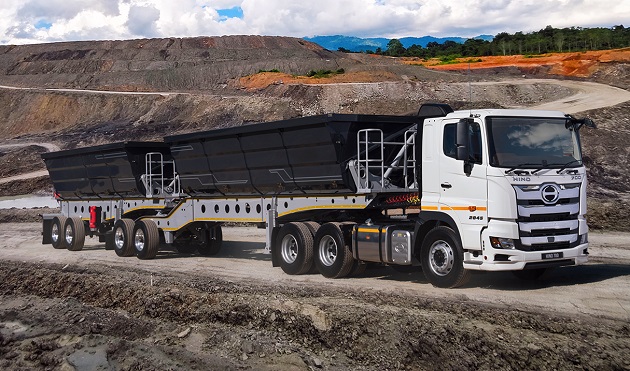
Tippers under pressure
In construction, mining, and quarrying, few assets work harder than a tipper truck. Long hours, abrasive dust, extreme temperatures, and unforgiving terrain place constant strain on vehicles and operators alike. In this environment, buying decisions are no longer driven by purchase price alone. Fleet owners are scrutinising total cost of ownership (TCO) more closely than ever, weighing fuel efficiency, uptime, durability, resale value, and aftersales support alongside outright performance.
Across the board, manufacturers are responding with highly specialised tipper offerings designed specifically for local conditions. From heavy-duty drivetrains and advanced traction systems to predictive maintenance and nationwide support networks, today’s tippers are engineered to “earn their keep” over long, demanding lifecycles.
Matching the tool to the job
Hino South Africa takes a purpose-built approach, offering four dedicated tipper models across the 10 m³, 5 m³, and 3 m³ segments. At the top end, the Hino 700 2841 AMT 6x4 serves as the flagship heavy-duty tipper, powered by a 13-litre engine paired with a 16-speed ZF automated manual transmission. The drivetrain is reinforced with inter-axle differential locks and cross locks on both rear axles, delivering the traction and stability required on challenging terrain.
According to Agenbag, the focus is firmly on durability and real-world operating efficiency. Each model is “engineered to Hino’s exacting quality standards and specifically designed to perform in the demanding and often harsh operating conditions of the South African market”.
Volvo Trucks South Africa, meanwhile, positions its construction range firmly around application-specific flexibility. As Engelbrecht explains, “In an industry as tough and demanding as construction, there are no one-size-fits-all tools. Trucks are no exception. Whether it’s higher horsepower, payload, traction control, better manoeuvrability, or lower CO₂ emissions, ultimately it comes down to finding the right tool for the job.”
Within Volvo’s portfolio, the FH and FMX ranges are central to tipper applications in construction, mining, and quarrying, available in both on-road and off-road configurations depending on the territory and duty cycle. Volvo also offers battery-electric trucks for the construction industry in South Africa, responding to growing demand for “vehicles with lower noise levels and zero exhaust emissions at and around urban construction sites”.
Daimler Truck Southern Africa (DTSA) completes the picture with a comprehensive lineup that includes the Mercedes-Benz Arocs 3336K/36, 3236B/51, and 4152K/51 for heavy-duty work, complemented by FUSO FJ26 variants for medium-duty tipping. As Petersen notes, these models are “engineered for heavy-duty performance and durability in demanding environments”, ensuring coverage across a broad range of construction, mining and quarrying applications.
Built for harsh local conditions
South African operating conditions are unforgiving, and manufacturers are acutely aware that reliability is non-negotiable. From a Daimler Truck perspective, the emphasis is on rugged, practical engineering. DTSA’s tipper models are built on heavy-duty chassis and equipped with drum brakes for reliable stopping power in demanding environments. Stabiliser bars reduce body roll, hub reduction axles enhance traction and load-carrying ability, and differential locks improve control on slippery or uneven terrain. Dust-proof air filtration systems protect engines from fine particles, while protective grilles shield vulnerable components from stone impacts and branches.
Volvo echoes this focus on durability. Engelbrecht points out that construction trucks often face “heavy loads over rough terrain and muddy, unpaved roads”, while also needing to “operate around the clock” and manoeuvre safely in confined, high-risk environments.
The Volvo FMX exemplifies this philosophy. It is built with a robust drivetrain, increased ground clearance, reinforced axles and suspension, and a heavy-duty exterior designed to absorb punishment. “An iconic heavy-duty bumper, made from 3 mm high-grade steel, [is] there to shield the truck’s front from dents and broken headlights in any terrain,” says Engelbrecht. Axle capacities are equally impressive, with the front axle rated up to 10 tonnes and the bogie up to 38 tonnes.
Performance that translates into productivity
Power, torque, and payload optimisation are central to productivity in tipper applications, but manufacturers are increasingly focused on how these elements interact with fuel efficiency and driveline longevity.
At DTSA, the flagship Mercedes-Benz Arocs 4152K/51 stands out for its advanced powertrain technologies. Petersen highlights its High Performance Engine Brake for improved braking performance on steep gradients, while Turbocompound technology “boosts engine efficiency and output, resulting in better fuel economy and enhanced productivity”.
Volvo’s approach remains centred on extracting maximum value from every litre of fuel. “All our models are designed with power, torque, fuel efficiency, and payload optimisation in mind,” Engelbrecht says. “Our solutions are to offer the best value to our customers, even in tipper applications.”
Hino’s strategy balances outright capability with low running costs. The Hino 500 1627 Tip MT, for example, has earned a strong reputation locally for “exceptional build quality, durability, and low running costs”, making it a preferred choice where uptime and TCO are critical decision factors.
Technology that keeps trucks moving
Modern tipper operations rely heavily on technology to maximise uptime and reduce operator fatigue. Hino equips all its tipper models with Hino Connect as standard, providing fleet managers with detailed insights into fuel consumption, operating time, distance, and real-time diagnostics. This data-driven approach supports proactive maintenance and performance optimisation across diverse operating environments.
Volvo’s I-Shift transmission plays a central role in productivity under demanding conditions. Engelbrecht explains that it “helps operators get the best power and efficiency out of the truck’s powertrain”, with optional crawler gears and heavy-duty software for extreme operations. Volvo Dynamic Steering further enhances control and comfort by filtering out bumps and reducing physical strain on the driver.
DTSA complements mechanical robustness with digital intelligence. Mercedes-Benz PowerShift 3 delivers smooth, precise gear changes, while standardised Fleet Management System interfaces and Mercedes-Benz Uptime enable predictive maintenance and early fault detection, reducing unplanned downtime.
Lowering the total cost of ownership
Across all three manufacturers, TCO is a unifying theme. Hino reinforces its value proposition through custom-designed service plans and, from 2025 onwards, a standard six-year drivetrain warranty across all vehicles, providing customers with long-term cost certainty.
Volvo Connected Services lower total cost of ownership by using real-time vehicle data to run trucks smarter and longer. Telematics and remote diagnostics let fleets cut fuel use, reduce idling, and improve driving behaviour, while predictive maintenance prevents breakdowns and optimises service intervals. The result is higher uptime, fewer workshop visits, and a lower cost per kilometre over the truck’s life.
From a DTSA perspective, residual value plays a significant role. “One of the most significant contributions to customers is the high resale value of our trucks, driven by the strong brand reputation and durable build quality,” Petersen notes, translating into improved lifecycle returns.
Aftersales support where it counts
In sectors where downtime can bring entire operations to a halt, aftersales support is critical. DTSA’s support strategy is led by its Customer Service, Parts, and Value Chain division. As Gaba explains, the company offers 24/7 roadside assistance through its Service24H programme, supported by strategically positioned dealers, mobile service units, and a sophisticated Dealer National Inventory system to ensure rapid parts availability and reduced downtime.
Volvo Trucks operates an extensive national network of accredited workshops, staffed by Volvo-trained technicians and supported by genuine parts backed by a two-year fitted parts warranty. “From proactive service planning to round-the-clock roadside assistance, Volvo Trucks helps you reduce downtime, cut admin, and stay in control,” Engelbrecht says.
Hino’s aftersales footprint includes 66 dealerships nationwide, daily parts delivery to Hino and Toyota dealers, and dedicated mobile service units that provide on-site assistance. This combination ensures “rapid turnaround times and dependable vehicle uptime – keeping businesses productive and vehicles on the road”.
The next phase for tipper solutions
While diesel remains dominant, sustainability is increasingly shaping procurement decisions. Engelbrecht notes that “one of the biggest challenges facing the construction industry is the need to reduce carbon emissions and transition to Euro 5 or Euro 6 diesel drivelines”, with alternative fuels and electric solutions gaining traction, particularly in urban environments.
DTSA is seeing similar trends, with customers prioritising payload efficiency, safety compliance, telematics and sustainability through the lens of total cost of ownership. As Gerber succinctly puts it, “DTSA doesn’t just sell trucks – we deliver complete solutions that keep Africa moving.”
Hino, meanwhile, continues to focus on proven, purpose-built tipper solutions that prioritise durability, low running costs, and dependable uptime. With a dedicated local tipper range, nationwide dealer support, and the introduction of a standard six-year drivetrain warranty from 2025, Hino positions itself as a pragmatic, value-driven choice for operators working in demanding South African conditions.
In a market defined by hard work and harder conditions, modern tipper solutions are about far more than moving material. They are strategic assets, engineered to deliver productivity, resilience, and long-term value, load after load.