

Capital Equipment News’ Juanita Pienaar spoke with Wesley Cloete, Managing Director of Cloete’s Sand and Stone, about operating in one of South Africa’s most demanding sectors and why Scania has become a key partner in maintaining uptime, efficiency, and resilience across the company’s fleet.
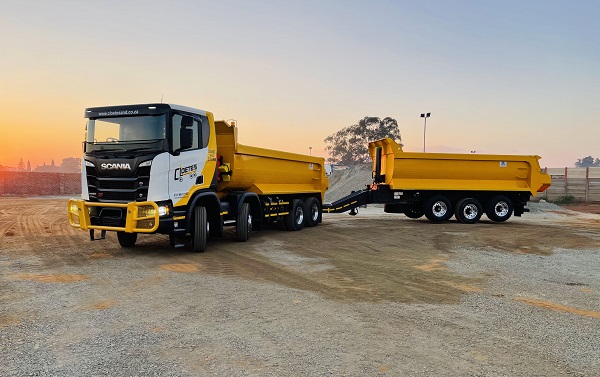
Scania supports Cloete’s Sand and Stone in a high-pressure materials market
Operating in the construction materials sector has never been easy, but in recent years, the pressure has intensified. Rising costs, tight margins, ageing infrastructure, and ongoing market uncertainty have forced operators to reassess how they run their fleets and where they place their trust. For Cloete’s Sand and Stone, uptime, reliability, and aftersales support have become non-negotiable - and this is where Scania has carved out a distinct role in the business.
Based in Gauteng with a second operation in the Western Cape, Cloete’s Sand and Stone supplies aggregates and materials to construction projects across its respective regions. The company operates a fleet of 82 trucks, of which 21 are Scania vehicles, deployed across demanding site conditions where downtime quickly translates into lost revenue.
“There’s definitely been pressure on the construction industry over the last few years,” says Cloete. “If you’re running older fleets, your uptime is not where it needs to be. Guys end up having to run maybe a 25% bigger fleet than they actually need, simply because vehicles are down so often. For us, uptime is everything.”
Aftermarket service that keeps trucks moving
While vehicle specification and fuel efficiency play an important role, Cloete is clear that Scania’s aftermarket support is the cornerstone of the relationship.
“One of the biggest things for us is reducing running costs, and that’s been achieved through fuel efficiency and uptime,” he explains. “But where Scania really stands out is their aftersales service. If we report a breakdown to their Scania Assistance team central control room, they are the quickest of all the OEMs we work with to get that vehicle back on the road.”
He points to a recent incident that left a lasting impression.
“We had a vehicle with a clutch failure and an engine mounting failure - not a small job by any means. We reported it around midday, and because Scania had the parts on hand, they worked through the night. That vehicle was released back to us at seven o’clock the next morning. That’s unheard of.”
According to Cloete, Scania’s approach to parts availability and responsiveness reflects a deeper commitment to customer uptime.
“They really take customers’ uptime seriously. If they don’t have a part, they’ll fly it in or even cannibalise another unit to get you running again. That mindset makes a huge difference in our industry.”
Comfort, fatigue, and driver preference
Beyond mechanical performance, Cloete highlights another advantage that directly affects productivity: driver comfort.
“The comfort level in a Scania is notable,” he says. “Fatigue is a big issue in our industry. We work long hours, and if a driver is more comfortable, he fatigues less, makes fewer mistakes, and causes less damage to the vehicle.”
He adds that the preference among drivers is unmistakable.
“There’s a fight to drive the Scania vehicles. Everyone wants to be in them.”
Cloete attributes this to a combination of suspension design, ergonomics, and drivetrain technology.
“The cab has air suspension, the seat is on air, and the way the gearbox software operates is incredibly smooth. It feels like an automatic, even though it’s a manual gearbox controlled by the computer. The driver doesn’t have to focus on gear changes - he can just focus on the road.”
So pronounced is the difference that Cloete notices it personally. “Even when I jump from a Scania into my private car, my car feels hard compared to the truck. It’s actually crazy.”
Specifying the right truck for the job
Cloete’s Sand and Stone operates in varied environments, from urban construction sites to quarry operations, and matching the right vehicle to the task is a constant process of refinement.
“We don’t want to put ourselves in a box,” Cloete explains. “We’re constantly trying different specifications - different horsepower ratings, different configurations - to see where we can improve fuel efficiency or extend engine life.”
Scania’s willingness to tailor-make each customers vehicles plays a significant role here.
“They’re willing to sit down with you and tailor-make a solution. You can specify exactly what you need, and they’ll work with you to try different variants. Some combinations work better than others, but they’re always willing to engage and assist.”
This collaborative approach, Cloete says, sets Scania apart. “They’re not just deciding in isolation what the market needs. They engage with multiple customers, gather feedback, and then apply that insight when developing or specifying equipment. That partnership approach is impressive.”
Balancing durability with rapid support
While Cloete is candid about areas where improvement is possible, he believes Scania’s strengths outweigh any shortcomings.
“There are certain items where we think durability could be better compared to some other OEMs,” he notes. “But they make up for it with their aftermarket service. If something does fail, they fix it faster than anyone else, and it doesn’t cost us extra.”
In a high-volume materials handling environment, that balance is critical. “Ultimately, a truck standing still costs you money. Fast turnaround times keep us operational, and that’s what matters most.”
Strong resale value and financial flexibility
From an asset management perspective, Cloete sees long-term value in Scania vehicles.
“Scania holds its value exceptionally well. We know that after five or six years, the vehicle will still retain a strong percentage of its original value, and that benefits our bottom line.”
This resale value feeds directly into fleet renewal cycles, allowing Cloete’s Sand and Stone to reinvest strategically while maintaining cash flow.
Scania’s finance offering further supports this flexibility. “The process is easy, professional, and transparent. They’ve actually given us a larger facility than we currently need, which means we can scale quickly if the market demands it.”
A partnership built on understanding
Looking ahead, Cloete believes Scania’s role as a partner, rather than simply a supplier, will remain central to the business.
“They understand our requirements, they listen, and they adapt their offering accordingly. That’s what partnership means to us.”
His advice to other operators is straightforward: “Take the time to sit down with the Scania team. Explain your operation properly and let them propose solutions. Don’t just ask for a specific model - allow them to add value.”
In an industry where uptime defines success and resilience determines survival, Cloete’s Sand and Stone’s experience underscores the importance of choosing partners who understand the realities on the ground - and are willing to work through them, day and night.