


By: The Southern African Association of Freight Forwarders (SAAFF)
The launch of the Container User Forum (CUF) in March this year is more than a formality. It represents an industry drawing a line in the sand. And no one frames the urgency of this moment more powerfully than Prof. Jan Havenga, whose 10-minute presentation — delivered with characteristic bluntness — has laid bare both the scale of South Africa's logistics crisis and the roadmap to reversing it.
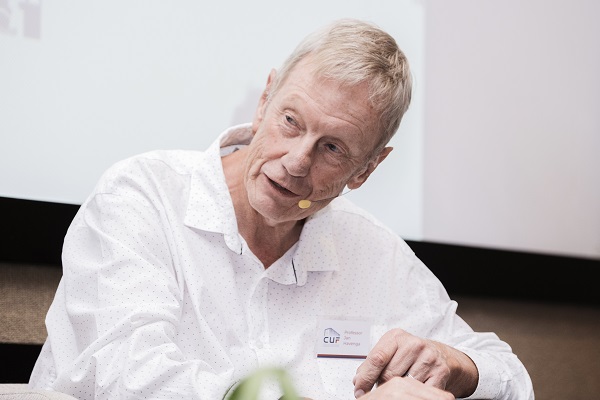
“The forum aims to provide a structured platform through which container industry stakeholders can coordinate operational improvements, infrastructure planning and policy engagement”.
Havenga’s presentation opens with a sobering anchor: logistics costs in South Africa consume more than 50% of the value of the country's physical economy - the roughly 800 million tons of goods that physically move through the economy every year. On average, more than half of all commodities’ value disappears into logistics. "This thing doesn't work," he says simply. It was not rhetorical flourish. It was data.
The rail catastrophe no one is fixing fast enough
The centrepiece of Havenga's argument is the state of general freight on rail.
While bulk commodity lines - manganese in particular - have shown recovery, general freight rail volumes continued to decline in 2025 despite the significant work of the National Logistics Crisis Committee and the arrival of new Transnet leadership.
The recovery, where it exists, is sluggish and concentrated entirely in bulk. Containers are not moving.
This matters enormously because of a target that hangs over the entire sector: Minister of Transport Barbara Creecy's goal of 250 million tons on rail by 2029. Havenga was unambiguous — roughly half of what is still missing to reach that target will have to come from containers, or it will not come at all. "Dear minister," he said in effect, "we need to solve this problem on containers.
This is the platform on which this is going to be solved, or you minister are going to miss your target." This is not a political provocation. It is arithmetic.
The spatial problem and the freight village solution
Havenga has spent over two decades building the intellectual case for what he calls spatial logistics planning — organising freight movement around hubs, freight villages and consolidation centres rather than letting the country's awkward geography dictate ever-rising costs.
South Africa's economic heartland sits 600 kilometres from its primary port. That distance is not going away, but its cost can be dramatically reduced through intelligent intermodal infrastructure. Havenga pointed to the missing railway that his team identified 15 years ago — the DC-to-DC corridor connecting manufacturer to retailer via rail — and noted, with dry humour, that he is still using the same slide because the solution still hasn't been built.
His prescription is surgical and specific: rebuild the general freight rail network, develop freight villages along key corridors, and plan for the domestic intermodal container market — a segment he argues is double the size of the international container market and almost entirely untapped.
He referenced India's first two freight villages – as conceived and proposed by the World Bank - now under construction in Varanasi and Kolkata as proof of concept and pointed to the Durban-Gauteng Corridor as the obvious priority: a single quarter of South Africa's total national logistics cost sits on that one route.
The regional hub imperative
Looking further ahead, Prof. Havenga's vision is audacious but grounded: South Africa must become a regional container hub or risk being bypassed entirely. Ultra-large container vessels now carry more than 24,000 TEUs – with Durban’s capabilities terminating at the 13,500 TEU capacity mark. Shipping lines can only route these ULCV’s to accommodating ports, with Durban missing the cut and only Ngqura making it.
The North-South Corridor is being replaced by East-West trade flows. Dar es Salaam is expanding at a pace, while the Nacala-Lobito and Maputo-Walvis Bay corridors are already preferred routes. South Africa predicted these shifts 15 years ago. As a result, both South Africa and Durban largely stood by as it materialised. This puts South Africa and Durban at risk. SADC needs East/West Corridors. South Africa must now decisively redefine Durban’s role or risk being sidelined.
Besides targeting Ngqura, the solution is to reconfigure Durban substantially to handle these vessels, use it as the sub-Saharan redistribution hub – as it already currently handles 22 per cent of all sub-Saharan boxes - and develop extended gate infrastructure including new inland dry ports near Johannesburg to effectively expand port capacity without building into the sea.
The Cost of Inaction
Havenga calculated what South Africa wastes annually through poor last-mile and long-haul logistics planning: R100 billion. That is not a projection of potential gain. It is a measure of current, ongoing loss — money that leaves the economy every year because freight moves inefficiently, containers sit idle, and roads carry freight that should be on trains.
The CUF, he argued, can help close what he called the "integrative gap" — the space between knowing what needs to be done and actually coordinating the actors required to do it. The bulk industry cracked this code through the Richards Bay Coal Terminal and the Iron Ore Users Forum. The container sector has lacked an equivalent body. Until now.
Havenga closed his presentation with three imperatives: rebuild the rail network, develop a national spatial plan for freight villages, and implement collaborative container fleet planning. These are not abstract policy wishes. They are actionable, sequenced, and supported by two decades of modelling.
“The CUF therefore represents more than a new industry body. It is an attempt to provide the institutional coordination required to translate well-understood logistics solutions into execution,” according to SAAFF.