

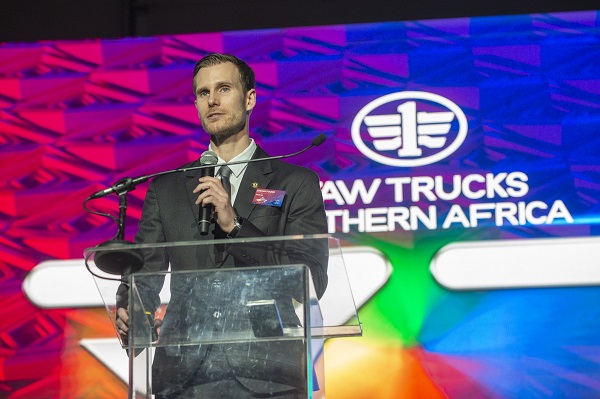
Juanita Pienaar spoke with Joshua Fourie, General Manager: Commercial Operations; Ricqui Alexander, National Service Manager at FAW Trucks South Africa; and Chunming Jian, Sales and Marketing General Manager at FAW Trucks SA, at the recent launch of the FAW J7.
A market under pressure
South Africa’s transport sector is operating under sustained pressure, with rising costs, constrained infrastructure, and ongoing global volatility shaping fleet decisions. Against this backdrop, FAW Trucks South Africa has introduced its flagship J7 model - a move the company positions not simply as a product launch, but as a strategic response to evolving market demands.
Reflecting on the broader operating environment, Fourie noted that the industry has had to absorb multiple shocks in recent years. “South Africa has seen the impacts of COVID, shortages in terms of diesel, and border and port congestion,” he said. “All of these things have obviously impacted on the cost of transport.”
These pressures are clearly reflected in the numbers. “Over the last 10 years, transport CPI has increased 60%,” Fourie added, highlighting the difficulty transporters face in passing these costs on to customers.
This reality has shifted focus sharply towards total cost of ownership (TCO), where both capital and operational efficiencies are critical. “On the capital costs, it really comes down to how much truck are you getting for every rand you invest in,” he explained. “On the variable cost side, it’s about fuel consumption, driver performance, and how that impacts your business ecosystem.”
A premium positioning for the J7
Within this context, the J7 enters the market as FAW’s premium offering, sitting above the established JH6 range. “The J7 will not be replacing our JH6 range,” Fourie clarified. “The JH6 has been a wildly successful product, selling over 5 420 units within the last three years alone.”
Instead, the J7 is designed to complement the existing line-up. “The J7 comes in as a premium offering - when nothing but the best will suffice,” he said.
Developed through collaboration between China and Europe, and manufactured in a dedicated facility, the J7 represents a significant step forward for the brand. “Ultimately, this vehicle is positioned to be the premium offering for transporters in South Africa,” Fourie noted.
Importantly, FAW is taking a measured approach to market entry. “We want to scale at a steady pace to make sure that the parts holding within the network and the development within the customer base happen over a period of time,” he said. Initial targets sit at around 500 units within the first year.
Driving down total cost of ownership
A central pillar of the J7’s value proposition is its potential to significantly reduce TCO. According to Fourie, the numbers are compelling.
“At a retail level, the potential savings are sitting around R750 000 per unit over the life of that unit,” he said. “When you scale this within a large fleet, the average saving moves from R750 000 to R7,5-million.”
Engineering for reliability and efficiency
From a technical perspective, the J7 has been engineered with a strong emphasis on reliability, efficiency, and durability - key considerations for operators running increasingly long asset lifecycles.
Alexander highlighted the extensive testing programme behind the vehicle. “The product was tested across 200 units, accumulating 18 million kilometres worth of testing,” he said. This included a 20 000 km route from China to Italy, covering “99,9% of global operating scenarios”.
The result is a truck designed for longevity. “The J7, if maintained correctly and maintenance practices are adhered to, achieves a peak end service life of 1,5 million kilometres,” Alexander explained.
Efficiency has been addressed through what FAW terms its “golden powertrain”. “We have achieved up to 10% fuel savings compared to previous models and competitors,” he said. The drivetrain combines an in-house engine with a ZF Traxon gearbox and FAW-developed differential, delivering high transmission efficiencies and improved performance.
Range is another standout feature. “With a 1 200-litre tank, we have achieved 3 000 km ranges on our test units,” Alexander noted.
Comfort, safety, and driver performance
Recognising the growing importance of driver wellbeing, FAW has also prioritised comfort and ergonomics.
“Comfort no longer is considered a luxury; it’s considered a necessity,” Alexander said. “If you have a comfortable driver, you have a good driver.”
The J7 features a spacious cab, advanced noise suppression, and modern in-cab amenities, including a 10-inch display, refrigeration, and enhanced storage. Noise levels have been reduced to “54.4 decibels at idle and 63.2 decibels at 80 km/h”.
Safety is equally comprehensive. The vehicle includes adaptive cruise control, automatic emergency braking, lane departure warning, and forward collision warning as standard. “The vehicle complies with collision regulations to make sure that in the event of an accident, the occupants will be safe,” Alexander said.
Built for African conditions
Durability, particularly in harsh operating environments, has been a key focus area. Coastal corrosion, in particular, has been addressed through enhanced material treatments and testing.
“Plans have been made, and tests have been done to ensure that they will stand up to 10 years of corrosive resistance,” Alexander explained, referencing extensive salt spray testing and thicker protective coatings.
This focus is echoed in FAW’s broader development approach. “The requirement was identified both globally and locally,” Alexander added. “The result is aimed at enhanced long-term durability and improved lifecycle value for customers.”
Strengthening aftersales support
A premium product requires equally robust support, and FAW has invested heavily in its aftersales infrastructure.
“We have a 24-hour in-house call centre linked to a live breakdown platform,” Fourie said. The company also maintains over R200 million in parts inventory at its Isando distribution centre, with additional regional hubs.
The dealer network - now 40 strong across the SADC region - has undergone significant upgrades. “We’ve done upgrades over the last five years extensively within our dealer network,” Fourie noted.
Parts availability for the J7 has been carefully planned. “Stock holding is scaled proportionately in line with the growing number of J7 trucks on the road,” Alexander explained. “Each dealership is required to maintain a predetermined level of stock, and this is actively monitored.”
Digital integration and fleet intelligence
Telematics and data-driven fleet management form another key component of the J7 ecosystem. Zhang outlined FAW’s OEM telematics platform, which connects millions of vehicles globally.
“We serve over 200 000 vehicles and process 220GB of daily data,” she said.
The system addresses key fleet pain points, including safety, cost control, and visibility. “Drive behaviour analysis helps you move from gut feeling to data-driven,” Zhang explained. Features include driver scoring, remote diagnostics, video monitoring, and fuel management.
In high-risk environments, technology also plays a role in asset protection. “We can limit speed or reduce torque to help protect your assets,” she said, noting that local partnerships for recovery services are part of future plans.
Financing for resilience
Recognising the importance of cash flow, FAW Financial Services has introduced tailored financing solutions for the J7.
“In times like this, it is crucial to keep your cash flow steady,” said Liu Xiao, CEO of FAW Financial Services SA. “Cash is king.”
The company’s balloon payment structure reduces monthly instalments significantly. “Your monthly payment is as low as R41 000 - 34% lower compared with traditional products,” she explained.
Flexibility is built into the model, allowing customers to refinance, settle, or trade in at the end of the term. “No rigid rules - we adapt to your business needs,” Liu said.
A strategic step forward
Ultimately, the J7 represents more than just a new model - it signals FAW’s intent to compete at the top end of the market while maintaining its value-driven DNA.
“The J7 will offer significant value to our transporters,” Alexander concluded. “We know that they’re stretching their assets, and we believe our J7 is what it takes to do that.”
The J7’s combination of efficiency, durability, and support may prove to be a decisive advantage.