

South Africa’s transport industry is operating in an increasingly demanding environment. Rising operating costs, tighter margins, infrastructure pressures, and growing customer expectations are forcing fleet operators to look beyond traditional measures of performance.
And according to discussions at a recent Scania Southern Africa roundtable and assembly plant tour in Johannesburg, the future of transport efficiency may have less to do with individual vehicle specifications and more to do with how entire systems work together to improve operational performance over time.
While the event introduced the Scania Super powertrain platform, the central discussion extended far beyond the product itself. The broader focus was on what efficiency actually means in a modern transport operation and how incremental engineering improvements can translate into substantial long-term business value.
One of the recurring themes throughout the session was that transport efficiency can no longer be measured purely through fuel consumption figures alone.
Instead, operators are increasingly evaluating total transport economy: fuel usage, payload optimisation, vehicle weight, uptime, service intervals, driver consistency, component durability, and operational flexibility all form part of the equation.
As Scania representatives explained during the tour, modern commercial vehicles are evolving into highly integrated systems where multiple small efficiencies compound into larger operational gains.
This is particularly important in a market where fuel can account for between 45% and 55% of operating costs.
At fleet scale, even marginal savings become commercially meaningful.
According to Scania’s team, improvements in drivetrain efficiency, gearbox optimisation, internal engine friction reduction, and intelligent fuel management are all contributing to lower operating costs across long-haul applications.
The discussions highlighted how engineering refinements are increasingly focused on extracting more usable energy from the same amount of fuel.
Lower engine RPM operation combined with higher torque output, for example, allows vehicles to maintain performance while consuming less fuel under load. Improved gearbox efficiency and revised oiling systems further reduce mechanical losses throughout the drivetrain.
Another area receiving significant attention is vehicle weight reduction.
Scania representatives explained that lighter gearbox configurations and more flexible chassis layouts create opportunities for improved payload efficiency while reducing unnecessary mass carried over long distances.
Even relatively small weight reductions can generate measurable gains over the lifespan of a truck operating hundreds of thousands of kilometres annually.
Fuel utilisation itself is also being reconsidered.
One example discussed during the assembly walkabout was the optimisation of fuel tank usage through redesigned fuel systems capable of extracting more usable fuel from tanks than previous configurations allowed.
By reducing unusable reserve fuel and improving fuel scavenging capability, operators can achieve greater range without necessarily increasing tank size or vehicle weight.
The result is a vehicle carrying less dead weight while improving operational efficiency.
Importantly, much of this efficiency focus is not only about hardware, but also about predictability and consistency.
Modern drivetrains are increasingly designed to reduce variations caused by driver behaviour. Automated gear shifting, intelligent transmission logic, and optimised torque delivery all help standardise performance across fleets.
This reduces the dependency on individual driving styles and allows operators to achieve more consistent fuel consumption results.
The discussions also reflected a broader shift happening globally within commercial vehicle manufacturing.
As emissions regulations tighten internationally and transport operators place greater pressure on operational efficiency, manufacturers are being forced to rethink vehicle design holistically rather than incrementally.
Scania representatives acknowledged that while South Africa’s emissions legislation still lags behind many global markets, international engineering trends are already influencing product development locally.
At the same time, the company emphasised that operational realities in South Africa remain unique.
Fleet operators require solutions capable of handling long distances, variable road conditions, fuel quality considerations, and demanding working environments while still delivering strong returns on investment.
This places significant pressure on manufacturers to balance technological advancement with durability, serviceability, and practicality.
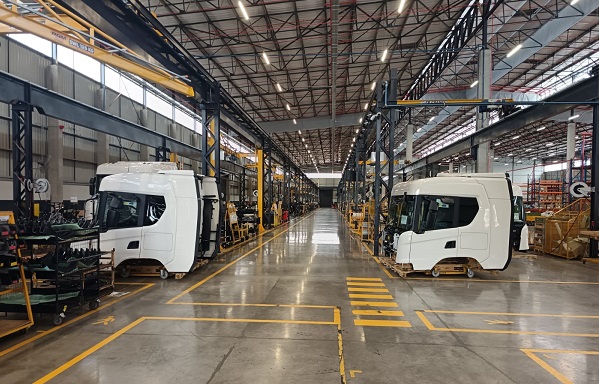
Another interesting aspect highlighted during the assembly tour was the continued role of human craftsmanship in vehicle production.
Despite growing automation in global manufacturing, much of the assembly process at the Johannesburg facility still relies heavily on skilled technicians. Representatives noted that while automation improves efficiency in some areas, the complexity and variability of commercial vehicle assembly still require substantial human oversight and expertise.
That balance between advanced engineering and practical operational understanding appears central to how manufacturers are approaching the next phase of transport evolution.
Ultimately, the strongest message emerging from the session was that efficiency is becoming far more strategic than technical.
For transport operators, the conversation is no longer simply about purchasing a truck. It is about understanding how vehicle specification, fuel performance, uptime, payload capability, maintenance requirements, and lifecycle costs combine to determine long-term profitability.
As transport operators face mounting cost pressures, operational efficiency is becoming one of the few areas where meaningful competitive advantages can still be created.
And as transport businesses continue searching for ways to move more with less, the future of commercial vehicles may ultimately be defined not by size or power alone, but by how intelligently every kilometre is utilised.