

Juanita Pienaar recently spoke with Mark Erasmus, General Manager Sales and Marketing at Scania South Africa, Erik Bergvall, Managing Director Scania Southern Africa, and other key representatives about the launch of the Scania Super powertrain platform and what it could mean for fleet operators across the region.
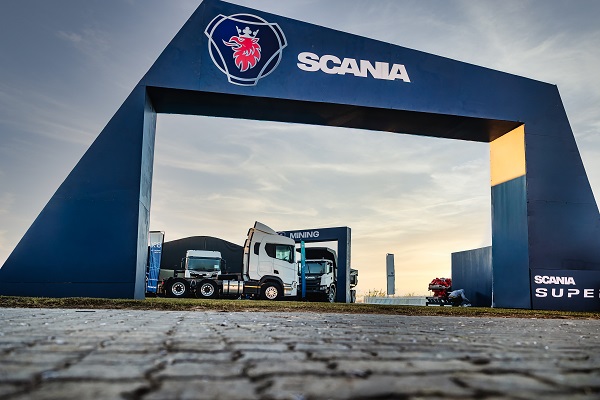
Bringing Super to Southern Africa
While the global launch of Scania Super took place several years ago in Europe, the technology is now entering the Southern African market following extensive local testing and customer demonstrations.
For Scania, the timing could not be more significant.
“We know many of our customers are heavily under pressure,” said Bergvall. “With these new technology innovations and connected services, we can at least do our part to support the customers in these challenging times.”
A new generation of efficiency
At the centre of the launch is Scania’s new 13-litre Super engine platform, which the company describes as the most efficient internal combustion powertrain it has produced to date.
“This has been five years in the making, and it’s an unparalleled feat in the science of engineering internal combustion engines,” explained Erasmus during the launch presentation. “It delivers the best fuel economy and does so in a sustainable way.”
According to Scania, the Super platform is capable of delivering fuel savings of at least 8% compared to previous drivetrains - a figure the company says has already been proven in Europe and validated through local testing.
“When we say 8% better, then we are 100% confident that we will be 8% better than anything that’s gone before from a Scania perspective,” said Erasmus.
Importantly, Scania emphasises that the efficiency gains are not linked to a single technological improvement, but rather to an integrated redesign of the entire drivetrain.
“To say what is the one thing that gives the vehicle the efficiency on fuel - it’s not just one thing,” Erasmus explained. “It’s the whole drivetrain.”
The redesigned gearbox, reduced internal friction, improved lubrication systems, new rear axle configurations, and optimised thermal efficiency all contribute to lower fuel consumption.
“The powertrain as a whole is a truly integrated system with every part working together as a team,” Erasmus explained.
Looking beyond upfront cost
For operators, however, the conversation extends well beyond technical specifications.
Erasmus stressed that efficiency ultimately translates into profitability.
“If you buy a Scania, it will start making money, not costing you money,” he said.
The company repeatedly returned to the idea that transport operators are increasingly evaluating vehicles based on lifecycle value rather than upfront purchase price.
“I don’t like focusing on upfront price because I think the lifecycle of a truck and a transporter’s speed is more significant than paying an upfront price,” Erasmus noted.
According to him, changing customer behaviour is reshaping the industry.
“Back in the 1990s, we were dealing with people who started the business themselves. Today, those second- or third-generation businesses are run by people coming out of universities. They’re talking languages which are more accounting-based - total operating expense, return on investment.”
Competing in a changing market
That shift is particularly relevant in a market facing growing pressure from lower-cost competitors.
Scania acknowledged that Chinese truck manufacturers have significantly altered the competitive landscape over the past several years, particularly through aggressive upfront pricing strategies.
“What’s happened in that space is that the alternative brands specifically have come in and taken market share from the Europeans,” Erasmus said.
However, rather than competing directly on purchase price, Scania says its strategy is focused on long-term efficiency, support, uptime, and residual value.
“We have to be the best - the most efficient vehicle along with the best services,” Bergvall explained.
Uptime and connected services
Service and uptime form a major part of that offering.
Scania highlighted its new service solutions, which use continuous vehicle monitoring and predictive maintenance strategies to reduce unexpected downtime.
“This system focuses on renewing components before they break down,” Bergvall explained. “Vehicle status reports are continuously evaluated by Scania, and we call for action before anything unexpected happens.”
Maintenance intervals have also been extended.
“While in the past we always looked at 40,000km, now we’re stretching it to at least 50 000 km,” Bergvall said. “In certain applications, we can stretch the maintenance intervals even more.”
That translates into more time on the road and lower operational disruption for customers.
Technology inside the cab has also evolved.
Bergvall pointed to a new dashboard and driver assistance systems designed to help operators optimise driving behaviour in real time.
“It supports the driver in making the right decisions,” he explained. “It enables him to focus solely on his task of bringing the goods from A to B.”
The road to lower emissions
The company also sees the Super platform as part of a broader transition toward more sustainable transport.
“Our new combustion powertrain platform is a step on the way to a future of carbon-neutral transport,” Erasmus said during the launch presentation.
At the same time, Scania acknowledged that internal combustion technology will continue to play a critical role in Southern Africa for the foreseeable future.
“This is probably the last internal combustion engine that Scania will ever produce,” Erasmus said. “But it’s not just Scania who’s got to get into that space - it’s the world. It’s the infrastructure around it, charging, storing the power. There’s quite a long road before the end of ICE technology.”
Focused on efficiency
For now, the company believes the focus remains firmly on helping customers extract greater value from every litre of fuel and every kilometre travelled.
“The future isn’t a truck,” Erasmus concluded. “The future is Super.”