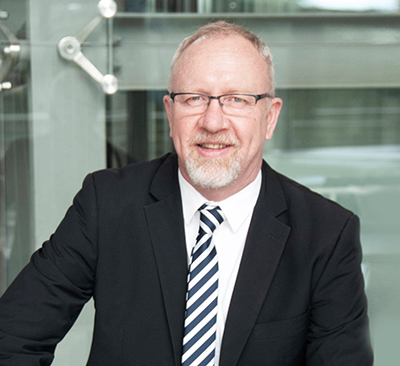
Globally trusted infrastructure firm AECOM has been delivering data centre projects in Africa for the last decade and is seeing exponential growth locally. “We have global agreements with Tier 1 players establishing their own hyperscale data centres in South Africa,” says Africa MD Darrin Green. “On the other end of the scale, small edge data centres are also increasingly being established closer to demand.”
 Data centre projects are particularly suited to AECOM due to their multidisciplinary nature, from upfront environmental investigations and permitting to the costing and procuring of the land and all necessary approvals to get to the building stage, as well as the design.
When establishing in a new region, cloud services providers typically house their servers in colocation data centres. As their customer numbers increase, these providers invest in their own data centre campuses.
“The last few years has seen the focus shifting from established regions like Europe to newer locales such as South Africa,” says Green. Elsewhere in Africa, with limited terrestrial fibre infrastructure, data centres are smaller and modular in nature and confined to fibre landing sites and larger cities.
Green notes that AECOM is working with various firms rolling out infrastructure across Africa, assisting them to navigate local permitting, logistics and power supply challenges. A shift to renewable power supply is high on the priority list. “We help clients to move away from diesel generators to renewables with battery energy storage and green hydrogen.”
What continues to differentiate AECOM globally is that it is probably one of the few almost completely multidisciplinary built environment professional services companies. “I do not think anyone else has the breadth of services and expertise that we have,” says Green, adding that consulting companies tend to either focus on niche or general services.
AECOM, on the other hand, has capability in architecture, electrical, ICT, plumbing, structural and mechanical engineering, civils, cost management and control, quantity surveying, building fitout and control systems, geotechnical engineering and even environmental and sustainability advisory services.
“We are truly a kind of one-stop shop, which I do not believe anyone else can lay claim to locally. Now some will say that does not necessarily help us always. It depends on the client’s approach. But we are strong in each of those disciplines; it is not a ‘Jack of all trades’ approach,” stresses Green.
In addition to being differentiated by the breadth of services it offers, AECOM has access to global expertise and best practice. “Where we see a clear differentiator for us is in the digital engineering space. AECOM is at the forefront of that globally. Everything is going digital and has been for some time. It is how you turn it into a practical service that counts. We have done more than most and keep on pushing the envelope.”
This remains an international trend, with cost-conscious local clients reluctant to fork out money on innovation. However, AECOM still applies digital tools in its everyday design work, from 3D to even 5D modelling. “There are a lot of add-ons that clients are not willing to pay for, but which can be beneficial to manage and execute projects,” says Green.
For example, the trend in the commercial property sector in South Africa is to award single disciplines to a range of consultants. Not only is this seen as putting checks and balances in place, but it allows the client “to play the one against the other to drive the price down.” Green advocates for an integrated approach as “making absolute sense” to drive efficiencies both in cost and delivery.
A multidisciplinary approach is critical to large, complex infrastructure projects undertaken by AECOM such as the Gibela Rail Consortium’s Dunnottar factory, the stadia for the 2010 FIFA Soccer World Cup, the new Heineken brewery in Mozambique and the refurbishment of the Heineken brewery in Sedibeng, Gauteng.
“That is where the strength of AECOM lies in pulling in people from overseas who have worked on that client’s infrastructure. They are aware of all the lessons learnt and know what the clients want and need. We have already built up a specialism here in South Africa, so much so that we are carrying out projects in Europe from South Africa for some major clients. Certainly, that is where we bring all these kinds of services together to give us a definite advantage,” says Green.
Looking to the future, Green says the strategy is to continue to support AECOM’s global client base. “That is an avenue of work some of our local competitors obviously do not have. We are building up our capacity locally to be able to offer this support where there is work but not necessarily the skills and capacity.”
Key markets are the US, which accounts for the bulk of AECOM’s work globally, and Australia and New Zealand. All these countries have embarked on major infrastructure stimulus drives, while the European market remains muted due to the impact of the war in Ukraine. While AECOM continues to win work globally, there is also a skills shortage to contend with, which makes South Africa attractive as a centre of excellence.
“We are already doing a lot of work in the Australia and New Zealand area out of South Africa. There is a good cultural fit,” says Green. The South African business is also heavily involved with mega infrastructure projects in Saudi Arabia, while other Middle East regions like the UAE are also starting to show green shoots again.