It takes a team effort to get concrete right, as was demonstrated recently with the Concrete Society of South Africa (CSSA) hosting the Concrete: Getting it right seminar with the assistance of two other industry bodies and a representative from the cement industry.
While the seminar might have been uncomplicated, the significance of the co-operation between industry bodies is more significant and punctuates the new spirit of teamwork that is being fostered between industry bodies that had previously worked independently within their own defined area of expertise.
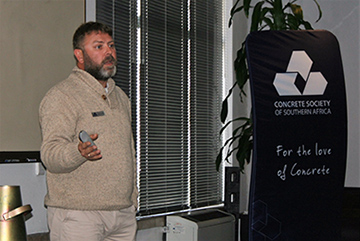 Johan van Wyk of Sarma speaks at the Concrete Society of South Africa ‘Back to Basic’ seminar held in Midrand recently.
However, the concrete industry is changing and for this particular course the CSSA chose to host the event at the premises of The Concrete Institute (TCI) with speakers from the Southern Africa Readymix Association (Sarma) and backed-up by cement producers in the form of Lafarge and PPC. Later this year all the bodies will once again cooperate and work together at the Readymix Conference by Sarma where the Concrete Manufacturers Association (CMA) and Association of Cementitious Material Producers (ACMP) will join the others to discuss industry matters in a panel-type discussion.
Sharing resources
Johan van Wyk, general manager of Sarma, says that it is an opportune moment for the associations to start working together and pooling their resources (and knowledge) for the overall benefit of the concrete and construction industries. “Each organisation has an area of expertise, as well as physical and intellectual resources that can be pooled together for the benefit of everyone involved in the concrete supply chain.
“Just like the Concrete: Getting it right seminar that we hosted together it is important that everybody involved in the concrete supply chain gets things right from the very beginning. In this course we start from the very beginning with the manufacture of cement and aggregates and work our way through batching, mixing, placing and curing of concrete. There are many role players along the way and if we want satisfactory results, then each person or company in the chain needs to comply with requirements at every step along the way,” says Van Wyk.
Johan points to the topics of discussion of the recent seminar to illustrate the many steps that concrete takes from raw materials to set concrete. Starting with Roelof Jacobs, Lafarge manager product and customer support, who spoke at length about the cement manufacturing process and the properties of cement. From a micro level the requirements for strong crystals to grow; and what the technical requirements are for cement to form strong bonds with aggregates for quality concrete.
Versatile material
During his own talk, Johan picked up the reins where the previous speaker left off and discussed the importance of correct batching of materials as well as mixing concrete. Also how testing needs to be done throughout the whole process to ensure consistency of the concrete supplied. He added that other important issues involved in the procurement of concrete included correctly specifying and placing orders for concrete on site.
Finally, George Evans, PPC Technical Specialist Cement and Concrete, discussed the handling, placement and correct curing of concrete and the many options that are available to contractors on site. He explained that concrete is a relatively inexpensive building material that has infinite uses, as long as it is specified, procured and handled correctly.
“Each industry body and each company involved in the concrete supply chain has its own level of expertise at every step along the way and if we all work together and understand each other the end result will be better quality concrete and better quality construction,” Van Wyk concludes.