The second day of Johannesburg Arbitration Week (JAW) 2026 delivered a packed programme of high-level discussions, strategic partnerships, and thought-provoking debates on the future of international arbitration.The day opened with an exclusive Women in Arbitration breakfast hosted by the Arbitration Foundation of Southern Africa (AFSA), aimed at fostering networking and advancing gender diversity in a field where women remain underrepresented.
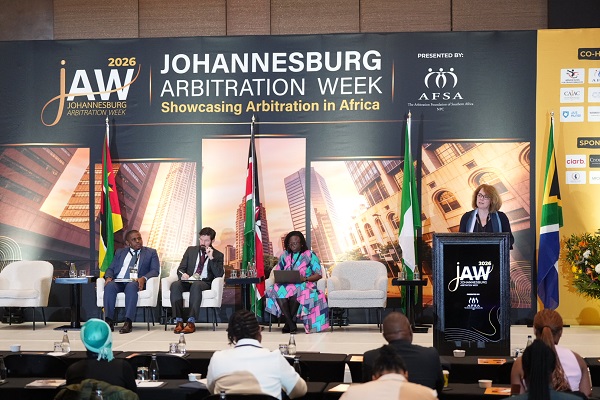
The conference continued with high-stakes discussions positioning Africa as a resilient hub for international arbitration amid geopolitical turbulence and technological disruption.
“JAW 2026 is proving Africa’s arbitration ecosystem is not just adapting to global uncertainty, it’s leading it,” said Prof Lise Bosman, AFSA Court President and Executive Director of the International Council for Commercial Arbitration (ICCA).
The first session, “Leveraging Opportunities in Times of Uncertainty”, dissected Africa’s legislative modernisation, Bilateral Investment Treaties (BITs), and increasingly supportive judicial enforcement. Moderator Clement Mkiva, Co-Head of Litigation at Bowmans, led panellists Gerhard Rudolph, Jonathan Barnes, John Kawana, Brian Mambosho, and Akshav Mossuddee in highlighting how proactive reforms are attracting foreign direct investment. “Africa’s BIT evolution is unlocking investment flows despite headwinds,” said Barnes.
Panellists speaking during the “AFSA in the World session”, outlined how local and international arbitration needs to find a middle ground and how the further establishment of arbitration centres across the continent will be able to support this.
Diamana Diawara, Talex International and AFSA Court Member, AFSA Court Vice President Jonathan Ripley-Evans, Mkiva, also an AFSA Court Member, and Aisha Abdallah, Partner and Head of Disputes at ALN Kenya: Anjarwalla & Khanna LLP mapped global institutional synergies under moderator Prof Bosman. Diawara noted,
“Strategic partnerships position AFSA as a bridge between continents.” She added that AFSA’s collaborations are successfully elevating African arbitration internationally.
A central theme of this panel was the enforceability of arbitral awards. Mkiva stressed that an award “is no better than the paper it is written on” if it cannot be enforced. He reminded arbitrators that their main responsibility is to ensure the award is enforceable in the relevant jurisdiction, urging them to always consider who they are writing for the parties and the courts that may be called upon to recognise and enforce it.
Ripley-Evans addressed practical issues in the South African context, including the need for full and timely disclosure to avoid conflicts of interest, and the importance of properly addressing costs in arbitral awards.
Lastly, Abdallah highlighted similar challenges in East Africa, particularly the inconsistent interpretation of public policy and conflicts between the New York Convention and local legal frameworks. She called for greater capacity building, judicial guidance, and institutional support to improve coherence and enforcement outcomes.
Prof Bosman and the panellists agreed that arbitration institutions have an important role to play in supporting arbitrators to produce enforceable awards through strong secretariats and practical guidance tools.
A special judiciary-led moot and dialogue, led by Supreme Court of Appeal Judge Fayeeza Kathree-Setiloane, saw the parties involved in the matter recreate arguments from the SCA case Industrial Development Corporation of South Africa Limited and Another v Kalagadi Manganese (Pty) Ltd 2025 (6) SA 401 (SCA). Adv Andre Gautschi SC and Ndumiso Luthuli presented arguments for Kalagadi, and Webber Wentzel’s Vlad Movshovich, Ahmed Rajan, Qaasim Ganey, Margeaux Wassenaar, as well as Dr Faadhil Adams presented arguments for IDC. “This moot exemplifies how arbitration resolves Africa’s landmark disputes efficiently,” said Judge Kathree-Setiloane.
Parallel sessions unpacked pressing frontiers. The JSA/AFT session on “Energy, Infrastructure and Transition Risk,” unpacked what it really takes to make projects work across jurisdictions. Moderated by Adv Kerusha Pillay, the panel featured Lintle Tuke, President of the Law Society of Lesotho; Peter Tshisevhe, Director of Mergers & Acquisitions at TGR Attorneys Commercial Law Firm; and Mmiselo Freedom Qumba from the Department of Mercantile Law at the University of Pretoria. The panellists highlighted why dispute resolution sits at the heart of all major projects.
“To unlock infrastructure and energy development across Africa, we need trusted, institutional arbitration centres, not fragmented, ad hoc systems. When arbitration becomes the preferred mechanism, not the alternative, we create the certainty and confidence required to make projects across the region truly bankable,” Tuke stated.
This was echoed by Tshisevhe: “Energy and infrastructure projects are complex by nature, and too often risk is underestimated. From regulatory requirements and environmental considerations to land rights and project structuring, success depends on understanding these risks upfront and putting the right frameworks in place to manage them effectively.”
The Jus Mundi session on AI in international arbitration, moderated by Alexandre Vagenheim, VP Institutional & Legal Affairs at Jus Mundi, explored the role AI is playing and will continue to play in arbitration. Webber Wentzel partner Sarah McKenzie highlighted, “We have taken deliberate steps to be forward-looking in how we use AI, but it has to be applied responsibly. While it has significantly reduced the time required to prepare submissions, it also introduces real risk, particularly where arguments don’t hold up under proper scrutiny against the underlying case law.”
Prof Fola Adeleke predicted AI streamlining evidence analysis. “AI is proving most valuable in document-intensive arbitrations, helping practitioners navigate vast volumes of information, identify what matters, and prepare more effectively. But it cannot develop strategy; it provides options, and it is still up to counsel to decide the way forward.”
“The best use of AI in arbitration is not to replace legal thinking, but to strengthen it. Tools that challenge your position, whether by surfacing opposing arguments or testing your case theory, ultimately make practitioners more rigorous and better prepared,” Vagenheim added.
Associate Professor in the Department of Private Law at the University of Pretoria, Sylvia Papadopoulos concluded, “AI is undoubtedly enhancing efficiency and responsiveness, but it also raises an important challenge for the profession: how we develop the next generation of lawyers. If foundational tasks are automated, we need to rethink how experience, judgement, and legal intuition are built.”
“The Impact of Sanctions on International Arbitration and Enforcement” examined the growing legal and commercial complexities at the intersection of geopolitics and cross-
border dispute resolution. The session was moderated by Chandni Gopal, Partner at Webber Wentzel; and featured panellists Lele Modise, Group Chief Legal and
Regulatory Affairs Officer at MTN; Neil Boyd, Counsel at Linklaters; and Trevor Versfeld, Partner at Webber Wentzel. The panel considered the impact of sanctions on international arbitration and enforcement, and the conversation made clear that thinking of sanctions primarily as instruments of geopolitics rather than day-to-day commercial life is an increasingly outdated view.
The final session for the day, "Critical Minerals, Energy Security & Strategic Supply Chains: Disputes in the New Geopolitical Battleground", highlighted how these resources have moved to the centre of geopolitical competition. Vivien Chaplin, Director & Sector Head at CDH, noted: "This dynamic is fundamentally reshaping our approach to investment risk and supply chain resilience.” The panel examined how energy transition pressures, resource nationalism, and increasingly fragmented trade dynamics are transforming cross-border commercial risk and dispute resolution.
The session was moderated by Denise Durand, Director at CDH, and also featured panellists Clive Rumsey, Director and Sector Head at CDH; Jackwell Feris, Director and Sector Head at CDH; and Burton Meyer, Director at CDH, who unpacked the intersection between critical minerals, supply chain security, and evolving geopolitical and investment frameworks.
With global competition for critical minerals, the rise of resource nationalism, and the growing tension between trade liberalisation and domestic protectionist policies, investment decisions and contractual risk allocation are being reviewed more intensely.
The panel also underscored the impact of infrastructure constraints, regulatory volatility, and expanding export control regimes on project bankability and long-term commercial certainty. This is increasingly pushing both investors and governments toward more adaptive, risk-conscious structuring approaches in an evolving global order.