Against the backdrop of the devastating floods affecting parts of the Western Cape, the Institute of Municipal Engineering of Southern Africa (IMESA) has highlighted the urgent need for improved municipal flood preparedness, planning and governance.
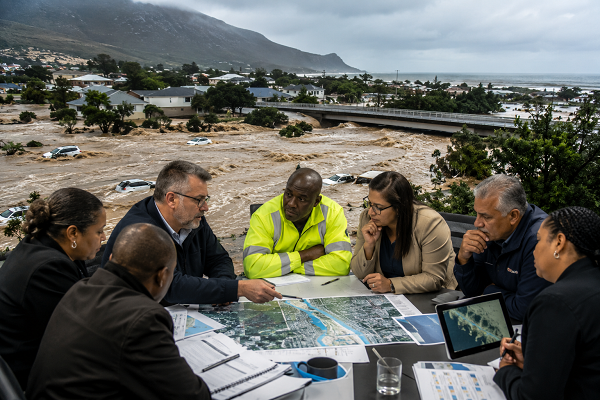
The institute has just wrapped up a series of flood risk workshops aimed at creating greater awareness among councillors and senior municipal officials about the realities of flood risks, their legal responsibilities, infrastructure vulnerability and the importance of scientifically informed planning. The training sessions, hosted in partnership with sector stakeholders including the Water Research Commission (WRC) and the South African Local Government Association (SALGA), were held in Thohoyandou in Venda, in East London, Makhanda, Pretoria, Newcastle and Moorreesburg in the Western Cape, reaching municipal representatives from multiple provinces and municipalities.
This IMESA initiative was rolled out at a critical time for South Africa as severe flooding events are demonstrating the importance of flood preparedness in urban planning, stormwater infrastructure, disaster management coordination and development control processes. IMESA explains that the workshops were specifically designed to help councillors better understand the technical, legal and governance dimensions of flood management, while reinforcing the importance of protecting lives, infrastructure and economic activity.
“Flood risk management is no longer a niche technical issue. It is a governance issue, a planning issue and ultimately a public safety issue,” IMESA notes. “Municipal decision-makers play a critical role in ensuring that development takes place responsibly and that communities are protected from avoidable flood risks.”
The workshops provided comprehensive guidance on flood risk understanding, design flood estimation, municipal legal obligations, land-use planning, stormwater management and disaster preparedness. The training content covered the fundamentals of what constitutes a flood, factors influencing flood behaviour and the growing complexity of flood modelling in an era of urbanisation and climate uncertainty. Participants explored how topography, soil conditions, vegetation, infrastructure development, catchment response and rainfall intensity all influence flood severity.
Special attention was given to the concept of residual risk, which is the increasing threat today of flooding events larger than the design standard typically used in infrastructure planning. IMESA explains that as urban populations grow and climate pressures intensify, municipalities globally are increasingly considering more severe flood scenarios, including 1 000-year flood events, as part of modern flood risk planning and disaster management.
The workshops also emphasised the strong relationship between urban planning, stormwater management and disaster management, underscoring the need for municipal departments to collaborate and to maintain accurate infrastructure asset registers, reliable rainfall data and updated flood records. Among the key themes covered were the importance of data quality and technical expertise in flood estimation and infrastructure planning. Municipal leaders were cautioned against relying on inadequate or poor-quality information, with the IMESA trainers warning that inaccurate data can significantly compromise flood event analysis and infrastructure design outcomes.
The workshops also addressed the distinction between natural uncertainty in weather systems and uncertainty arising from insufficient knowledge or technical capacity. IMESA stresses the need for experienced and professionally registered practitioners in flood hydrology, hydraulics and flood management.
The legal and regulatory responsibilities of municipalities formed a major component of the workshops. Councillors were guided through relevant legislation, including the Constitution, National Water Act, Water Services Act, Municipal Systems Act, Disaster Management Act and National Building Regulations.
The sessions outlined municipalities’ obligations to identify and manage flood lines, regulate development within flood-prone areas, maintain appropriate bylaws and ensure that qualified professionals are appointed to undertake flood-related assessments and planning. According to IMESA, many councillors expressed surprise at the extent of municipalities’ legal accountability relating to floodplain development and unsafe settlement patterns.
Feedback from participants also revealed that many elected representatives had not previously understood the importance of professionally registered engineers and scientists in floodline determinations, nor the significance of maintaining accurate local rainfall and infrastructure data.
Councillors acknowledged the need for stronger alignment between disaster management departments and municipal stormwater divisions, recognising that flood resilience requires coordinated planning and information-sharing across departments.
Importantly, many participants mistakenly believed that every flood event can simply be attributed to climate change, IMESA reports. This misconception was addressed in the workshops and the councillors gained a deeper understanding of the multiple technical and planning factors that contribute to flood disasters. Poor maintenance, due to an imbalance in funding allocation to infrastructure maintenance, as well as a lack of technical capacity, is frequently the main reason for more frequent flooding challenges, the institute states.
IMESA says that the workshops reinforced the need for municipalities to move beyond reactive disaster response and instead adopt proactive, risk-informed planning approaches.
“Flood resilience starts long before a storm arrives,” the institute stresses. “It requires careful planning, sound engineering judgment, reliable data, effective bylaws, skilled professionals and political leadership that understands the long-term implications of development decisions.” While acknowledging the legal challenges facing municipalities in this regard, IMESA further stresses the importance and need to prevent illegal informal settlements in flood plains. Proper awareness and visible risk markers (flood line markers) can assist in protecting communities from looming flood damages to their property and their lives.
The positive response from councillors has prompted calls for additional workshops and ongoing engagement sessions.
As South Africa confronts increasingly complex infrastructure and climate challenges, IMESA believes that empowering municipal leaders with technical knowledge and governance awareness is essential to reduce future flood risks and protect vulnerable communities and assets.