Efforts to conserve the wellbeing of the threatened Sungazer lizard, found only in South Africa, have been boosted after a research team from Wits University received an inspection camera donation from Bosch, which will help them to more effectively study the lizards in their natural underground habitats.
Sungazer lizards are a species of girdled lizards that are endemic to the Highveld grasslands of the Free State and Mpumalanga. The name ‘Sungazer’ is derived from its character of basking in the sun at the entrance to its burrow. According to the Endangered Wildlife Trust, the population status of the Sungazer species in unknown, but thought to be declining. It is therefore classified as vulnerable.
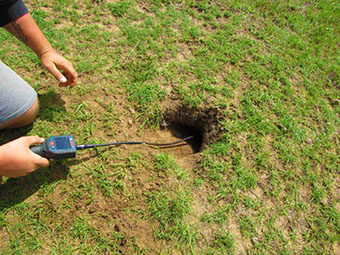 Wits University Reptile Ecology Masters student Wade Stanton-Jones and his team have been assessing the temperature patterns and social structure of the Sungazer, to obtain a better understanding of how it survives in the wild, in order to protect and increase the population number.
“Habitat destruction such as cultivation, usage for traditional medicine and illegal smuggling for the pet trade have contributed to the decrease in the numbers of Sungazers. Although there are claims that the lizards can breed in captivity, these claims have not been yet substantiated,” he says.
As part of the Wits University research, the Sungazers are fitted with a modified temperature probe to monitor the body temperature and a camera is placed at the burrow entrance to record the body postures and orientations displayed by the lizards throughout the day. “We are interested in assessing the target body temperatures of the lizards and how body posture and orientation affects the lizards’ ability to achieve these temperatures,” adds Wade.
Using the Bosch inspection camera, which features a 1,7 cm camera head that can navigate tight bends and hard-to-reach places, the research team is able to see the Sungazer and possible threats inside the burrow, which are projected onto a high resolution LCD screen. The camera also boasts an LED light for dark spaces and comes with a 122-cm-long waterproof camera cable.
The lightweight camera has a plus and minus button to control the intensity of the light for a full spectrum of the burrow. The video-out allows for external image transfer and it is able to run for an extended period time, thanks to its Li-Ion batteries. What’s more, impeccable colour reproduction capabilities ensure that the Bosch inspection camera provides a clear image every time.
Wade further asserts that the research is imperative. “By tracking the lizards, we will be able to tell its population turnover, movement patterns and the growth rate at different phases. This project aims to assess the long and short term demographic characteristics of Sungazers, a central theme to understanding how these lizards respond to anthropogenically driven changes, forming the next vital step in conservation planning. Through this, we are hoping to make a difference to society and conservation. It is important for people to appreciate lizards in their natural habitat, as they form an important part of a balanced ecosystem,” he concludes.