South Africa is in the grip of a water emergency, and Gauteng sits at its epicentre. The province is heading toward a "Day Zero" scenario, with leading scientists warning that the water crisis has reached a near-term climate change tipping point.
As the economic hub of South Africa, accounting for over a third of the country's GDP, a water deficit in Gauteng will have far-reaching consequences locally, nationally, and beyond (PSA, 2024).
South Africa already faces a projected 17% water shortfall by 2030, worsened by failing infrastructure, poor maintenance, and high non-revenue water losses of 47%, well above international norms, due to leaks, theft, and inadequate metering (Polity, 2025).
Yet even as municipalities scramble to patch ageing pipes and secure bulk supply, one sector continues to quietly haemorrhage millions of litres every single day: the construction industry.
While there has been much discussion about the role of green buildings in reducing carbon emissions, the preservation and efficient use of water in construction is often overlooked (Infrastructure News, 2022). This cannot continue. In Gauteng, where every drop is now a strategic resource, construction companies have a moral and commercial obligation to lead.
How much water does a construction site actually use?
The numbers are sobering. Among the main contributors to onsite water consumption are dust suppression activities, hydro-demolition, vehicle and equipment washing, wet trades such as bricklaying, plastering, concreting and screeding, and groundworks (Databuild, 2022).
It requires an estimated average of 350 litres of water to construct a single square metre of wall. Scale that across a large infrastructure project such as a highway interchange, a reservoir, or a mixed-use development, and the volumes become staggering.
The Department of Water and Sanitation's No Drop report has indicated that water losses account for 40.8%, or 1.79 million cubic metres nationally. Much of this is lost through preventable issues such as burst pipes, overflowing reservoirs, leaking connections, and inadequate or non-existent metering (GBCSA, 2025). Construction sites contribute meaningfully to this figure, and they can also be a meaningful part of the solution.
The Gauteng context: A province under pressure
Daily water usage in Gauteng has surged to 290 litres per person, well above international norms. Leaks, illegal connections, and ageing infrastructure have compounded this unsustainable demand (Parliamentary Monitoring Group, 2024).
Rand Water supplies water to 18 municipalities serving approximately 18 million people through an extensive network of 3,500 kilometres of large-diameter pipes. That system is already under maximum strain. A staggering 6,724 leaking pipes, 2,396 burst pipes, 442 defective valves, and 259 leaking hydrants currently afflict Johannesburg alone, and 46% of treated water is lost between treatment plants and consumers (Whats On Gauteng, 2025).
Sixty percent of Gauteng's water demand is met by the Lesotho Highlands Water Project, which annually transfers over 1.27 billion cubic metres of water to sustain urban centres and support agricultural activities crucial for food security. The project's second phase has now been postponed until 2029, leaving the province's long-term supply in a precarious position despite recent high dam levels (H2O Guru, 2025).
Against this backdrop, every litre lost on a construction site is not a minor operational inefficiency. It is water removed from a system that is already failing millions of people.
Where construction sites lose water: The four main problems
Understanding where water escapes is the first step toward controlling it. Water damage and loss on construction sites occurs in two general categories: water intrusion and water escape. Intrusion refers to external water entering the site, such as rising groundwater or rain, while water escape comes from pipes or other equipment that transport water around the site. (WhyAfrica, 2020).
In practice, this manifests in four key ways on large infrastructure projects.
The first is temporary water storage failure. Water brought onto site for concrete mixing, dust suppression, and curing is commonly stored in temporary tanks or unsealed earth excavations. Without professional lining or containment solutions, significant volumes seep into the ground within hours of being pumped in.
The second is leaking supply lines and fittings. Taps, pipes, and hoses should be regularly checked for slow leaks, as these can lead to an enormous loss of water over time (Infrastructure News, 2022). On large sites with hundreds of metres of temporary supply infrastructure, even hairline leaks can amount to tens of thousands of litres per day.
The third is over-application in wet trades. Concreting, plastering, and screeding are inherently water-intensive processes, but without proper measurement and trained application, far more water is used than is structurally necessary.
The fourth is unmanaged runoff and evaporation. Open temporary dams and holding ponds lose water rapidly through evaporation, a particular challenge on the Highveld where summer temperatures regularly exceed 30 degrees Celsius, and through uncontrolled overflow during the intense afternoon thunderstorms that characterise the Gauteng wet season.
A practical water management framework for Gauteng construction projects
DamPro recommends that project managers and site engineers on large infrastructure projects in Gauteng adopt a structured approach to water loss prevention from the planning stage onward.
At the planning and design phase, water storage requirements should be calculated in full before breaking ground. Every temporary holding dam, supply line, mixing point, and dust suppression system should be specified with containment in mind. Soil permeability in the project footprint should be assessed, as Gauteng's variable geology means that unsealed earthworks in sandy or dolomitic areas will lose water almost immediately.
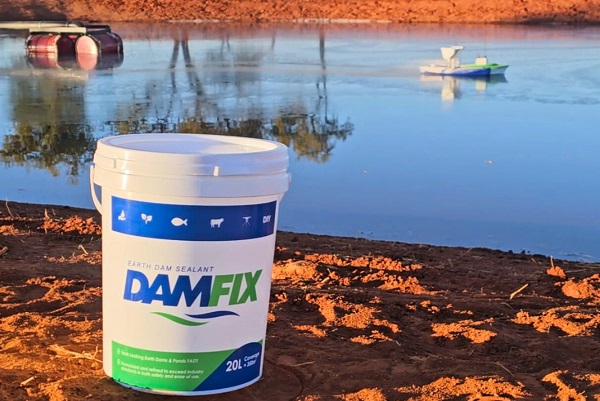
During construction, all temporary earth storage structures should be lined or treated with an appropriate sealing product before first use. If a dam is not built correctly it will not hold water. A common mistake is not ensuring there is a key in the wall during construction, which can cause water to leak through or under the wall. Lack of compaction is another frequent cause of failure, and porous soil types will consistently battle to hold water. The same principles apply to temporary construction site storage excavations.
Supply infrastructure should be monitored continuously. A dedicated site water manager, even on smaller projects, can identify and act on leaks before they become significant losses. Simple practices such as turning off the water while not in use can result in large financial savings, and embracing water conservation during construction reduces project costs and minimises delays caused by water shortages (GBCSA, 2025).
At project close-out and handover, all temporary water storage structures should be properly decommissioned. Liners should be removed and disposed of correctly, and earth structures should be rehabilitated to prevent ongoing seepage or groundwater contamination.
The business case for acting now
Beyond environmental responsibility, there is a hard commercial argument for water loss prevention on Gauteng construction sites.
Water tariffs in Johannesburg, Tshwane, and Ekurhuleni have all increased substantially in recent years as municipalities attempt to recover the costs of an overburdened system. Major bulk infrastructure projects currently under development include a new Crosby bulk infrastructure project costing R305 million and a new reservoir with 22 megalitres of storage in Brixton costing R318 million (Infrastructure News, 2024). These costs will eventually be passed on to consumers and commercial users through tariff increases.
The 2024 Budget allocated almost R156 billion for ten major water projects across six provinces, including R42.1 billion for the Lesotho Highlands Phase 2 project supplying Gauteng (Polity, 2025). This level of public investment underscores just how critical the water system has become, and it signals that regulatory pressure on large water consumers, including construction sites, is likely to intensify in the years ahead.
Construction companies that invest now in proper water storage, containment, and sealing infrastructure are not only doing the right thing. They are protecting themselves against the rising cost of water, reducing the risk of project delays caused by supply shortages, and building a reputation for environmental compliance that is increasingly valued by public sector clients and infrastructure funders.
Contact DamPro
DamPro serves clients across South Africa with a network of experienced specialists offering site visits, product supply, and full application services for all water storage and sealing solutions.