For more than 180 years, Lafarge has provided innovative solutions and high-tech cement and concrete materials that have built sustainable infrastructure for communities. Now a member of the LafargeHolcim international group, a global leader in building materials, the company continues to be at the forefront of its industry with advanced laboratories that meet the needs of today and anticipate the building needs of tomorrow.
“In years to come, faced with daunting refurbishment costs, it is no use thinking ‘if only’ we had built with different materials,” says Lafarge’s Roelof Jacobs, Integrated Solutions and Innovation Manager. “Faced with the demands of high population growth and rapid urbanisation, we owe it to our communities to build a longer service life in our concrete structures. We simply cannot afford to reconstruct or repair our raw, potable or waste water infrastructure every few years.”
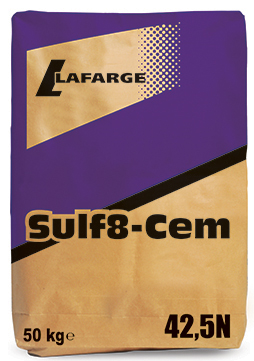 In constructing concrete infrastructure, frequently encountered problems are heat of hydration in mass pours and building in an aggressive environment with exposure to sulphate attack. One of Lafarge South Africa’s latest cement innovations, Sulf8-CEM, offers a solution for both of these challenges.
Sulphates are said to ‘attack’ concrete because they can permeate the surface layers in solution with water, which then reacts with unreacted C3A and calcium hydroxide (Ca(OH)2) in the cement paste leading to the formation of various compounds that are far more voluminous than the original chemicals – as much as 600 per cent more! The outer layer of the concrete suffers cracking, spalling (surface layers bursting open) and separation of aggregate from the cement paste, leaving more surface area of the paste to react. In addition, any reinforcing is then exposed to corrosion and the progressive destruction of the concrete structure is well underway.
Sulphates, especially in the form of salts of calcium, sodium, potassium and magnesium, are a challenge for concrete civil works in aggressive environments such as sewerage plants, abattoirs, areas exposed to mining activity common in areas where mines are operating and coastal areas where soil is high in sulphate. As a general guideline, if ground concentrations of sulphate are above 1000 ppm, ‘Sulphate Resistant’ cement should be used in concrete structures.
The innovative solution, after extensive development at the renowned Lafarge Integrated Solutions and Innovation Centre (ISIC) in south-west Johannesburg (previously known as Quality Department Southern Africa [QDSA]), was Sulf8-CEM, a Low Heat (LH), Sulphate Resistant (SR) cement. Produced in bulk and bags at the company’s Lichtenburg Cement Works in North West Province and its Randfontein Grinding Station, the product is a CEM IV/B-V 42,5N LH SR Pozzolanic cement formulated from Portland clinker with more than 36 per cent selected quality siliceous fly ash, and C3A content in the clinker below 9 per cent. The product also contains performance enhancing additives. Sulf8-CEM has been certified to conform to the latest applicable South African and European standards (SANS 50197-1 and EN 197-1).
“Reflecting our particular focus on developing a solution for constructing concrete civils infrastructure for the water industry, Sulf8-CEM also offers a significant benefit as a classified Low Heat of Hydration product,” comments Jacobs.
The exothermic cement hydration reaction that rapidly raises the temperature of freshly placed concrete is not a problem in normal structures that allow the heat energy to dissipate easily. However, in large structures the heat builds up, causing high temperatures and expansion of the concrete while it is hardening. The temperature differential between the interior of a mass pour and the cooling outer layers can generate sufficient tensile stresses to cause cracking. Jacobs says that this not only reduces the bearing capacity of the structure but also creates entrance points for harmful substances to penetrate the concrete.
As a result of the high siliceous fly ash content in its innovative formulation, Sulf8-CEM is an exceptionally good Low Heat Pozzolanic Cement with a typical heat of hydration value of 166 J/g tested at 41 hours as per EN 196-9. While this contributes to lower peak temperatures with lower temperature differentials and the associated tensile stresses in mass concrete, the peak temperatures also occur at a later age, by which time the concrete is more mature and better able to withstand any tensile stresses.
“At Lafarge, we set out to offer the water industry a solution for creating durable concrete structures suitable for use in aggressive environments,” concludes Jacobs. “We are extremely proud to have developed the all-round high performance product, Sulf8-CEM.”