Botswana Oil’s mandate is clear: secure, manage and distribute petroleum products in a way that supports operational efficiency and long-term sustainability.
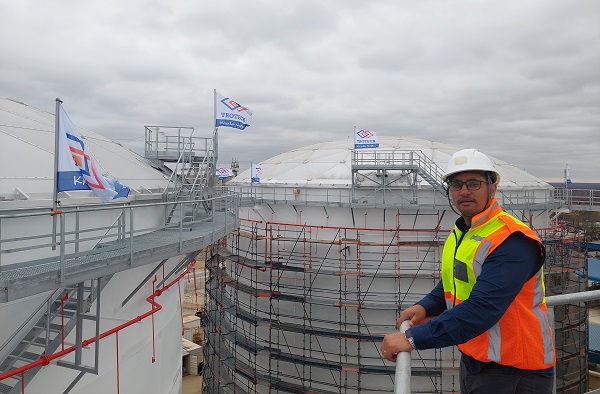
The Francistown project was designed to strengthen national fuel storage capacity and ensure reliability across the supply chain. From the outset, the brief demanded more than a physical build. It required a solution aligned with regulatory compliance, safety excellence and adaptability for future expansion.
Scope and delivery
The works were executed within a live operational environment, under heightened audit and compliance scrutiny. Key deliverables included the design, procurement, prefabrication, installation and corrosion protection of four above-ground storage tanks, each with a capacity of 15 000 m³. The project also incorporated four aluminium geodesic dome roofs and two aluminium internal floating roofs, engineered to reduce vapour loss and improve environmental performance.
Despite the complexity of working within an active fuel facility, the project was completed within the approved contractual framework of 14 months. Final close-out confirmed full alignment with technical requirements and client expectations.
Engineering approach and innovation
Trotech’s methodology was anchored in three priorities: safety, quality and programme discipline. Operating in a high-risk oil environment demanded uncompromising safety standards. Comprehensive risk assessments, permit-to-work systems and continuous monitoring ensured zero compromise throughout execution.
Quality assurance was embedded at every stage, with all works delivered in accordance with international codes for bulk storage tanks and Botswana’s regulatory standards. Programme discipline was equally critical. The team adopted a structured schedule, enabling real-time adjustments without impacting delivery milestones.
Innovation played a decisive role in overcoming technical challenges. Design engineers identified opportunities to optimise shell strake thickness on tanks, reducing welding requirements and material costs. A temporary stiffener ring was introduced to prevent shell collapse during heavy winds, and wind girder designs were revised mid-fabrication to simplify installation. These interventions improved efficiency without sacrificing safety or integrity.
Local engagement and skills development
Beyond technical delivery, the project prioritised local participation and skills transfer. Botswana-based labour and subcontractors were engaged across multiple work fronts, from scaffolding and painting to safety oversight and non-destructive testing. Structured on-the-job training exposed local teams to tank erection methodologies, inspection processes and compliance systems, reinforcing Botswana Oil’s commitment to building national technical capacity.
Workforce development extended beyond the site. Initiatives such as developing a welding school, and internal promotions created pathways for long-term employment, strengthening community relations and earning commendation from both client and media.
Safety and environmental performance
Health, safety and environmental performance were central to the project’s success. Despite operating under forensic audit conditions, the team achieved zero lost-time incidents over 329 129 manhours. Strict adherence to isolation procedures and permit-to-work systems ensured operational integrity, while environmental controls prevented contamination and managed waste streams in line with regulatory requirements.
Results and impact
The project delivered outstanding results against a backdrop of logistical and operational challenges. All major milestones were achieved on schedule, with progress often ahead of plan. Cost savings were realised through strategic procurement and the transition from imported labour to locally trained workers. Effective stakeholder engagement and robust site welfare facilities enhanced productivity and morale, while contractual claims were managed under FIDIC provisions to secure time extensions without compromising cost control.
A benchmark for future projects
For Botswana, the Francistown development represents more than an infrastructure upgrade. It is a statement of intent - a commitment to energy security and operational resilience. For the construction industry, it offers a case study in balancing safety, quality and programme certainty within complex environments.
As Senior Project Manager, Storme Wilson, commented, “As Botswana continues to invest in its energy infrastructure, projects like this highlight the role of experienced construction partners in delivering assets that stand the test of time. Trotech’s success in Francistown underscores the value of collaboration, innovation and disciplined execution in shaping the region’s energy future”.