Concrete pavements offer substantial environmental economic and social benefits and are the sustainable solution to the road networks of all African countries, says Bryan Perrie, MD of The Concrete Institute in South Africa.
 Perrie is widely recognised as one of the world’s leading authorities on concrete pavements. He has authored several internationally acclaimed books on the subject and has presented papers at conferences on the subject throughout the world and holds membership of global bodies representing the concrete pavement industry.
Perrie says concrete roads – providing they are built by skilled personnel - are the natural choice for developing countries’ projects where performance, value, longevity, social responsibility and concern for the environment are paramount.
“In addition to a service life which normally exceeds 30 years, concrete pavements require relatively little maintenance and repair and result in long-term savings in raw materials, transport and energy. The reduction in traffic delays caused by road works also cuts fuel consumption and exhaust gas emissions,” Perrie states.
He says among the many benefits of concrete roads are:
- Safety: Surface texturing of concrete pavement can improve water run-off so that traffic on wet roads does not cause splash, spray and skidding. The light colour of concrete pavements deflects light from vehicles and street lights, improving night-time visibility while effecting energy and materials savings by requiring fewer street lights per kilometre of road.
- Heat retention: Concrete roads reflect sunlight which helps to mitigate the ‘heat island’ effect. “Research shows that black surfaces exposed to sunlight can become 21ºC hotter than reflective white surfaces. This heats up the air around roads, contributing to increased temperatures in surrounding buildings, necessitating greater use of air conditioning, energy consumption and electricity demand,” Perrie explains.
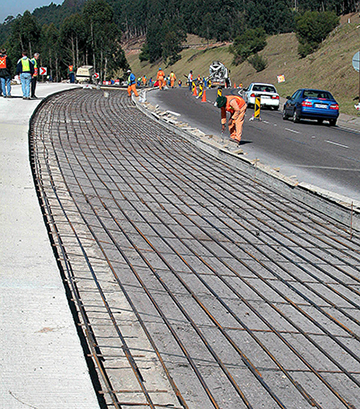
- Labour-intensive construction: In countries where unemployment is a major burden to the economy, the manual aspects of the construction of concrete roads can be carried out by members of the local community after on-site training. Their newly-acquired skills can thereafter be utilised in other sectors of civil engineering.
Perrie adds: “As for the allegations that concrete roads are noisy, a five-year Canadian study showed that concrete roads were only 2-4 decibels louder than asphalt: a conversation registers 60-70 decibels and a whisper, 20 decibels. So, in view of the many other benefits of concrete roads, this is a minor and really an irrelevant factor.”
The Concrete Institute’s School of Concrete Technology, in collaboration with the SA Road Federation, offers a special training course, Concrete road design and construction. The TCI Information Centre, which can be accessed free of charge, houses a vast amount of literature on the subject.