Working in partnership with Lamo Solar, the Eastern Cape Provincial Government, the Federal State of Lower Saxony in Germany and GIZ, the German agency for international cooperation and sustainable development, Siemens was recently involved in the installation of a standalone hybrid microgrid in the village of Upper Blinkwater, to provide electricity to 70 homes. The system provides enough energy for each household to run a mobile phone charger, TV and satellite dish, lighting and a kettle. Some communal washing machines and a few commercial machines are also connected.
Sabine Dall’Omo, CEO of Siemens Sub-Saharan Africa says, “Microgrids offer a localised method of generating, storing, and distributing power, and can operate in the harshest environments to benefit remote communities The Upper Blinkwater project demonstrates this technology's potential to address Africa's electricity challenges and our commitment to investing to improve people’s lives. We hope this success story inspires other businesses to join us in driving sustainable electrification and transforming Africa into a land of opportunity for all.”
The power of technology
The Upper Blinkwater story demonstrates what the continent can achieve when innovation meets purpose. Siemens developed the project to test a decentralised, sustainable energy supply concept for rural settlements underserved by grid electricity. The hybrid microgrid system is based on renewable energy and diesel backup to provide an alternative electrification model. As a result, Upper Blinkwater, never previously served by national electricity supply grid, now has a 75 KWp photovoltaic (PV) system, a diesel-fuelled generator, and a battery storage system, all controlled by a Siemens SICAM Microgrid Controller.
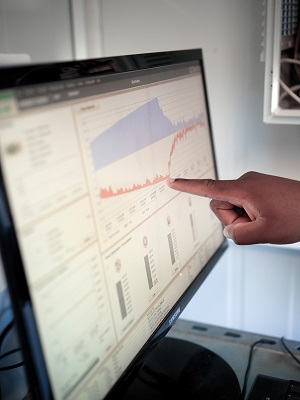
The microgrid controller manages the energy sources and load distribution to ensure optimal electricity usage. The technology supports a sustainable and climate-neutral energy supply for basic household needs, with about 90% of the electricity supplied by the PV system.
Dall’Omo says, “A distinguishing factor of this initiative is that it addresses two crucial challenges – rural electrification and climate change. It aligns with Siemens’ DEGREE framework – a comprehensive approach focusing on decarbonisation, ethics, governance, resource efficiency, equity, and employability. We acknowledge our responsibility towards creating a sustainable future, aiming to limit global warming to 1.5 degrees Celsius, and this project is a reflection of our commitment.”
The Upper Blinkwater project has illuminated homes, ignited economic growth, and opened educational opportunities in this remote village. Access to electricity supply has triggered economic activities within the community. Local businesses can now use renewable energy to create quality products. It is a bold step towards breaking the cycle of poverty by providing opportunities for economic growth and improved living conditions.
Community member and carpenter Kurt Swartbooi says, "There was no life or work in this community before this project. People used to fetch wood in the bush to make fires to cook, make coffee or tea, and even boil water to wash. I now own a business and wish the same for other communities that don't have electricity."
Tshibvumo Sikhwivhilu, Co-founder and CEO of Lamo Solar, adds, "When we came across the Siemens Microgrid Controller, we had no doubt this was the intelligent solution we needed to transform the community. It was a place that was silent, with just a lot of smoke from people cooking over fires. Today, you walk into a community with countess opportunities and fresh air because households aren't cooking with charcoal.”
Sikhwivhilu says it’s been amazing to see the economic activity that has spiralled out of the provision of electricity, seeing how young people can access information on their phones, tablets, and laptops because they can charge those devices from home, opening a new world of opportunities.
“What we’ve achieved here with Siemens brings immense pride and a hunger to do more. Now we must replicate what we've accomplished in this small community. The technology is there for us to provide electricity to communities that lack access and help end energy poverty. Siemens has proven its ability to bring stakeholders together to achieve this goal,” he says.
Upper Blinkwater is not an isolated case. Countless other rural villages throughout Africa are not connected to the electricity grid, excluding them from many opportunities for economic livelihoods, trade and communication. Microgrid solutions can enhance the sustainability of these smaller remote communities, boost local economies, and improve residents' quality of life.
Siemens says this successful project is part of its plan to extend its microgrid solution to other communities and businesses that want to lower their emissions and achieve their decarbonisation goals.
Dall’Omo notes that members of the community take responsibility for managing the microgrid system and she adds, “The Upper Blinkwater project is an excellent example of how technology can create a brighter future for local communities.”
For more information visit: www.siemens.com/global/en.html