Keeping solar panels clean is an important factor in ensuring they function effectively. Dust, dirt and other debris can block the sunlight that solar panels use to deliver power. Dirty solar panels can lead to a reduction in performance of up to 25% and accumulated dust can potentially cause hot spots that damage cells.
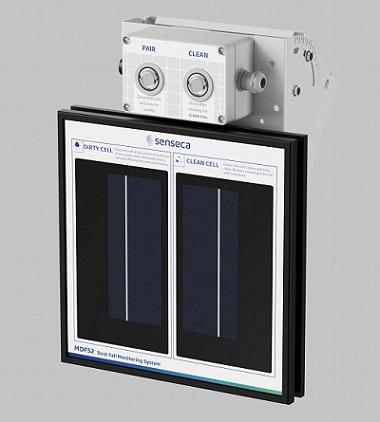
To assist in the quick monitoring of solar panels for dirt, Senseca has introduced a Dust Fall Monitoring System (MDFS). Used at solar photovoltaic farms and other commercial installations, it is designed to alert control centre operators at photovoltaic solar farms when the panels need to be cleaned.
“The MDFS can easily be added to the solar panel control system,” says Jan Grobler, Managing Director of Senseca South Africa. “It compares the radiation collected by two-compensated reference cells with outputs either in voltage (Model MDFS2) or Modbus protocol (Model MDFS2-S). One cell (the clean cell) must always be kept clean, and the other cell selected to be monitored by the system (the dirty cell) is cleaned at the same time as the PV panels.
“The device enables quick identification of dirty solar panels so any drop in the performance of the panels can be rectified in good time,” says Groble. He adds that the MDFS is compact, lightweight and easy to install.
The MDFS can be used in two ways.
In Basic Mode, when manually comparing the clean and dirty cell readings, the operator can decide when cleaning is needed. In this mode, the control box is not required.
In Advanced Mode, with the optional control box, the system automatically calculates the soiling attenuation rate (%) of the PV panels. This value can be used directly to decide if cleaning is necessary and to provide confirmation when cleaning and other maintenance tasks have been performed.
The MDFS system provides five data channels: sun elevation, clean solar cell rad, dirty solar cell rad, MDFS status and attenuation.
Both the MDFS2 and MDFS2-S offer a measurement range of 0 to 1400 W/m2 , operating in temperatures from -20o C to + 60o C and warning, pairing instruction via digital outputs. The MDFS2 offers a measurement error of +-2.1% the MDFS2-S a +-2.2% measurement error.
The Data Acquisition System (DAS) model METEODATA-4000 collects the solar radiation gathered by the clean and dirty reference cells and additional information regarding tasks performed at the field monitored by the control box. This data is used in the calculation of attenuation due to soiling. The data collected by the DAS is recorded in a SQL Server installed in a Data Collection Centre, where it is accessible to be displayed and exported to Excel files.
“The MDFS is a welcome addition to the Senseca product range of environmental monitoring instrumentation. It will assist in ensuring PV farms and large commercial solar panel installations are always running optimally,” says Grobler.
For more information visit: www.senseca.com