


If you ever believed that making cement bricks were simply a case of mixing cement powder, sand and water, think again. It is a lot more complex than that when considering that quality and strength of the final product builds structures and reputations.
When two partners in a cement brick plant found that the material they were hauling at great expense to their Chloorkop brickyard north-east of Johannesburg, contained much of what they did not want in their bricks, they knew to make effective contingency plans.
Steven Carr and Sean Cameron were friends at school and when they decided to make a radical career change from the IT field, they chose brick-making. “My father had run a similar type of business so it was not as if we were going into the business not knowing what it was about,” Steven Carr says. “But we have gone through a steep learning curve and keeping open minds about the challenges we face on a daily basis, has benefitted us.”
The partners have called their business Brick-It and they produce cement stock bricks, maxi bricks and will soon be manufacturing paving bricks. They service hardware stores, building developers and contractors as well as day-to-day consumers in a radius of 80 to 100km from their base at Chloorkop, and have done so since the start of their business in 2006. Deliveries are done using their own fleet of rigid and tri-axle trucks. The company employs some 200 people comprising administrative, technical and supervisory staff as well as manual labour.
“The man in the street may not be aware that we use ash as an important ingredient in the making of our cement bricks as the clinker in ash creates a good medium for strength, binding well with cement and water,” says Sean Cameron. “We therefore have to source three different types of ash namely coarse, ‘pozzfill’ and slag ash and these are becoming more difficult to find.”
According to the partners, the ash gets sourced from ash dumps spread across Gauteng but the cost of excavating, loading and transporting it to their factory site, is a big cost factor on their bottom line. The fact that many impurities and foreign objects are found in the ash has caused them to look at screening the ash at the point of sourcing it to ensure that a cleaner product is hauled to their factory site. “If we’re paying out good money to transport a raw material, we might as well ensure a clean and useful product to suit our purposes," they echo.
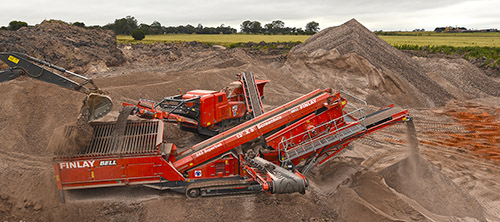
“We started looking for mobile screening equipment at the start of 2015 and did in-depth research on a number of brands,” Steven Carr says. “We believe we made the correct choice in a Finlay 683 Screen as being a product that has proved itself and is distributed and backed up by a reputable company such as Bell Equipment with experienced technical staff and spare parts.”
The machine was delivered to them in October 2015.
Due to the Finlay Screen’s mobility, Brick-It production teams could now move the machine to the source of its ash anywhere and process the raw material down to the correct size of minus 14mm. This production is done in two shifts for six days a week from 6am to 10pm. The Finlay 683 Screen runs for at least 12 hours a day.
“We did encounter some problems with oversized material that we’d find on some remote ash dumps but we remedied this by deploying a Finlay I100 Impact Crusher that we added to the Finlay 683 Screen in February 2016,” Sean Cameron says. “Oversized material from the Screen is now fed directly into the Finlay Impact Crusher from where it is returned to the Screen for processing to the correct size. This has ensured that we have a better flow of the raw product.”
Brick-It’s operators report production figures still slightly less than the machines’ design capacity of 100 to 120 tonnes per hour but the both Carr and Cameron are confident that this will improve in time. “Where we have seen a vast improvement is in the quality of the raw ash material that is now fed into our new brick plant and this has had the very real effect of smoothing out our brick production,” the partners say. “We should really have bought the Impact Crusher at the beginning.”
“Sourcing sand and cement is easy, but we’re finding that due to increased demand for our products that we have to source our ash in an ever-increasing radius further from our base,” Steven Carr says. “This has got us thinking to perhaps increase our crushing and screening equipment. To further ensure that we minimise downtime on the equipment when it occurs, we are considering a maintenance contract with Bell Equipment to take care of our Finlay equipment. In that way, we’re confident that there won’t be delays in getting this important raw material to our plant.