South Africa generates 2.4 million tons of plastic waste every year, according to the Worldwide Fund for Nature (WWF). In effect, this means every South African contributes about 41 kilograms of plastic waste per year. About 14% is recycled. The South African Bureau of Standards (SABS), together with other national standards bodies and standardisation forums, continues to work to provide standards and guidelines for environmentally friendly production and processing of plastics and plastic products.

SANS 1728 requires that plastic material used in packaging must be noted by identification code on the packaging.
The SABS has recently published South African National Standard (SANS) 1728: The requirements for the marking and identification of degradable plastics. Degradable plastics include but are not limited to biodegradable, compostable, oxo-biodegradable and water-soluble plastics. SANS 1728 advises consumers to familiarise themselves with the correct markings and to be aware that any product that is claimed to be biodegradable plastic needs to be verified according to the standard, which is aligned to global requirements.
Dr Sadhvir Bissoon, Acting CEO of the SABS explains that vague environmental claims such as ‘environmentally safe, environmentally friendly, earth friendly, non-polluting, green, ozone friendly, plastic free’ and similar, are specifically cautioned against in SANS 1728. “Manufacturers that want to claim their plastic packaging is degradable need to subject the packaging to the relevant testing and certification requirements.”
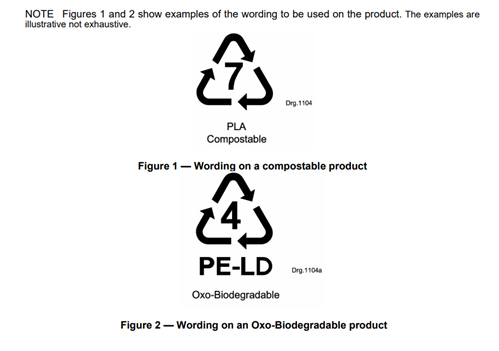
SANS 1728 requires that plastic material used in packaging must be noted on the packaging, using a material identification code from 1 to 7, contained in a triangle. The material identification codes are:
- 1 = PET (polyethylene terephthalate)
- 2 = PEHD (High-density polyethylene)
- 3 = PVC (Polyvinyl chloride)
- 4 = PELD (Low density polyethylene)
- 5 = PP (Polypropylene)
- 6 = PS (Polystyrene)
- 7 = all other materials (such as ABS, PLA, SAN and others)
Should the plastic packaging be of a degradable nature, it will be indicated below the triangle, as illustrated below in this extract from SANS 1728.
“Currently, in South Africa, there are no products that have been certified by the SABS as compliant with the requirements of SANS 1728 and consumers are urged to be vigilant when purchasing plastic products which may be making false claims of being degradable or environmentally friendly or plastic free. Manufacturers need to ensure they have verified the type of plastic in their packaging before they make any claims about their products,” says Bissoon.
In South Africa, the Department of Forestry, Fisheries and Environment holds the authority and regulatory power over packaging. In May 2021, the Extended Producer Responsibility (EPR) recommendations became regulations and include requirements for packaging and correct labelling of products and packaging.
For more information visit: www.sabs.co.za