The Department of Electrical, Electronic and Computer Engineering at the University of Pretoria (UP) held their fourth Autonomous Robot Vehicle (ARV) race in the Amphi Theatre at the University’s Hatfield Campus recently. This much anticipated annual event is organised to showcase and celebrate Electrical, Electronic and Computer Engineering students' hard work and accomplishments.
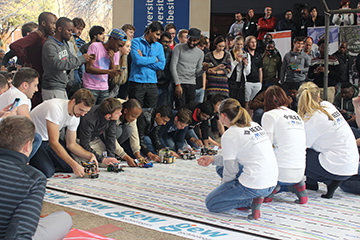 The race involves small ARVs that are built by third year students as part of the Microcontrollers module in their course. On Race Day, the students’ ingenuity is put to the test when they compete against each other to see which team’s ARV can complete a track made up of red, green and blue lines that zigzag across each other, in the shortest possible time. Students are required to work in teams of up to four people to develop an ARV that can detect the different coloured lines on the track and navigate through it. When students started their project in February, there were 60 teams of students, but only 52 teams made it through to eventually compete and put their creations to the test on the big day.
Reading the track
An ARV, such as the ones built by the students, is able to ‘read’ the track that it is supposed to follow through a light sensor that shines down onto the track, from where it is reflected back onto the sensor. The ARV’s sensors are programmed to follow the green line, but as many of the students who took part in Race Day can attest, this is often much easier said than done as some of the cars seem to have a ‘mind’, or maybe a colour preference, of their own. During the race, the ARVs have three minutes to move from one end of the track to the other, during which time they are closely monitored by track officials and picked up and moved back onto the green line if they lose their way.
A learning experience
Although Race Day itself is mostly fun and games, the process of building the ARV’s provides an excellent opportunity for students to integrate everything they have learnt in a practical way. Students are responsible for all facets pertaining to the building and design of their ARV, from writing, testing and implementing the firmware for the designed hardware to building the chassis of the vehicle itself. The sensor system that is responsible for detection of the multi-coloured track for example, is partly developed in the Analog Electronics module, which students take concurrently with the Microcontrollers module in the first semester of their third year.
In addition to the obvious benefits that current engineering students enjoy as a result of this innovative project, the Department also invites teachers and prospective engineering students from neighbouring schools to the event every year. Learners who register online and attend Race Day are treated to a tour of the Department's facilities and also have the opportunity to engage with the students taking part in the race who explain the design and development of the robot cars so that the learners know exactly what is going on when the race starts, and hopefully become inspired to enrol for a degree in Electrical-, Electronic- or Computer Engineering in the future.
Professor Tania Hanekom
The idea for Race Day and the project behind it, is the brain child of Prof Tania Hanekom who has received several awards including a 2015 UP Innovation and Excellence in Teaching Award, for the innovative teaching methods that she has helped to implement in the Department over the years. Prof Hanekom says that her main teaching philosophy involves challenging students, as this has proven to be an effective strategy to develop excellence, especially in engineering students who cannot resist a competition that requires the application of their technical ingenuity with the added prospect of achievement. A second foundational philosophy, she says, is that excellence fosters excellence: if one wants to nurture excellence in students, one must offer excellence in the teaching and learning strategy – one needs to set an example that students cannot resist following.
Enquiries:
Liesel Swart
Department of University Relations
University of Pretoria
Tel: 012 420 3650
Cell: 082 672 0067
Email: liesel@roundtree.co.za