Many clean energy technologies are growing very quickly – but none faster than batteries, which are set to play an increasingly important role alongside renewables and electrification in the global transition away from fossil fuels. This is according to a special report published by the International Energy Agency (IEA).
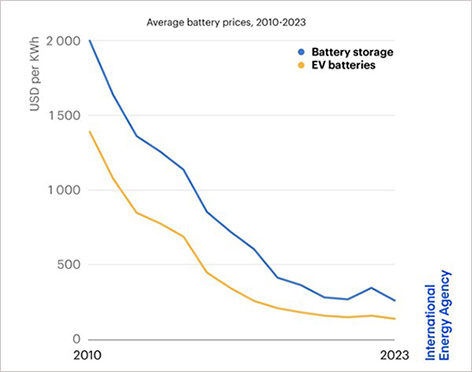
In less than 15 years, battery costs have fallen by more than 90%.
Batteries and Secure Energy Transitions – the first comprehensive analysis of the battery ecosystem – finds that in less than 15 years, battery costs have fallen by more than 90%, one of the fastest cost declines seen in clean energy technologies.
The most common type of batteries, those based on lithium-ion, have typically been associated with consumer electronics such as smartphones. But today, the energy sector accounts for over 90% of overall battery demand. In 2023, battery deployment in the power sector increased by more than 130% year-on-year, adding a total of 42 gigawatts to electricity systems around the world.
In the transport sector, batteries have enabled electric car sales to surge from 3 million in 2020 to almost 14 million last year, with further strong growth expected in the coming years (as noted by the IEA in its recent Global EV Outlook).
Nonetheless, beyond this rapid growth, according to the IEA’s special report on batteries, battery deployment will need to scale up significantly between now and the end of the decade to enable the world to get on track to achieve its energy and climate goals, including those set recently at the COP28 summit in Dubai. In this scenario, which aims to triple global renewable energy capacity, double the pace of energy efficiency improvements, and transition away from fossil fuels, overall energy storage capacity rises sixfold by 2030 worldwide, with batteries accounting for 90% of the increase.
The report highlights that the versatile nature of batteries means they can serve utility-scale projects, behind-the-meter storage for households and businesses and provide access to electricity in decentralised solutions like mini-grids and solar home systems. Moreover, falling costs for batteries are fast improving the competitiveness of electric vehicles as well as storage applications in the power sector.
The IEA's Special Report on Batteries and Secure Energy Transitions brings together the latest data and information on batteries from around the world, including recent market developments and technological advances. It also offers insights and analysis on leading markets and key barriers to growth. Looking at the entire battery ecosystem, from critical minerals and manufacturing to use and recycling, it identifies synergies and potential bottlenecks across different sectors. The report also highlights areas that call for greater attention from policy makers and industry.
The full report can be downloaded here.
For more information visit: https://www.iea.org