The World Economic Forum’s 56th Annual Meeting takes place this week, 19 to 23 January 2026, under the theme, A Spirit of Dialogue. World leaders from business, government, international organisations, civil society and academia will convene in Davos-Klosters, Switzerland, to engage in forward-looking discussions to address global issues and set priorities. The call for bold collective action makes the meeting particularly relevant..
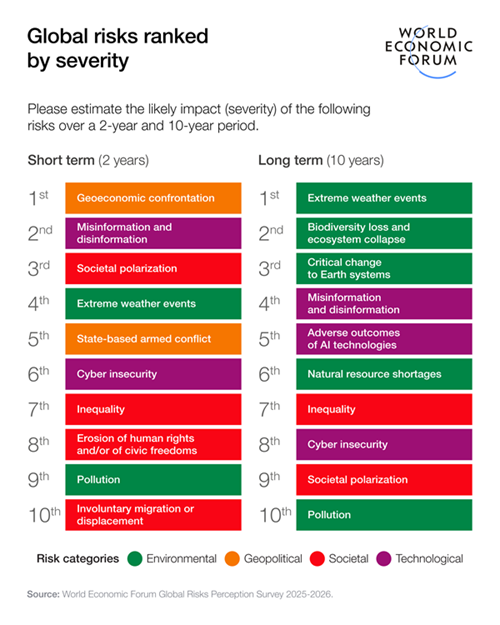
One of the reports recently released by the World Economic Forum looks at global risks: environmental, geopolitical, societal, and technological.
Discussions are centred around five key global challenges: cooperation in a contested world, unlocking new sources of growth, investing in people, deploying innovation responsibly, and building prosperity within planetary boundaries.
Amid rising fragmentation, accelerating complexity and rapid technological change, the imperative for an impartial platform for dialogue has never been greater.
At this moment, the World Economic Forum's 56th Annual Meeting builds on the forum's long-standing tradition of convening stakeholders from across geographies, industries and generations to enable real dialogue, solve shared challenges, and spotlight innovations driving the future.
Breakthroughs in artificial intelligence, biotechnology and clean energy are opening new frontiers for growth. Yet with these opportunities comes the responsibility to ensure the technologies achieve their promise. At the same time, shifting markets and geopolitical uncertainty are rewriting the rules of global commerce.
Ahead of the annual meeting, the World Economic Forum released a series of reports, including the Chief Economists Outlook 2026, the Global Value Chains Outlook 2026, the Global Risks Report 2026, and the Global Cybersecurity Outlook 2026 (12-1). It also shared the third annual iteration of its Global Cooperation Barometer, which uses 41 metrics to assess the level of cooperation worldwide across five pillars: trade and capital; innovation and technology; climate and natural capital; health and wellness; and peace and security.
The Chief Economists Outlook 2026 notes the relative resilience of the global economy but flags continuing concern about asset prices, debt and geoeconomic tensions.
- Acknowledging the relative resilience of the global economy amid turbulence, 53% of chief economists surveyed expect global economic conditions to weaken in the year ahead, significantly down from 72% in September 2025.
- Uncertainty around technology remains high, with 52% expecting AI-related stocks to decline and 40% expecting gains. On growth, expectations diverge by region, with economists expecting strong momentum in South Asia and East Asia and weak to moderate growth in Europe.
- On macroeconomics, nearly a third of respondents are concerned about sovereign debt crises in advanced economies and nearly half in emerging economies; over 60% expect governments to rely on higher inflation and tax revenues to manage elevated debt.
The report suggests that the global economic outlook has improved modestly but remains uncertain, with asset valuations, mounting debt, geoeconomic realignment and rapid artificial intelligence deployment creating both opportunities and risks.
"The chief economists survey reveals three defining trends for 2026: surging AI investment and its implications for the global economy; debt approaching critical thresholds with unprecedented shifts in fiscal and monetary policies; and trade realignments,” said Saadia Zahidi, Managing Director, World Economic Forum. “Governments and companies will have to navigate an uncertain near-term environment with agility while continuing to build resilience and invest in the long-term fundamentals of growth.”
About the Chief Economists’ Outlook
The report builds on extensive consultations and surveys with chief economists from the public and private sectors, organised by the World Economic Forum’s Centre for the New Economy and Society. The report supports the Forum’s Future of Growth Initiative, aiming to foster dialogue and actionable pathways to sustainable and inclusive economic growth. The Chief Economists’ Outlook is complemented by other recent publications with economic foresight. Four Futures for the New Economy and Four Futures for Jobs in the New Economy explore strategic implications for businesses navigating geopolitical shifts, technology disruption and workforce transformation through 2030, offering indicators to track and strategies to prepare for multiple scenarios.
All the reports are available as publications downloadable from the forum’s website.
For more information visit: www.weforum.org