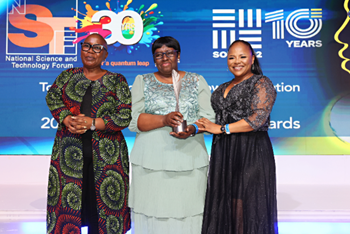
National Water Week ran 16 to 20 March 2026 in South Africa. Although water access and service delivery remain uneven in the country, Prof Ncube’s work stands out for its contribution to strengthening water governance and improving how water systems serve communities.
Receiving her award at the NSTF-South32 Awards last year, Prof Ncube said: “This isn’t just my win, it’s our win – the communities, the farmers, students, collaborators and my institution. This award amplifies our collective voices and the work we are doing together.”
Prof Bongani Ncube is a leading scholar in water governance and economics, the chair holder of the DSTI/NRF/WRC South African Research Chairs Initiative (SARChI) in Governance and Economics for the Water and Sanitation Sector at Cape Peninsula University of Technology (CPUT). She supervises numerous postgraduate students, shaping the next generation of water governance experts. Her research focuses on the relationship between water access, policy, and socio-economic development, particularly in vulnerable and underserved communities.
Prof Ncube’s work provides critical insights into how governance structures and economic frameworks shape water distribution and service delivery. Through her work – bridging research and policy – she has contributed to more informed decision-making processes that support equitable and sustainable water management.
“The future of water governance is collaborative, inclusive and just. We must keep building systems that honour the voices of those most affected – because that is where transformation begins.”
In addition to her academic contributions, Prof Ncube has played a key role in fostering collaboration across sectors, linking research institutions, government, and international partners. This approach strengthens the development of practical solutions to complex water challenges, particularly in the context of climate variability and growing demand for resources.
Her work continues to highlight the human dimension of water insecurity, emphasising that access to water is closely tied to dignity, stability, and socio-economic development.
World Water Day
Led by the United Nations (UN), World Water Day focuses global attention on the need to provide access to safe water for all and to promote sustainable management of water resources.
The day serves to highlight challenges such as water scarcity, pollution, and the increasing pressure placed on water systems by climate change and population growth. These issues are reflected in the South African context, where infrastructure constraints and environmental factors continue to affect reliable water supply.
Recognising leaders like Prof Ncube, the NSTF highlights the importance of research-driven solutions in addressing these challenges. Her work demonstrates how strong governance and informed policy can contribute to more resilient and inclusive water systems.
As SA marked this important day, the NSTF emphasised the need to prioritise water security through science, innovation, and inclusive governance. Prof Ncube’s work demonstrates the impact that research can have in shaping policies and improving access to essential resources.
The NSTF says government, industry, academia, and communities need to work collaboratively in addressing water challenges. Strengthening governance systems, investing in research, and supporting evidence-based solutions are essential steps towards ensuring sustainable and equitable access to water for all. Through collective action, SA can build a more resilient water future that supports people and the environment.
For more information visit: www.nstf.org.za