Invented by Paul C. Lauterbur in 1971, magnetic resonance imaging (MRI) has long been a standard medical apparatus found at hospitals worldwide. MRI scanners use magnetic fields to form an internal image of the body, and therefore require a magnetic field that is both strong and uniform.
The magnets used in MRI machines are measured in teslas (T), and while the majority of systems operate at 1.5T, commercial systems are available between 0.2T to 7T. While most clinical magnets are superconducting, permanent magnets are used in "open" MRI scanners.
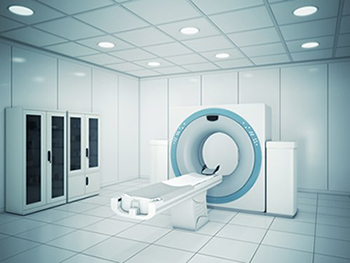 When these machines reach end of life, they have generally been relegated to the rubbish dump. However, old MRI magnets are now being repurposed for instruments used in high-energy and nuclear physics experiments.
Industrytap.com recently reported that "Researchers at the U.S. Department of Energy's (DOE) Argonne National Laboratory recently acquired two decommissioned magnets from (MRI) scanners from hospitals in Minnesota and California. The two new magnets have a strength of 4 Tesla, not as strong as the newest generation of MRI magnets but ideal for benchmarking experiments that test instruments for the g minus 2 ("g-2") muon experiment currently being assembled at the DOE's Fermi National Accelerator Laboratory. The Muon g-2 experiment will use Fermilab's powerful accelerators to explore the interactions of muons, which are short-lived particles, with a strong magnetic field in 'empty' space."
In addition, MRI technology is being enhanced, with a new MRI machine designed for brain scans using a magnet more powerful than the ones inside the Large Hadron Collider. Reports indicate that the strength of this magnet means that it could pick up a 60-metric-ton tank, and could create a field strong enough to affect the weak diamagnetism of blood, even levitating small animals.
Called INUMAC, this new MRI machine can reach strengths of almost 12T as opposed to the usual range of between 0.5T and 3T. This is achieved using coils made of more than 200 kilometers of superconducting cable, and because INUMAC's magnetic field is so strong it could even allow new forms of imaging.
Image: http://www.shutterstock.com/pic-137901701/stock-photo-machine-in-hospital.html?src=6hwsilXVsMGCm5C8Y8jAlA-1-70