15 May 2019, saw the Austrian Ambassador in South Africa officially launch the first solar district heating system and the largest solar process heat system in Sub-Saharan Africa. Both major SOLTRAIN projects, the district solar water heating plant for the University of the Witwatersrand (Wits) in Johannesburg and the solar process heat plant for the Klein Karoo International (KKI) tannery in Oudtshoorn, represent the use of solar energy at significant scale and will save millions in energy costs over the lifetime of the plants.
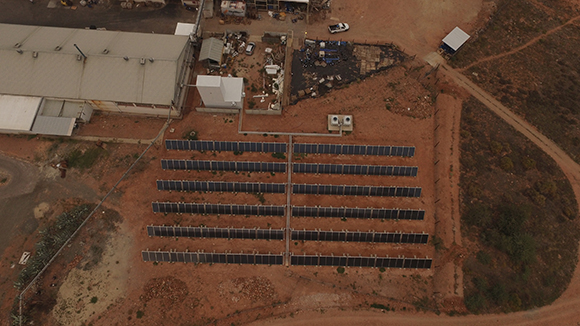 The 600 m2 solar collector system installed at KKI supplies process heat to the tannery.
SOLTRAIN – the Southern African Solar Thermal Training and Demonstration Initiative – is a regional initiative aimed at building capacity and demonstrating the implementation of solar thermal systems in the SADC region. It is funded by the Austrian Development Agency and co-funded by the OPEC Fund for International Development (OFID). In South Africa the programme is managed by the Centre for Renewable and Sustainable Energy Studies (CRSES) at Stellenbosch University, and the South African National Energy Development Institute (SANEDI), in partnership with AEE-Institute for Sustainable Technologies (AEE INTEC) from Austria.
Werner Weiss, Director of AEE INTEC, said at the launch, “SOLTRAIN is the most important and most successful know-how transfer project that AEE INTEC carries out worldwide. The two solar thermal systems launched today were built as part of SOLTRAIN and are the two largest solar thermal systems south of the Sahara. We are proud to have supported our South African partners to design and build them.”
Weiss also announced that the success of the SOLTRAIN programme to date will see it continuing into a fourth phase, from July 2019 to December 2022.
He noted that: “With a broad transition to solar thermal systems for hot water preparation in the residential as well as the commercial and industrial sectors, the electricity sector in the SADC region could be massively relieved and, moreover, contribute to the reduction of CO2 emissions, since most power plants in the region are run on coal.”

The first of its kind, the Wits Junction district water heating project combines solar, co-generation and gas heating technologies, to serve 14 student residence buildings.
Wits Junction
Wits Junction is a complex of 14 student residence buildings, accommodating more than 1 100 students. The district heating project combines solar, co-generation and gas heating technologies and serves the total hot water needs of all the residence buildings – averaging 94 000 litres per day – from one centralised hot water plant room. The installation includes a 600 m2 solar water heating plant using 10 m2 Austrian-manufactured collectors.
The design team involved BlackDot Energy as project leader and appointed engineering company, DSB and Holms and Friends, which handled the solar construction.
Wally Weber of BlackDot Energy explained, “A combined system uses the advantages of each technology: solar has a very low running cost, while CHP (combined heat and power) provides continuous base load coverage. The combination covers thermal and essential electrical loads.
Fana Sibanyoni, Chief Operating Officer at Wits, highlighted that, as well as the cost savings, one of the major benefits of the new system is that students’ complaints of not having hot water have declined significantly to almost nil. The water heating system is designed to guarantee supply, even during maintenance periods.
Weber noted that, “Cost savings are estimated at R40 million over the next 20 years and already the university has seen substantial electricity savings over the trial period of eight months. As the electricity cost from the co-generator is equal to municipal cost, the thermal energy is free and the centralised plant requires a lot less maintenance, running costs are considerably reduced.”
Klein Karoo tannery
Klein Karoo International (KKI) has installed a 600 m2 solar collector system to deliver process heat at the tannery. With the primary aim of reducing costs and increasing its competitiveness in the global market, KKI was also motivated by the strategic intention to move its production to a more sustainable base.
Stellenbosch University’s CRSES had approached a number of tanneries to look at the viability of using solar energy for process heat applications. KKI was prepared to take the risk and committed to contributing to the study.
Doran Schoeman of E3 Energy, the company that handled the installation, explained: “The process heat infrastructure uses an oil burner and not electrical heating. The fuel used is LO10 paraffin oil, at an indicated rate of 11.8 kWh per litre. The feasibility study looked at using solar energy in place of the local fuel and indicated a 60% solar fraction. The savings, based on measurements from the plant over the period of eight months from installation, amount to about R265 000, or 24 150 litres of oil.
“The feasibility study indicated a payback period on the plant of six and a half years, based on a solar fraction of 60%. The financial model used includes maintenance, finance costs and all system related expenses.”
He added that: “Strategically, the approach was to implement a first phase using solar thermal energy and to monitor actual results to estimated savings. This analysis is still in progress and further commitment will be based on the results achieved.”
Dr Karen Surridge, Centre Manager, Renewable Energy Centre of Research & Development at SANEDI said, “SANEDI is delighted to be associated with such landmark developments that put the SOLTRAIN projects firmly on the renewables table. The successful conference we have just held with SOLTRAIN regional partners indicates the relevance of this programme for the SADC renewable energy strategy and the development of successful systems across six countries.”
For more information, visit www.sanedi.org.za or https://soltrain.org