MechChem Africa visits the manufacturing facilities of ZebraTube and StitchWise in Carletonville, South Africa, and talks to StitchWise managing director, Vincent Prior (right) and Carien Spagnuolo (left), the general manager of ZebraTube.
Click to download and read pdf
StitchWise has its origins in the manufacture of geotextile dewatering and backfill bags that support the hanging walls of some of the deepest mines in the world. “We have more than two decades of experience in retaining solids and percolating liquids through our woven and stitched geotextile bags,” begins Vincent Prior, MD of StitchWise and a director of ZebraTube.
These backfill dewatering bags and tubes are manufactured from woven geotextile sheets locally manufactured by Spilo in Cape Town. “Spilo first extrudes polypropylene pellets into different grades of tape. The tape is then woven into continuous lengths of sheeting for use in agriculture, mining, civil and outdoor applications. Many different weave patterns, strengths and widths are available, which makes this material ideal for manufacturing our extensive range of dewatering bags and tubes,” he tells MechChem Africa.
While StitchWise’s focus remains mostly on the manufacture of bags for the underground mining and backfill market, ZebraTube® was formed back in 2016 with a strong focus on above-ground dewatering. “We are a sister company formed as a 50-50 partnership between Spilo, our textile manufacturer, and StitchWise, our bag and tube manufacturer,” says Carien Spagnuolo of ZebraTube. Describing typical aboveground use of these bags, Spagnuolo says that most projects tend to be emergencies. “The materials we use are specifically designed for retaining solids such as silt and sand while enabling water to filter through. They are now widely used for dredging the wastewater storage dams at mining facilities, which get silted up over time and generally require cleaning every year to restore their water storage capacity.
“Mixed slurries from slimes and wastewater dams are pumped into our ZebraTube geotextile tubes, which hold the solids while slowly, over a few weeks, allowing the water to drain back into the dam. Once filled and dry, the tubes are broken open so the dry solids can be loaded onto trucks for safe disposal,” she explains.
“Sometimes, the slurry has mineral value,” continues Prior, “in which case geotextile bags will be used which, once dry, can be lifted into trucks and easily transported to a reprocessing plant,” he says, adding that these bags are certified to be able to contain 5.0 t. of solids while being lifted.
Using geotextiles for dewatering is a passive alternative to mechanical solutions such as filter or belt presses, horizontal belt filters or centrifuges. “Mechanical solutions all use much more energy and are far more capital intensive. Since a lot of our work is for temporary dewatering applications, clients are reluctant to invest in permanent mechanical solutions. By far the most economical way of dredging a silted up dam, for example, is to use geotextile bags or tubes,” explains Spagnuolo.
“Since geotextile bags are consumable, this also enables the costs to be justified as an operational expense, as opposed to having to seek capex approval for an expensive machine,” she adds.
“We have a number of different geotextile options in terms of filtration rates and strengths,” Prior continues. “Where we know the particles are relatively large, we can offer high-flow rate textile that enables the water to drain very quickly – and we have an onsite laboratory to test the solid retention and flowrate options for any slurry sample,” he notes.
At the other extreme are ultra-fines, which require a completely different weave to adequately retain the solids while still enabling dewatering. “Our smaller square bags used for recovery are typically manufactured using this geotextile, which has a weave density of between 250 and 280 g/m2.
ZebraTube’s geotextile weave patterns for dewatering are not widely known internationally, but, with extensive experience in South Africa, Australia, Middle East and across Africa, the company has come to understand how to solve a broad range of slurry dewatering problems. “Carien’s knowledge of water and the additional surface technologies that are needed, we believe, can compete with any of the imported products that some people believe to be superior,” notes Prior.
“We are able to go to site and establish a customer’s exact needs,” he continues. “If, for example, a customer only has space for a
28.5 m geotextile we can manufacture that exact length so it can be delivered and placed on site quickly and easily, without the need to modify an imported standard length that is too long or too short.
“We can easily adjust bag lengths or place additional anchor points so that boulders can be avoided or we can move the spout to best suit the outlet pipes of the pumps. None of this is possible if clients choose to use imported geotextile products,” adds Spagnuolo.
Manufacturing: the local advantage
“Because our entire manufacturing chain is local, we have the ability to respond to emergencies very quickly,” continues Prior. “In terms of delivering custom made dewatering solutions in an emergency, our lead times are shorter than any other geotextile manufacturer,” he asserts.
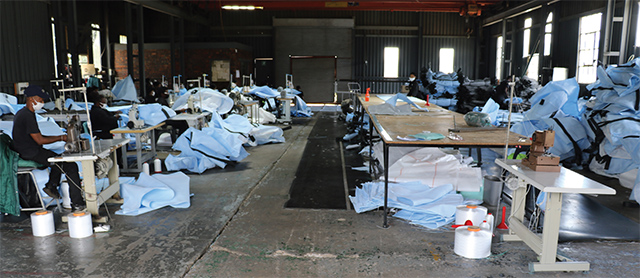
“Plus, we have production capacity. Each of our stitchers can produce 2.5 km of seams per day and currently, 4.0-million m2 of geotextile material goes through our Carletonville factory every year. When we get a call to make 10 000 bags in 10 days, we have an additional expansion facility and over 100 sewing machines to help deliver the order on time,” he informs MechChem Africa.
Not only is it unnecessary for South African clients to look overseas for solutions, but ZebraTube’s export sales have more than doubled in the past year, proving that the company can deliver directly to overseas plants – in Africa, the Middle East and Australia – in emergency timescales.
“Even for the Australian market, our lead times are extremely short and we offer a very high degree of flexibility. If we need to turn an export order around in three days, we can make it happen. The longest lead time is shipping and, in an emergency, we can fly the order to the client, which means that dewatering can often start within five or six days of an order being placed,” he says.
Prior tells of a current order for a client in the Middle East: “Initially, this client was very keen on our customisation capability and came to us wanting to know exactly where and how our ZebraTube dewatering solutions were manufactured. For current orders, this client gives us five days to get the bags stitched, boxed, crated, palletised and sent to OR Tambo International Airport for flying to site. The mere fact that this client is willing to bear the cost of flying our product out of South Africa proves that he sees our pricing as highly competitive compared to other global geotextile manufacturers,” he points out.
Locally, ZebraTube operates its own fleet of trucks to rapidly service mining and wastewater facilities in South Africa. “When clients require a quick solution for a dewatering task with a small laydown area, we supply our geotextile bags, which we hold in stock to ensure we can respond rapidly. These bags are also used as an interim emergency solution while we manufacture the dewatering tubes needed to complete the task.
“Large tubes are almost always custom made to order in another of our facilities on this site,” he adds. Because we are flexible, we can adopt a fit-for-purpose approach, making sure that the solutions we put onto a site will meet the needs specified by our clients without being overdesigned or unnecessarily costly,” says Prior.
We are a South African manufacturing and employment success story. The geotextile material we used is manufactured in Paarl by our partner company, Spilo, and we employ 145 people in Carletonville to custom stitch the geotextile bags. As well as servicing South Africa’s mining industry and mitigating against environmental harm, ZebraTube products are now also being exported, which generates foreign revenue for our country,” Spagnuolo concludes.