Process measurement and control specialist Henning Springer of Mecosa presents the key advantages of using Knick Ceramat fittings to protect and manage process control sensors in harsh, corrosive, abrasive, toxic, sticky or fibrous processing applications.
Click to download and read pdf
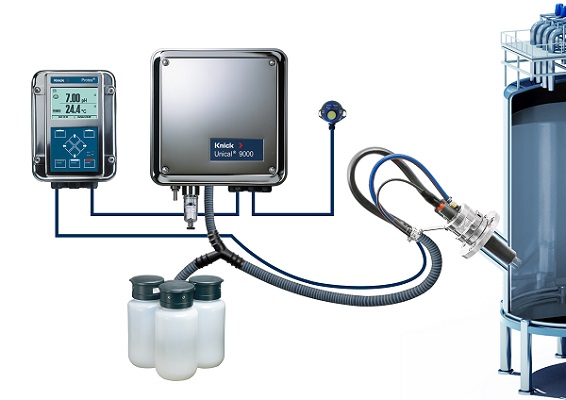
Knick offers a complete measurement and control solution via its Protos Process Analysis System (left), its Unical Controller, and metering pumps with cleaning and calibration solutions.
Ideal for accurate continuous monitoring of pH, dissolved oxygen and conductivity in harsh environments, the Ceramat retractable fitting from Knick features advanced flushing, calibration and cleaning functionality for the built-in sensors used for process management.
“Ceramat retractable systems are used in several processing plants in South Africa, including minerals processing, petrochemical, food and biotechnology facilities. Most notably, the system uses a ceramic-on-ceramic rotating seal between the measured medium and the outside environment, which delivers resistance to acids and abrasives,” begins Henning Springer, MD of Mecosa, South Africa’s niche process variable specialist.
According to Springer, one of the early success stories of the Ceramat system comes from the chocolate industry, where it is used for particle-size measurement and control. “With chocolate, the finer the grind of the cocoa, the better the quality and taste of the chocolate. The problem, though, is that cocoa grinding accounts for 40-50% of production costs. So, a smooth chocolate that melts on your tongue is typically more expensive,” he points out.
Today, SOPAT optical sensor systems, utilising the Knick Ceramat, are used to measure and control the grind size of cocoa used in chocolate production. However, with chocolate and other food products, optical sensors tend to foul quickly, so automatic sensor cleaning is required, with the sensor having to be removed from the process chamber.
This separation and subsequent sensor cleaning are performed using the Ceramat solution, which eliminates O-ring sealing issues associated with traditional sensor retraction systems. Instead, two planar ceramic discs that rotate towards each other are used to withdraw the optical sensor from the process fluid into a separate, sealed cleaning and calibration chamber with built-in flushing and recalibration systems tailored to the sensors in use.
Particle size is also a critical process-control parameter in the mining industry. The electricity cost of grinding ore in mills before it passes into the metallurgical plant for recovery and liberation of the high-value product accounts for the largest share of the processing circuit's cost. Oversized material must be returned for further grinding, while overground material consumes unnecessary energy and may even be lost as ultra-fines in the downstream process.
“So we measure the grind size by putting a sensor on the output to minimise the amount of grinding energy needed to liberate the target mineral,” Springer explains, adding that the Ceramat system is not yet used for these applications. Instead, Mecosa offers a purpose-built particle-size probe for the mining industry.
Electrochemical sensing
The Ceramat retractable fitting has found a niche in applications where pH, redox, dissolved oxygen, and conductivity measurements are critical to managing production processes or reactions. These are all electrical-based sensors. A Clark cell, for example, works by diffusing dissolved oxygen across a membrane to a platinum cathode, where it is electrochemically reduced. The current produced from this reaction is proportional to the dissolved oxygen concentration of the process fluid.
Measuring pH also uses the electrochemical cell principle, in which hydrogen ions migrate across a gel-based membrane in the sensing tube. The direction and extent of this transfer are directly related to the pH in the process vessel.
Control of dissolved oxygen and pH is used in fish farming, for example, to optimise healthy growth and survival rates and to promote conditions for beneficial microorganisms. “The typical Knick Ceramat units used for many industries include control and evaluation systems and pond cleaning solutions,” says Springer.
They are also used in wastewater treatment due to the chemical processes involved. “For the optimisation of activated sludge, the oxygen levels introduced during aeration become critical to the whole process,” he adds.
Key advantages of Ceramat systems
Ceramat’s patented retractable fitting is designed to overcome problems with retractable sensor systems that rely on O-rings, which tend to fail quickly under harsh conditions and in corrosive/abrasive media. “Sealing is achieved using a ceramic material, which is harder than steel and highly resistant to chemical, thermal and mechanical influences, which guarantees much greater uptime,” notes Springer.
To ensure the best possible resistance to process fluids and external environments, the static outer housing options for Ceramat fittings include PVDF, PEEK, stainless steel, Hastelloy, or titanium, each known for its chemical and UV resistance, strength and thermal stability, depending on the process medium.
The housing also ensures the sensors remain stationary and free of mechanical stress. “The system also offers options for several immersion depths, which are specially developed for measurements in conduits, thick-walled thermally insulated reactors, and large containers where the measurements need to be taken away from the side walls,” he tells MCA.
Ceramat’s design enables easy maintenance by allowing the entire drive unit to be removed under full-process conditions. The process medium, whether corrosive, hot, toxic and/or under pressure, remains reliably isolated. If a sensor is broken, it can be removed, replaced, recalibrated and cleaned, without stopping the process.
“The compact pneumatic rotary-lift motor and its integrated control valves can all be removed and replaced from the unit safely and without interruption,“ Springer assures.
Systematic process analysis
In addition to the fitting itself, Knick also offers a complete measurement and control solution via its Unical Controller and Protos Process Analysis System. “Knick has developed a fully automated measuring loop with uniquely high levels of safety and reliability. Its immersion fittings can be automatically cleaned and calibrated without contaminating the process medium.
“The controller is compatible with analogue and digital sensors. It is a 4-wire system with two explosion-protected active outputs and a modular structure that enables simple retrofit or conversion.
“Knick Ceramat systems offer the most robust and reliable solution for measuring pH, conductivity and dissolved oxygen, as well as several other process variables, where conditions are unsuitable and unsafe for any alternative option,” concludes Henning Springer.