

Robert Friedland, Executive Chairman of TSX-listed Ivanhoe Mines, and Lars-Eric Johansson, CEO, have announced the receipt of an independent, preliminary economic assessment (PEA) for the planned redevelopment of the company’s historic, high-grade, Kipushi zinc-copper mine in Katanga in the DRC.
The PEA plan covers the redevelopment of Kipushi as an underground mine, producing an average of 530 000 tonnes of zinc concentrate annually over a 10-year mine life at a total cash cost, including copper by-product credits, of approximately US$0,54 per pound of zinc.
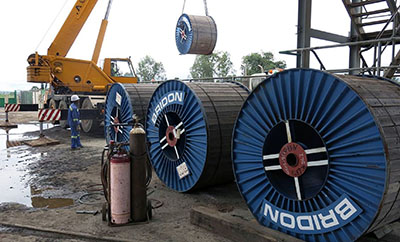 Off-loading new wire rope for the Shaft 5 hoist at Kipushi (photo: Ivanhoe Mines).
The Kipushi project is operated by Kipushi Corporation (KICO), a joint venture between Ivanhoe Mines (68 %) and Gécamines (32 %), the state-owned mining company. The PEA plan focuses on the mining of Kipushi’s Big Zinc Zone, which has an estimated 10,2 Mt of measured and indicated mineral resources grading 34,9 % zinc. This grade is more than twice as high as the measured and indicated mineral resources of the world’s next-highest-grade zinc project, according to Wood Mackenzie, a leading, international industry research and consulting group.
Highlights of the PEA include an after-tax net present value (NPV) at an 8 % real discount rate of US$533 million and after-tax real internal rate of return (IRR) of 30,9 %. The after-tax project payback period is estimated at 2,2 years.
Leveraging existing surface and underground infrastructure significantly lowers the redevelopment capital compared to a greenfield development project, as well as the time required to reinstate production.
“This preliminary mine redevelopment plan supports our view that Kipushi is the best brownfield zinc project in the world,” said Friedland. “Kipushi’s zinc grade of almost 35 % puts the project into a class of its own. Most of Kipushi’s underground development and infrastructure already is in place and it is expected to be a straightforward, underground mining and milling operation. The combination of extremely high zinc grades, low capital requirements and low operating costs makes this a compelling development project.”
Johansson said that since beginning operations almost a century ago, Kipushi has written a long and storied history of mining achievement in the DRC.
“We are optimistic that the release of this independent, preliminary mine redevelopment plan is a key first step toward redeveloping the mine and beginning the realisation of significant benefits for all of the Kipushi project’s stakeholders, including the Congolese people and our joint-venture partner, Gécamines.”
Kipushi, which was placed on care and maintenance in 1993, flooded in early 2011 due to a lack of pump maintenance over an extended period. At its peak, water reached 851 m below the surface level. A major milestone was reached in December 2013 when Ivanhoe restored access to the mine’s principal haulage level at 1 150 m below the surface. Since then, crews have been upgrading underground infrastructure to permanently stabilise the water levels and support the drilling programme.
Recent improvements to Shaft 5 – the newest shaft at Kipushi and the one which provides the primary access to the lower levels of the mine – have included dewatering to expose the main pump station at the 1 200-m level, installation of new hoist ropes on the Shaft 5 Maryanne rescue hoist, stripping of the 1 200-m level pump station and refurbishment and commissioning of the friction-reeler gearbox.