

Following the recent successful testing of the smelting characteristics of the ore from its Agbaja deposit in Nigeria, ASX-listed Kogi Iron says it will now progress negotiations with a number of parties to accelerate the development of the project. The project will be developed and managed through Kogi Iron’s 100-% owned Nigerian-based subsidiary, KCM Mining.
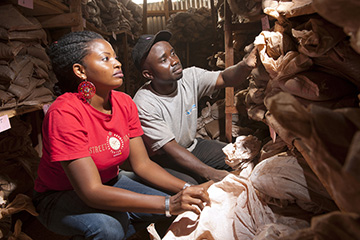 Employees of Kogi Iron inspect drill core (photo: Kogi Iron).
It is intended to initially build a mining operation alongside a 250 000 t/a steel processing plant at Agbaja, located 200 km south of Abuja, Nigeria’s capital, targeting domestic (Nigeria is currently a net importer of steel products) and European customers. The long-term plan is to expand production up considerably to 5 Mt/a.
The recent testing, conducted by South Africa’s Mintek, determined the project has the ability to produce three steel products – sponge iron, pig iron and a steel product containing 95 % Fe – on site using the deposit’s unique oolitic ore and Kogi Iron’s planned processing method. A four-step processing method is envisaged. This involves washing the iron ore product followed by a reduction process, melting in an electric arc furnace and, finally, blasting with oxygen to produce the final product.
Kogi Iron’s tenements cover 150 km2 but the initial focus will be on ground covering 20 km2 which hosts a JORC-certified resource of 586 Mt. The orebody is mostly at surface (maximum cover 8 m) and is mineable by a free-digging open-pit operation. The ore will be trucked to the processing plant, which is located 1 km away from the proposed pit.
With completion of the Mintek metallurgical testing, Kogi Iron is now moving to finalise the Definitive Feasibility Study (DFS), with completion expected by the end of June 2016.
Kogi Iron has estimated the capital cost of the project at US$200 million. The biggest part of this will be spent on infrastructure and the processing plant as the costs of establishing of the mining operation are expected to be relatively modest.